So, you need deionised water and you're wondering where to find it in the UK. Your main options boil down to a few key places: high-street shops like Halfords, big supermarkets, specialist online suppliers, and a growing number of 24-hour self-service filling stations.
The best choice for you really depends on what you need it for. Are you just grabbing a small bottle for your steam iron, or do you need much larger quantities for a professional car valeting business? Each source strikes a different balance between cost, convenience, and how much you can get at once.
A Quick Guide to Sourcing Deionised Water
Figuring out where to buy deionised water is all about matching the supplier to your specific job.
For those small, one-off tasks where you just need it now, popping into a local automotive shop or a supermarket is easily the quickest solution. You can walk in and grab a pre-packaged bottle right off the shelf, usually in a 1-litre to 5-litre container. The trade-off? You'll almost always pay a premium for that convenience, with the per-litre cost being quite high.
On the other hand, if you get through a lot of deionised water – maybe you're a professional window cleaner or a car detailing enthusiast – buying from online or industrial suppliers can make a lot more financial sense. You can order in bulk and get a much better price per litre. The only catch is you need to plan ahead to account for delivery times and any potential shipping fees.
The Rise of Self-Service Stations
There's a fantastic alternative that's been gaining a lot of traction lately: self-service filling stations. These stations give you access to ultra-pure water on demand, 24/7. You simply bring your own containers and fill them up.
This approach is a game-changer for a few reasons. It dramatically cuts down on plastic waste from single-use bottles and, crucially, it's often the most cost-effective way to get your hands on deionised water. It’s the perfect blend of on-the-spot convenience and the low cost you'd expect from buying in bulk.
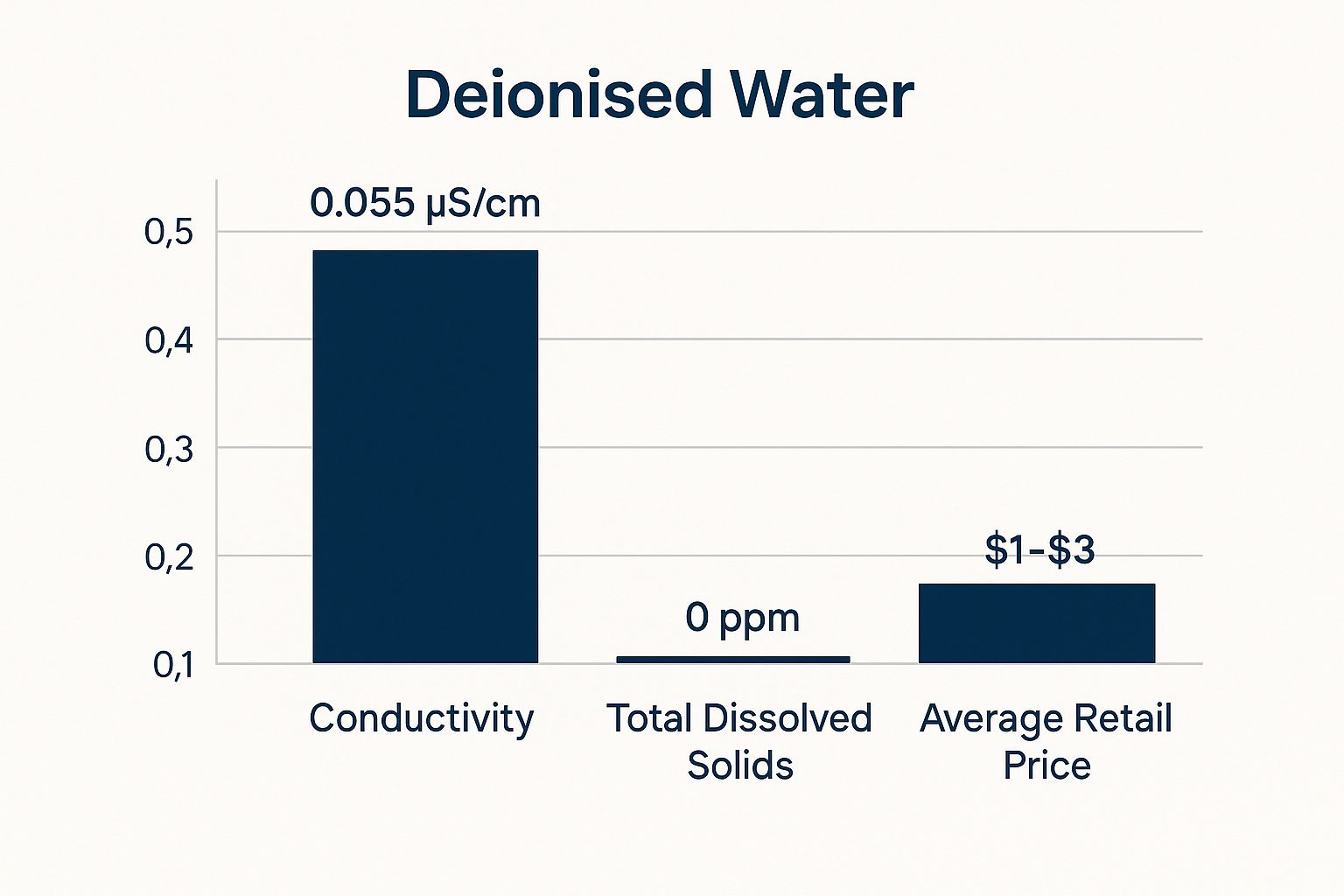
As the infographic highlights, deionised water is prized for its incredible purity, but its price can swing wildly depending on where you buy it. This just goes to show how important it is to pick your source carefully.
The bottom line is this: High-street shops are great for instant access but you'll pay for it. Online suppliers offer savings for bulk buys but you have to wait for delivery. Self-service stations offer a brilliant modern solution, giving you low costs and round-the-clock convenience.
UK Deionised Water Sourcing Options Compared
To make things even clearer, here’s a straightforward comparison of the most common ways to purchase deionised water in the UK. This table breaks down what you can expect in terms of cost and convenience, helping you quickly see which option fits your needs best.
| Sourcing Method | Typical Cost per Litre | Convenience Level | Best For |
|---|---|---|---|
| High-Street Retailers | £1.50 – £3.00 | High | Small, urgent needs like topping up a steam iron or a single car battery. |
| Online Suppliers | £0.50 – £2.00 | Medium | Bulk purchases for regular users, requiring planning for delivery. |
| Self-Service Stations | As low as 4p | Very High | Professionals and enthusiasts needing frequent, cost-effective refills without plastic waste. |
Ultimately, whether you choose the immediate convenience of a retail store or the unbeatable value of a self-service station, you’ve now got a clear picture of the options available across the UK.
What Exactly Is Deionised Water?
Before you can figure out where to buy deionised water, it’s really important to get your head around what makes it so different from the stuff that comes out of your tap. They might look identical, but chemically, they’re worlds apart.
Your everyday tap water is full of dissolved minerals and salts. Think calcium, magnesium, and sodium. While they're fine to drink, these minerals—which exist as electrically charged particles called ions—are the very things that cause problems in certain situations. They’re the culprit behind the limescale in your kettle, the frustrating white spots on your car after washing it, and even corrosion in sensitive machinery.
Deionised water is, quite simply, water that has had all of these mineral ions stripped out.
The process of creating it, called deionisation, is actually quite clever. Imagine running water through a filter that’s like a super-powerful magnet, but only for those pesky mineral ions.
Deionisation uses special ion-exchange resins that act like tiny, powerful 'magnetic sponges'. As water passes over these resin beads, they snatch the mineral ions out of the water and swap them for hydrogen (H+) and hydroxide (OH-) ions. These then just combine to form pure H₂O.
It’s an incredibly efficient way of removing mineral content, leaving you with water that is exceptionally pure in one very specific way: it has no charged ions.
How Purity Is Measured
Because it has virtually no ions left to carry an electrical current, high-quality deionised water is a terrible conductor of electricity. This lack of conductivity is actually how its purity is measured.
The gold standard is often measured in Total Dissolved Solids (TDS), and for top-grade deionised water, you're looking for a reading at or very near 0 parts per million (ppm). To be certain you're getting the right stuff for a perfect spot-free car wash, you'd typically use professional water testing kits, including TDS meters.
This extreme purity is precisely why it's so valuable. When water with no mineral content evaporates, it leaves absolutely nothing behind. No streaks, no spots, no residue. That makes it perfect for the final rinse on cars, windows, and even solar panels.
Deionised vs Distilled Water: A Common Mix-Up
It’s easy to get deionised and distilled water confused. People often use the terms interchangeably, but they are produced differently and aren't always suitable for the same jobs. Getting this right is key to buying the right product for your needs.
Here’s the breakdown:
- Deionisation is a chemical filtering process. It specifically targets and removes mineral ions but won’t necessarily remove other non-ionic contaminants like bacteria or viruses.
- Distillation is a physical process. It involves boiling water into steam (which leaves all impurities like minerals, bacteria, and organics behind) and then condensing that pure steam back into water.
So, which is "purer"? Well, it depends on your definition of pure. Distilled water is purer in an all-encompassing sense, as it’s free from almost everything. However, for applications where your only goal is to prevent mineral deposits—like in a car battery, a cooling system, or for that final spot-free rinse—deionised water is the perfect, and often more cost-effective, solution.
Ultimately, choosing the right one means matching the water to the task. For most of the automotive and cleaning jobs where you want to avoid spots and scale, deionised water is exactly what you’re after.
Finding Deionised Water on the High Street
Sometimes you just need deionised water, and you need it now. Perhaps your car battery warning light has just flickered on, or your steam iron has given up the ghost right before a big meeting. For those urgent, unplanned moments, heading out to a physical shop is easily the most practical solution.
The biggest plus here is pure convenience. You don’t have to wait around for a delivery driver; you just pop to the shops, grab what you need, and you’re sorted. It’s perfect for those small-scale, time-sensitive jobs where you simply can’t afford to wait. Let's take a look at the most likely places you'll find it.
Automotive Retailers: The Most Reliable Bet
If you want to be almost certain of finding deionised water, your first stop should always be a dedicated car parts shop. Chains like Halfords are a safe bet, as it’s a staple product for vehicle maintenance—especially for topping up older lead-acid batteries and certain types of cooling systems.
In most cases, you'll find it sitting on the shelf in the car maintenance aisle, right next to the engine oil and screenwash. The staff in these places usually know their stuff, too, so if you're having trouble locating it, just ask. This reliability makes automotive shops the top choice when you absolutely must get your hands on a bottle today.
Supermarkets and Their Car Care Aisles
Believe it or not, many of the UK's major supermarkets are another great place to check. Larger stores like Tesco, Asda, and Sainsbury's often have a pretty decent car care section, and that’s exactly where you should look for deionised water. It’s usually tucked away with the antifreeze and car cleaning supplies.
The main advantage here is being able to pick it up during your weekly shop without making a separate journey. Be warned, though: stock levels can be a bit hit-or-miss compared to a specialist retailer. You’re far more likely to have luck in a massive superstore than a smaller local or express branch.
Pro Tip: If you’ve scoured the car aisle in a supermarket with no luck, try the household cleaning section. Some stores place it near the ironing aids, since one of its most common household uses is preventing limescale build-up in steam irons.
Local Hardware and DIY Shops
Don't forget about your local independent hardware shop or big DIY chains like B&Q or Homebase. While maybe not as much of a sure thing as a car shop, many hardware stores do stock deionised water for things like tool maintenance or specific cleaning tasks.
It's always good to support a local business, and these smaller shops can be hidden gems. That said, it's probably wise to give them a quick call to check they have it in stock before you head over, as availability can vary quite a bit from one store to the next.
What to Expect: Price and Packaging
When you buy deionised water from a high street shop, it will almost always come in pre-packaged plastic bottles. The most common sizes you’ll see are 1-litre, 2.5-litre, and 5-litre containers. This is fine for occasional home use, but it quickly becomes expensive and impractical if you’re a professional needing it in bulk.
To give you a rough idea of cost:
- 1-Litre Bottle: Expect to pay between £2 and £4.
- 5-Litre Bottle: Usually better value, costing around £5 to £8.
While convenient, there’s a clear trade-off. The price per litre is much higher than what you’d pay through other methods. For instance, a 5-litre bottle for £7 works out at a steep £1.40 per litre. You're essentially paying a premium for instant access, which makes this route unsuitable for anything more than small, one-off needs. Plus, the reliance on single-use plastic creates waste, a factor that's becoming more important for many of us.
Buying Deionised Water from Online Suppliers
While popping to a high-street shop is fine for a quick top-up, the digital world is where you'll find a much bigger pond of options for deionised water. If you need anything more than a single, small bottle, heading online is almost always the most sensible and budget-friendly move.
The biggest perk of buying online? You can compare prices from countless suppliers with just a few clicks. This natural competition usually means better deals, especially when you're buying in bulk. For a professional car valeter or anyone running an industrial process that gets through a lot of pure water, the savings can really add up over time.
Plus, let’s not forget the sheer convenience of getting bulky containers delivered right to your doorstep or business. It completely cuts out the hassle of driving to a shop and lugging heavy drums back yourself.
Where to Find Deionised Water Online
The web is home to a whole spectrum of sellers, from massive general marketplaces to highly specialised chemical companies. Where you should buy really depends on what you need in terms of quality, quantity, and cost.
For most people, general e-commerce sites are a great place to start.
- Amazon UK: You'll find a massive selection here from all sorts of sellers, with sizes ranging from a single litre right up to 25-litre drums. The customer reviews are incredibly useful for getting a real-world feel for a product's quality before you part with your money.
- eBay UK: Much like Amazon, eBay connects you with a wide array of suppliers. It's often a good spot to hunt for deals from smaller businesses, especially if you're after multi-packs or larger quantities.
If your needs are more specific or demanding, it’s best to turn to a specialist. In the UK, deionised water is mainly sold through industrial suppliers and online platforms that serve the laboratory, pharmaceutical, and manufacturing industries. Big names like Alfa Aesar, VWR International, and Fisher Scientific are major players, offering packaged solutions both online and through their UK distribution networks. You can learn more by looking into data on the deionised water systems market.
Key Considerations Before You Buy
Shopping online gives you fantastic choice and value, but it pays to be a smart buyer. Not all water labelled "deionised" is the same, so a little bit of homework can make all the difference.
First things first, look for proof of quality. A reputable supplier will have no problem providing a Certificate of Conformity or a technical data sheet. This document should clearly state the water's purity level, typically its conductivity (µS/cm) or resistivity (MΩ-cm), giving you confidence that it’s right for your job.
A key indicator of a trustworthy online supplier is transparency. Look for clear information on their purification process, quality control measures, and readily available contact details for customer support.
Another vital thing to check is the delivery cost. That low price on a 25-litre drum might look like a steal, but eye-watering shipping fees can wipe out your savings in an instant. Always check the total cost at checkout, delivery included, to work out the true price per litre. Some suppliers offer free delivery on larger orders, which can make buying in bulk even more appealing. This model is quite different from the pay-as-you-go convenience you'll find at physical locations, and you can see how 24 Pure Water filling stations are now at your service for a handy alternative.
The Rise of 24/7 Self-Service Filling Stations
While buying bottles from a shop or ordering online both have their place, a new, genuinely modern way to get pure water has been popping up all over the UK. These are self-service filling stations, open 24/7, and they offer an incredibly convenient and budget-friendly way to get deionised water exactly when you need it.
Think of it like a petrol station, but for ultra-pure water. You just drive up with your own containers and fill them on the spot. It’s a simple idea that neatly solves the biggest headaches of the other methods: the high price of pre-packaged bottles and the annoying wait for online deliveries to show up.
This approach is proving a massive hit with professionals like window cleaners and car detailers who rely on a steady supply. But it’s just as handy for hobbyists and homeowners who just want great value and zero hassle.
How Do These Filling Stations Work?
The real beauty of these automated stations is their simplicity. They’re designed to be completely self-sufficient, which means you can get pure water at any time of the day or night, without a single member of staff in sight.
The whole process is refreshingly straightforward and usually just takes a few steps:
- Locate a Station: You’ll typically find them in easy-to-reach spots like petrol station forecourts, car washes, or dedicated industrial units. Most providers have an app or an online map to point you to the nearest one.
- Bring Your Containers: A core part of the model is bringing your own tanks or drums. This is fantastic for cutting down on plastic waste and lets you fill up with as much or as little as you need.
- Pay and Dispense: Payment is quick and easy, usually with a contactless card, a pre-paid key fob, or through a mobile app. Once your payment goes through, you just grab the nozzle and fill your containers.
This pay-as-you-go system gives you total flexibility. There's no pressure to buy more than you need, and you aren’t left with a mountain of empty plastic bottles to deal with. The entire setup is built for speed and efficiency.
The global demand for deionised water is surging, driven by a need for higher purity in various sectors. This is not just a niche product; it represents a significant and growing market.
In fact, the numbers are pretty staggering. Recent data showed the global deionised water system market was valued at around £6.2 billion in 2025. By 2035, it's projected to more than double to over £12.6 billion. This boom is fuelled by new technology making production cheaper and more efficient—a trend that directly benefits UK customers through innovations like these self-service stations. You can read more in recent deionised water system market research.
The Three Core Benefits of Self-Service
When you get down to it, choosing a self-service station over the old ways really comes down to three compelling advantages.
1. Massive Cost Savings
This is probably the biggest draw for most people. By cutting out the costs of packaging, shipping, and retail mark-ups, these stations can offer deionised water for a tiny fraction of the usual price. You could be paying as little as 4p per litre. Compare that to the £1.50 or more you might pay for a bottle in a shop, and the difference is clear. For businesses using hundreds of litres a week, the annual savings can be huge.
2. Unmatched Convenience
Being able to get pure water around the clock is a genuine game-changer. You no longer have to worry about shop opening times or wait days for an online order to arrive. If you run out of water mid-job or need to stock up for the next day, you can just swing by your local station and refill. It means no more costly downtime or disruptions to your work.
3. Environmental Responsibility
The reliance on single-use plastic is a major environmental drawback of buying pre-packaged water. Self-service stations tackle this problem head-on by encouraging everyone to reuse their own containers. This simple switch drastically cuts down on plastic waste, making it a much more sustainable choice. This is especially true when you use dedicated services like our network of 24 Pure Water filling stations, specialists in ultra-pure water.
So, Why Bother With Deionised Water?
You've seen where you can get deionised water, but you might still be wondering if it's really worth the effort. The short answer is: absolutely. For a surprising number of jobs, the everyday minerals lurking in your tap water are the real problem. Choosing deionised water isn't about being fussy; it's a practical step to prevent damage, improve safety, and get a truly professional result.
The magic of deionised water is all about what it doesn't have. By stripping out all those mineral ions, you’re left with a very 'hungry' form of water that’s eager to dissolve any impurities it touches. More importantly, when it evaporates, it leaves absolutely nothing behind. That's the secret to its power in so many different situations, from everyday chores at home to critical industrial processes.
For a Flawless Finish in Car and Window Cleaning
One of the most common reasons people seek out deionised water is for that perfect, streak-free finish on their car or windows. You know those frustrating white spots that appear after washing? They’re the ghosts of minerals past—specifically, calcium and magnesium deposits left behind as tap water dries.
Since deionised water has no mineral baggage, it dries completely clear. This simple fact makes it an indispensable tool for professional car valeters and window cleaners who need to guarantee spotless results every single time. It's just as vital for boat owners, too. Its purity is crucial for tasks like when you need to effectively desalt your boat after a trip out on the water, stopping corrosive salt damage in its tracks.
Protecting Your Household Appliances
Back at home, deionised water is your best friend in the fight against limescale – that chalky gunk that slowly strangles the life out of your appliances.
- Steam Irons & Garment Steamers: Using deionised water stops mineral deposits from clogging the steam vents. This means your iron will work properly and won’t spit nasty white flakes all over your freshly cleaned clothes.
- Humidifiers: It prevents that fine, white mineral dust from building up on your furniture and being circulated into the air you breathe.
For these gadgets, using deionised water is a small, smart investment that pays off by extending their lifespan and keeping them working as they should.
Think of deionised water as a form of insurance. By using it in any system where mineral build-up could lead to failure—from a simple steam iron to a complex industrial cooling loop—you are actively preventing future damage and expensive repairs.
Essential for Batteries and Cooling Systems
When you get into more technical territory, using the right kind of water isn't just a good idea—it’s non-negotiable. If you top up a lead-acid car battery with tap water, you’re introducing minerals that will mess with the battery’s internal chemistry, leading to a shorter life and weaker performance. Deionised water is chemically inert, which makes it the only safe option.
The same logic applies to cooling systems in cars and machinery. Mineral deposits from tap water can build up inside radiators and engine channels, acting like a layer of insulation. This severely reduces the system's ability to cool the engine, leading to overheating and potentially catastrophic failure.
The demand for this level of purity is huge. The bottled water sector, which includes deionised water, was valued at around £9.1 billion in 2023. High-tech sectors like pharmaceuticals, a massive user, are pushing that demand even higher. In fact, you might be surprised to learn about the 7 important industries that use ultrapure water in our detailed guide.
Your Questions About Deionised Water Answered
We've covered a lot about where to find deionised water and what it's used for, but you probably still have a few questions rattling around. It's completely normal. Let's tackle some of the most common queries we hear, so you can buy and use your pure water with confidence.
Think of this as your go-to cheat sheet for clearing up any last bits of confusion.
Is It Cheaper to Buy or Make My Own?
For almost everyone, buying deionised water is much, much cheaper. Setting up your own deionisation system at home involves a pretty hefty upfront cost for the equipment. Then you have the ongoing expenses, like replacing the specialised ion-exchange resins and the electricity needed to run it.
Unless you're a business that needs a constant, high volume of pure water every single day, buying it is the way to go. For small or medium amounts, pre-packaged containers or, even better, a self-service filling station will always be the most budget-friendly option.
Can I Use Bottled Mineral Water Instead?
In a word: no. You should never use mineral water as a substitute in any task that calls for deionised water. The name says it all—mineral water is packed with the very dissolved solids, like calcium and magnesium, that you’re trying to avoid.
The whole point of deionisation is to get rid of those minerals. If you pour mineral water into your steam iron or car battery, you'll get the exact limescale and mineral build-up you were hoping to prevent. It can cause damage and will definitely leave you with disappointing results.
Storing deionised water correctly is key to keeping it pure. Always use a clean, tightly sealed container made from a non-reactive material like HDPE plastic or even glass. This stops it from pulling in carbon dioxide from the air, which can ever so slightly lower its quality over time.
Is Deionised Water Safe to Drink?
While it won't harm you if you have a sip, drinking deionised water isn't a good idea. Because it has absolutely no minerals, it has a very bland, flat taste that most people find quite unpleasant.
More importantly, it lacks the essential minerals like calcium and magnesium that your body needs and expects from tap or regular bottled water. It’s best to save deionised water for its technical jobs and stick to normal water for staying hydrated. If you have more detailed questions, you can find a lot more information by exploring our frequently asked questions about pure water.
When you need a reliable, affordable, and eco-friendly source for ultra-pure water, 24 Pure Water has you covered. Our UK-wide network of 24/7 self-service filling stations offers the ideal solution for professionals and home users alike. Find your local station and discover the difference pure water makes.