When you need water that's exceptionally pure, a standard filter just won't cut it. Deionised water systems are the solution, removing mineral ions to produce a level of purity that's critical for industries where even the tiniest impurities can cause big problems. Think of these systems less as simple filters and more as an essential part of quality control for countless sectors across the UK, from high-tech manufacturing to scientific research.
What Deionised Water Systems Are and Why They Matter
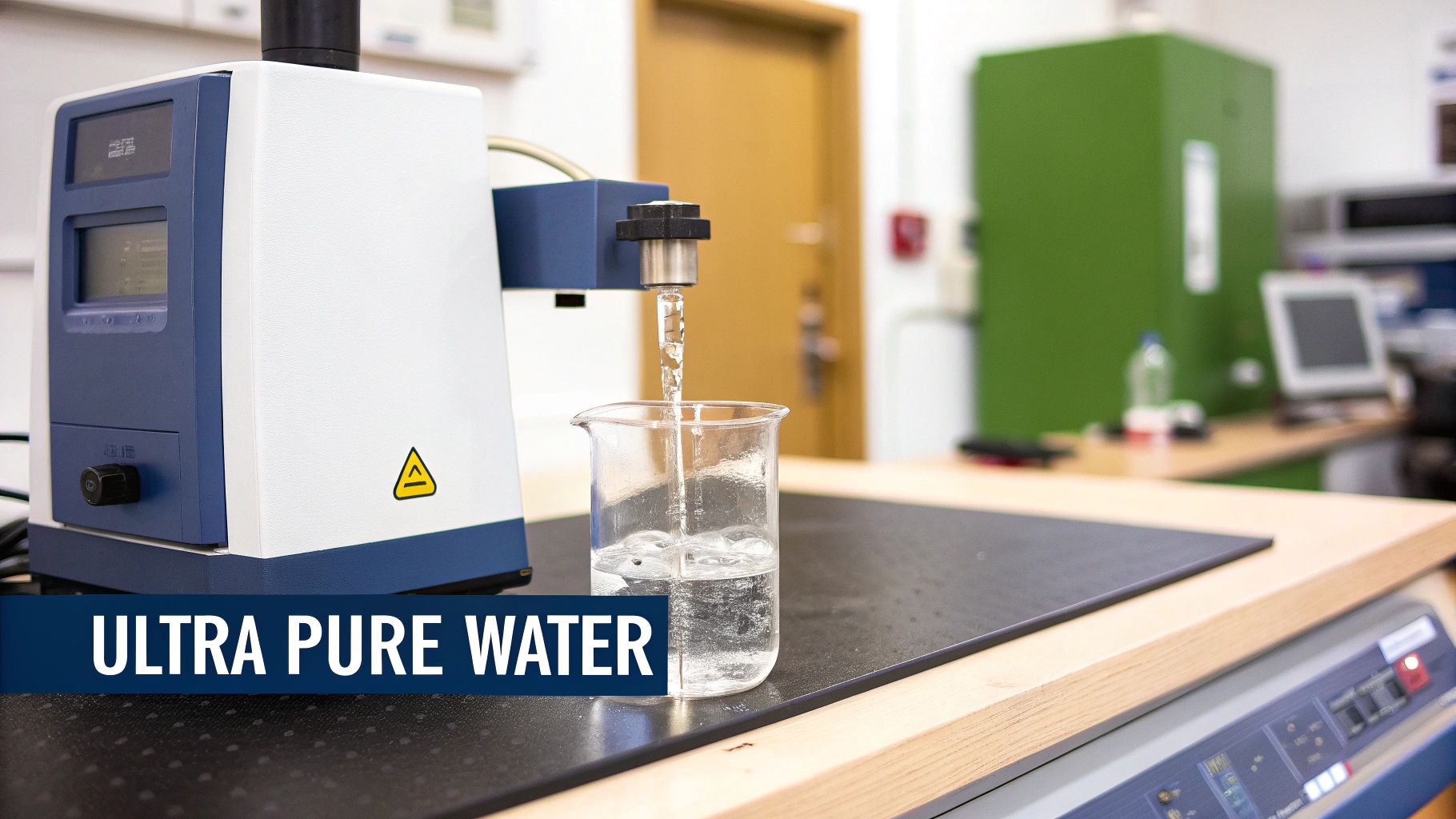
At its core, a deionised water system is a highly specialised piece of equipment that strips out mineral ions from regular tap water. The water from your tap is full of dissolved salts, metals, and minerals like calcium and magnesium, all of which carry an electrical charge. These systems use a clever process called ion exchange, which acts like a magnet to attract and trap these charged particles, leaving behind almost pure H₂O.
It’s a different game entirely from distillation, where water is boiled and the steam is collected. Deionisation is all about targeting those ions, which makes it an incredibly effective way to reach extreme levels of purity. Getting your head around this difference is the first step to understanding why these systems are so vital in so many fields. To get a better sense of what sets this water apart, you can explore our guide here: https://24purewater.co.uk/ultrapure-water-the-purest-water-is-not-your-drinking-water/
The Real-World Impact of Water Purity
The demand for deionised water is huge, touching almost every UK industry where precision is everything. A microscopic mineral deposit might sound harmless, but it can lead to some seriously expensive headaches. That’s why these systems aren't a luxury; they're a critical investment in quality and consistency.
You'll find them at work in all sorts of places:
- Pharmaceuticals and Laboratories: In this world, any contamination can ruin sterile solutions, throw off sensitive experiments, or compromise medical devices. Purity is non-negotiable.
- Electronics and Semiconductor Production: Tiny mineral ions can corrode or short-circuit delicate microelectronics during the manufacturing process. Deionised water prevents this.
- Automotive and Aerospace: It’s used for cleaning and rinsing critical components to ensure absolutely no mineral residue is left behind.
- Professional Cleaning: Ever wonder how professional window cleaners get that perfect, streak-free shine? They use deionised water. With no minerals, there are no spots left when the water evaporates.
Just to give you an idea of the scale we're talking about, the UK water industry treats and supplies just under 16 billion litres of water every single day. That water goes to homes and a massive range of businesses. For those specialised industries, deionisation is that final, crucial step to get the quality they need.
More Than Just Filtration
At the end of the day, a deionised water system is about managing risk and guaranteeing quality. It takes the guesswork out of water by removing the unpredictable variable of mineral content. This allows businesses to get consistent, repeatable results, protect expensive equipment from scale and corrosion, and meet the tough standards their industries demand. It’s all part of the bigger picture of advanced water quality filtration, a cornerstone of so many modern industrial processes.
Getting to Grips with Deionisation Technologies
At the heart of any deionised water system is the clever technology doing the hard work of stripping mineral ions from the water. While the end goal is always the same—achieving incredible purity—the methods for getting there can be quite different. Knowing how these core technologies work is the key to figuring out which system is right for your job.
Think of them as a team of specialists. Some are the heavy lifters, built for bulk removal, while others are the finishers, providing that final, perfect polish.
Ion Exchange Resins: The Tiny Ion Magnets
The most common and fundamental technology is ion exchange. This process uses tiny, porous resin beads that act like powerful, highly specific magnets, each designed to attract and capture a particular type of electrically charged mineral ion.
These resins live inside tanks or cartridges and come in two main flavours:
- Cation Exchange Resin: These beads have a negative charge. As water flows past, they grab onto positively charged ions (cations) like calcium, magnesium, and sodium, swapping them out for a harmless hydrogen ion (H+).
- Anion Exchange Resin: These beads do the opposite. They carry a positive charge and attract negatively charged ions (anions) like chloride, sulphate, and bicarbonate, releasing a hydroxyl ion (OH-) in their place.
When the released hydrogen (H+) and hydroxyl (OH-) ions meet, they click together to form a pure water molecule (H₂O). The unwanted mineral ions? They stay trapped on the resin, taken out of circulation.
Mixed-Bed Deionisation: The Polishing Stage
When you need the absolute highest level of purity, a mixed-bed deionisation system is usually the final step. It isn't a new process, but rather a perfection of ion exchange. It works by mixing both cation and anion resins together in a single tank.
This intimate blend creates an incredibly efficient purification environment. Any stray ion that might have slipped past one type of resin bead is almost guaranteed to be nabbed by the other type right next to it. This makes mixed-bed systems brilliant at ‘polishing’ water, wiping out the last traces of ionic contaminants to reach resistivity levels of up to 18.2 Megohm-cm—the theoretical peak of pure water.
The UK's deionised water systems market has boomed, largely driven by this demand for ultrapure water in sensitive industries. The adoption of mixed-bed technology is especially strong here, as it's essential for sectors like pharmaceuticals and semiconductor manufacturing. Market analysis actually projects the UK will hold a 17.0% share of this market in 2025. You can find more details on these market trends and what they mean for UK businesses online.
Electrodeionisation: Continuous Purification Powered by Electricity
Electrodeionisation (EDI) is a more advanced, hands-off approach. Instead of using resin beds that eventually fill up and need replacing or regenerating, EDI uses electricity to continuously pull ions out of the water and clean the resins at the same time.
An EDI system works by sandwiching ion exchange membranes and resins between electrodes. As water flows through, an electrical current actively pulls the captured ions away from the resin and flushes them out in a separate waste stream. The system essentially regenerates itself as it operates.
This is a huge advantage for industrial settings because it cuts out the downtime and chemical handling that comes with traditional resin regeneration. It’s a self-sufficient system that delivers a constant, reliable supply of high-purity water.
Reverse Osmosis: The All-Important First Defence
Now, Reverse Osmosis (RO) isn't technically a deionisation technology, but it’s a crucial partner to any DI system. RO acts as a bouncer, forcing water through a super-fine membrane that blocks up to 99% of dissolved salts, organics, and other larger contaminants.
Think of RO as the first line of defence. By getting rid of the vast majority of impurities before the water even touches the sensitive DI resins, an RO system drastically lightens the load on the deionisation stage. This means your DI resin cartridges last much, much longer, which in turn slashes your running costs. Many find that seeing how an on-demand service works provides a helpful perspective on efficiency; you can discover more about our streamlined process for pure water access.
While deionisation is a core method for achieving purity, it's also helpful to be aware of other techniques, such as those used by lab water purifiers for distilled water, to get a full picture of water treatment. Each technology brings something unique to the table, and they often work together to deliver the exact water quality your application needs.
Comparing Deionisation Technologies
To make things a bit clearer, here’s a quick side-by-side look at the main technologies. This should help you see at a glance where each one shines.
| Technology | Purity Level Achieved | Best For | Operating Cost | Maintenance Needs |
|---|---|---|---|---|
| Ion Exchange | High (Type II/III Water) | General-purpose demineralisation, pre-treatment, non-critical applications | Low-Medium | Resin regeneration or cartridge replacement required |
| Mixed-Bed DI | Ultra-High (Type I Water, up to 18.2 MΩ-cm) | Polishing stage for labs, pharmaceuticals, electronics, and microchips | Medium-High | Resin regeneration or cartridge replacement required |
| Electrodeionisation | High to Ultra-High (Type I/II Water) | Continuous, high-volume industrial processes requiring consistent purity | High (initial) | Minimal; self-regenerating system |
| Reverse Osmosis | Good (Removes 95-99% of contaminants) | Pre-treatment to protect and extend the life of DI systems | Low | Regular membrane cleaning and filter replacement |
Ultimately, the best approach often involves combining these technologies—using RO as a pre-treatment, followed by ion exchange for bulk deionisation, and finishing with a mixed-bed polisher for ultrapure results.
How to Select the Right Deionised Water System
Choosing the right deionised water system can feel a bit overwhelming, but it really just boils down to answering a few key questions about what you actually need. By figuring out your requirements for purity, flow rate, and overall capacity, you can confidently pick a system that fits your work like a glove.
This way, you avoid the classic mistakes of either buying a system that’s complete overkill or, even worse, one that can’t keep up. Get it right, and you'll have a reliable, cost-effective setup for years to come.
Matching Purity Levels to Your Application
First things first: how pure does your water need to be? In the world of deionised water, we measure purity by its resistivity, using the unit Megohm-cm (MΩ-cm). It’s a simple concept: the higher the number, the purer the water. A high reading means there are very few ions left to conduct electricity.
Different jobs need different levels of purity:
- General Rinsing & Cleaning (1-5 MΩ-cm): For everyday tasks like rinsing lab glassware or preparing simple buffers where a few trace minerals won't cause any harm, a basic ion exchange system (producing what’s known as Type III water) is usually all you need.
- High-Purity Laboratory Work (10-15 MΩ-cm): When you get into more sensitive work, like preparing microbiological media or general chemical analysis, you need a higher grade of water (Type II). This is often achieved with a two-step process, using reverse osmosis as a pre-treatment before the ion exchange stage.
- Ultrapure Critical Applications (>18 MΩ-cm): This is the top tier. Industries like semiconductor manufacturing, pharmaceutical production, and high-performance liquid chromatography (HPLC) demand the purest water possible, known as Type I. Reaching this gold standard of 18.2 MΩ-cm almost always involves a multi-stage system that finishes with a mixed-bed deioniser or an EDI unit.
The trick is to pick a system that meets your purity target without going excessively over. Over-specifying just means you’ll pay more upfront and in running costs, while under-specifying will compromise your results. It's about finding that sweet spot.
Calculating Your Required Flow Rate
Next up is your flow rate. This is simply how much deionised water you need over a certain time, usually measured in litres per hour (L/hr) or litres per minute (L/min). Getting this calculation right is crucial if you want to avoid a production bottleneck when you're at your busiest.
To figure this out, think about both your average and your peak demand. A small university lab might only need a trickle of 2-5 L/hr from a compact unit. On the other hand, a car valeting business running a spot-free rinse system will need a much beefier flow rate, maybe 10-12 L/min, to keep up during peak hours. If your system can't deliver during those crunch times, everything grinds to a halt.
The process of creating this pure water usually happens in stages, from pre-treatment right through to a final polish.

As you can see, it’s a sequence. The pre-treatment stage protects the main deionisation unit, and the final polishing step is what gets you to those ultra-high purity levels.
Planning for Capacity and Consumption
Finally, you need to think about capacity. This is all about how much deionised water the system can make before the ion exchange resins get used up and need regenerating or replacing. This is directly linked to how much water you use and how clean (or dirty) your incoming tap water is.
To get a good estimate, you’ll need to know two things:
- Your total daily water usage: How many litres do you get through in a typical day?
- Your feed water quality: You can get a rough idea with a simple TDS (Total Dissolved Solids) meter. The higher the TDS reading of your tap water, the faster your resin will become exhausted.
For instance, a home aquarium enthusiast who only needs 50 litres a week and has fairly low TDS tap water could get by perfectly well with a small, disposable cartridge system. But a pharmaceutical factory running a continuous process will need an industrial-scale EDI system that regenerates itself automatically to ensure there’s never any downtime.
By carefully considering these three pillars—purity, flow rate, and capacity—you’ll have a clear blueprint for the deionised water system that perfectly matches your work and your budget.
Getting Your System Installed and Keeping It Running Smoothly

Putting in a deionised water system isn't just a purchase; it's a long-term commitment to quality control. To really get your money's worth and ensure a long, happy life for your equipment, you can't skimp on a proper installation and a disciplined maintenance routine. Think of it this way: doing it right from the start helps you avoid those headache-inducing downtimes and guarantees you’ll always have the high-purity water you need, right when you need it.
A little bit of planning before the system even shows up at your door can make a world of difference. Getting these basics sorted out early on is the best way to sidestep common problems and set your system up for success from day one.
First Things First: Pre-Installation Checks
Before you even think about connecting a hose, it pays to take a good look at where the system will live. This simple step can prevent a lot of operational headaches and ensures your new gear will work as efficiently and safely as it should.
Here’s a quick checklist of the non-negotiables:
- Got Enough Water Pressure? Check your mains water pressure against the manufacturer’s specs. If it's too low, you’ll see poor flow and performance. Too high, and you might need a pressure regulator to stop things from getting damaged.
- Space and Access: It’s not just about fitting the unit in. You need to leave enough room to get your hands in there for maintenance. Changing filters, swapping out resin, and doing inspections will be impossible if it's crammed into a corner.
- A Proper Drain: Your system will need to get rid of wastewater, whether it's reject water from a pre-treatment RO unit or backwash from a regeneration cycle. You'll need a suitable drain nearby that can handle the flow.
- Power Supply: Many systems have pumps, monitors, or EDI modules that need electricity. Make sure you have a suitable power outlet close by that matches the system’s requirements.
Once you’ve ticked these boxes, you can get on with the physical installation. This usually means connecting the inlet water supply, linking all the tanks and filters in the right order, and running the outlet to where you'll be using the water. Don't forget to do an initial system flush, just as the manual says. This clears out any dust from the factory and gets the resin beds ready for action.
Sticking to a Simple Maintenance Schedule
The real secret to keeping a DI system running perfectly is consistent, proactive care. You don't need anything complicated—a simple, structured schedule is enough to turn these essential checks into a quick, easy routine.
Think of maintenance not as a chore, but as an insurance policy for your investment. A few minutes of regular checks can prevent a costly component failure, protect your other equipment, and guarantee the water purity your process relies on.
The easiest way to stay on top of things is to break tasks down into daily, weekly, and longer-term jobs.
Daily Checks (Takes less than 5 minutes)
- Glance at the Pressure Gauges: This is a fantastic quick diagnostic. A sudden pressure drop could mean a leak, while a slow, steady increase is often the first sign of a filter starting to clog.
- Quick Leak Inspection: Do a quick walk-around. Check all the fittings, connections, and housings for any drips or moisture. Catching a tiny leak early can save you from a whole lot of water damage later.
Weekly Tasks (About 10-15 minutes)
- Test the Water Quality: Use the system’s built-in monitor or a handheld meter to check the resistivity or TDS of the final water. This is your number one indicator for when the ion exchange resins are getting tired and need changing.
- Update the Logbook: Keep a simple log next to the system. Jot down the date and the water quality reading. This running history is incredibly useful if you ever need to troubleshoot a problem.
Periodic Duties (As and when needed)
- Replace Filters and Resins: Your water quality readings and pressure gauges will tell you when it’s time. When the purity drops or the pressure climbs, it's time to swap out the pre-filters or regenerate/replace the DI resins. Just follow the manufacturer’s guide to the letter.
- Sanitise the System: Biofilm can slowly build up inside the system, especially if it isn't used constantly. Running a sanitisation cycle every so often, as recommended in the manual, will keep everything clean and your water purity high.
Analysing the Costs and Return on Investment
When you’re thinking about bringing a deionised water system in-house, it’s easy to focus on the initial price tag. But to make a smart financial decision, you need to look at the bigger picture—the total cost of ownership and the very real return on investment these systems deliver over time.
A well-chosen system isn't just another expense. Think of it as a strategic asset that protects your quality, stops waste in its tracks, and keeps your operations running smoothly.
Breaking Down the Total Cost of Ownership
The true financial commitment for a deionised water system is a tale of two parts: the upfront cost to get it installed and the ongoing expenses to keep it running.
1. Capital Expenditure (CapEx)
This is the one-time investment to buy and install the equipment. The numbers can vary wildly here. You might spend a few hundred pounds for a small cartridge system for an aquarium, or you could be looking at tens of thousands for a fully automated, industrial-scale electrodeionisation plant.
What drives this initial cost?
- System Capacity and Flow Rate: It's simple, really. The more pure water you need and the faster you need it, the bigger and more expensive the system will be.
- Purity Level Required: If you need the gold standard—ultrapure Type I water (above 18 MΩ-cm)—you'll need more advanced tech like mixed-bed polishers or EDI. This naturally bumps up the price compared to a basic ion exchange setup.
- Automation and Monitoring: Features like built-in purity meters, self-regenerating cycles, and leak detectors will add to the initial bill. However, they often pay for themselves by cutting down on labour and preventing expensive accidents down the line.
2. Operational Expenditure (OpEx)
These are the recurring costs you'll need to budget for. Over the life of the system, these expenses are just as important, if not more so, than the price you paid to get it through the door.
While the upfront cost gets all the attention, it’s the ongoing operational expenses that will have the biggest impact on your budget in the long run. A system with a low purchase price but an appetite for expensive consumables can quickly become the pricier option.
The main OpEx components to watch for are:
- Consumables: This is often the biggest line item. It covers everything from replacement pre-filters and activated carbon cartridges to the ion exchange resin itself. How often you need to replace them comes down to how much water you use and how clean your incoming tap water is to begin with.
- Utilities: You’ll need electricity to power pumps, monitors, and EDI modules. Water is the other utility cost, especially if your system has an RO pre-treatment stage that produces a constant stream of reject water.
- Labour and Maintenance: Don't forget to account for the time your team spends on routine checks, swapping out filters, and sanitising the system.
Understanding the True Return on Investment
The ROI from a deionised water system rarely shows up as a direct profit. Instead, its real value is in cost avoidance. The financial win comes from preventing all the expensive problems that using plain tap water can cause in sensitive applications.
Just think about the cost of not having DI water:
- Product Failure: In electronics manufacturing, a single microscopic mineral spot can ruin a microchip. In the pharmaceutical world, it could contaminate an entire batch of sterile medicine, forcing you to scrap it all.
- Equipment Damage: Untreated water creates scale build-up in expensive machinery like lasers and autoclaves. This chokes their efficiency, causes overheating, and leads to eye-watering repair bills.
- Inaccurate Results: For any laboratory, impure water can completely throw off experimental results. That means wasted time, squandered reagents, and valuable resources down the drain.
What's more, this isn't just an operational issue; it's a strategic one. The UK's water resources are under increasing pressure. Regions like the South East of England are facing potential water shortages, which puts a spotlight on efficient water treatment. Investing in purification systems like DI water ensures you have a reliable supply of the high-grade water you need, no matter what. You can read the full research on UK water resource challenges to learn more about this growing concern.
Frequently Asked Questions
When you’re looking into deionised water systems, a few practical questions always seem to pop up. Whether you're just starting to explore your options or trying to get a better handle on the details, getting straight answers is key to making the right choice.
Let's tackle some of the most common queries to clear up the confusion around DI water.
Is Deionised Water Safe to Drink?
While it won’t harm you in small amounts, making deionised water your regular drinking water isn't a good idea. The purification process is so effective that it strips out everything, including beneficial minerals like calcium and magnesium that our bodies need.
Because it's so pure, many people find it has a flat, unappealing taste. There’s also a long-standing concern that regularly drinking it could gradually leach essential minerals from your body. Best to stick to tap or mineral water for hydration.
How Often Do I Need to Replace the Ion Exchange Resins?
This is the classic "how long is a piece of string?" question. The honest answer is, it really depends on a few key factors:
- Your water usage: The more water you run through the system, the quicker you'll exhaust the resin. Simple as that.
- Incoming water quality: If your mains water is packed with dissolved minerals (high TDS), the resin has to work much harder and will be spent far sooner than it would with softer water.
- System capacity: A larger system holds more resin, so it will naturally have a longer service life between change-outs.
Thankfully, most modern deionised water systems have built-in purity monitors. These will give you a clear signal when the resin needs replacing or regenerating, taking the guesswork out of it.
What Is the Difference Between Resistivity and Conductivity?
Think of resistivity and conductivity as two sides of the same coin—both are ways to measure water purity, but they have an inverse relationship.
Conductivity measures how easily electricity passes through water. More ions and minerals mean it's easier for a current to flow, so the conductivity reading is higher.
Resistivity is the opposite. It measures how strongly the water resists an electrical current. The fewer ions there are, the harder it is for electricity to pass, giving you a higher resistivity reading.
In high-purity applications, resistivity is the gold standard. It's measured in Megohm-cm (MΩ-cm), and a reading of 18.2 MΩ-cm is considered the theoretical peak for absolutely pure water.
For a deeper dive into these topics and more, feel free to explore the comprehensive list of FAQs on our website.
Ready to skip the hassle of system ownership and maintenance? With 24 Pure Water, you get on-demand access to ultra-pure, deionised water from our nationwide network of self-service filling stations. Find your nearest station and start filling for just 4p per litre at https://24purewater.co.uk.