Ever wondered why a professionally cleaned window sparkles without a single blemish, while your own efforts leave behind a frustrating patchwork of streaks and spots? The secret isn’t some magic chemical or a complicated technique. It’s the water itself.
This is where deionised water comes in, and it's a complete game-changer for a flawless finish.
Understanding the Power of Pure Water
Think of your normal tap water as being full of invisible passengers. While it looks clear, it's carrying a hidden load of dissolved minerals—especially calcium and magnesium, which make the water 'hard' across much of the UK. When that water dries on a surface, the water evaporates, but the minerals get left behind. The result? Those familiar chalky, white water spots.
From Tap Water to a Powerful Cleaning Tool
Deionisation is a sophisticated filtration process that strips those mineral "passengers" out. It uses special ion-exchange resins that act like powerful magnets, pulling out virtually all dissolved solids until the water is incredibly pure.
We measure this purity by its Total Dissolved Solids (TDS), in Parts Per Million (PPM). Your tap water might have a TDS reading of 300 PPM or even higher. Professionally produced deionised water, on the other hand, aims for 000 PPM. This isn't just clean water; it's a highly active cleaning agent. For a deeper dive into what makes this water so different, it's worth exploring the differences between ultrapure water and drinking water.
Because it’s so pure and free of minerals, deionised water is naturally aggressive. It actively grabs onto dirt and grime from any surface it touches, pulling it away. Then, it simply evaporates, leaving absolutely nothing behind—just a perfect, streak-free shine.
Tap Water vs Deionised Water at a Glance
To see the difference clearly, let's break it down. This table shows why deionised water is the only choice for professionals who can't afford to leave a job anything less than perfect.
| Characteristic | Typical UK Tap Water | Deionised Water |
|---|---|---|
| Mineral Content (TDS) | 150-350+ PPM | 000 PPM |
| Cleaning Ability | Limited; minerals interfere with detergents. | High; actively absorbs dirt and ions. |
| Post-Evaporation Result | Leaves white mineral spots and streaks. | Evaporates completely, leaving no residue. |
| Best For | General household use, drinking, gardening. | Professional cleaning, manufacturing, labs. |
The contrast is stark. One leaves a mess, the other a pristine surface.
The Professional Benchmark for a Flawless Finish
That 000 PPM reading isn't just a number; it's the gold standard for professionals. Whether you're cleaning windows, valeting a car, or maintaining solar panels, it’s a guarantee of a perfect, residue-free finish, every single time. Grasping this simple fact is the key to understanding why deionised water is so vital across so many industries.
Where Deionised Water Shines in Professional Cleaning
So, we've got the science down. But where does the rubber meet the road? The true power of deionised water really comes to life when you see it used in professional settings, tackling the everyday frustrations that cleaners face. From gleaming skyscrapers to immaculate supercars, using deionised water is all about getting a perfect finish, faster.
Here in the UK, especially across London and the South East, professionals are constantly fighting a battle against hard water. That mineral-rich tap water is the arch-nemesis of a pristine finish, leaving behind those stubborn, chalky spots on glass and paintwork. Deionised water simply cuts out the problem at the source.
This diagram neatly shows the journey from problem-causing tap water to a professional-grade cleaning tool.
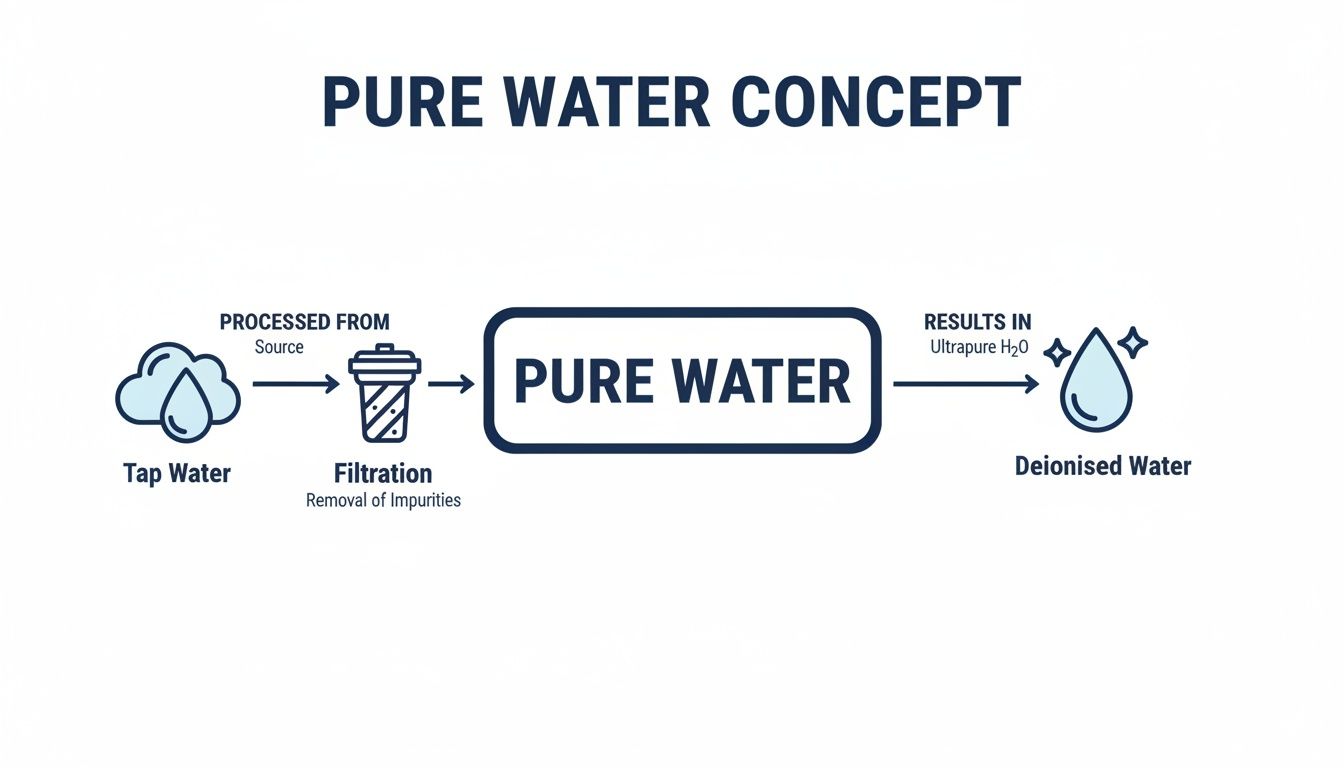
It’s a simple but effective process: filtration strips out all the impurities from standard tap water, turning it into the pure, sparkling H₂O needed for a completely residue-free clean.
The Window Cleaner's Secret Weapon
For professional window cleaners, the switch to deionised water has been a game-changer. When you combine it with a water-fed pole system, operatives can work safely from the ground, easily reaching several storeys high without ever touching a ladder or hiring a costly access platform.
The process itself is brilliantly straightforward. Pure water is pumped up the pole to a purpose-built brush head, which agitates the dirt on the glass and frames. Because deionised water is so keen to grab onto impurities, it actively loosens and pulls away grime and old chemical residues.
After a good scrub, the window gets a final rinse with more deionised water. This is where the magic happens. The cleaner can just walk away and let the window dry on its own. As the pure water evaporates, it leaves absolutely nothing behind—no minerals, no soap, and most importantly, no streaks.
This "rinse-and-go" method is a massive win for a few key reasons:
- Safety: It massively cuts down the risks that come with working at height, a huge deal in the industry.
- Efficiency: A good cleaner can get through large areas of glass so much quicker than with a traditional squeegee.
- Superior Results: It provides that flawless, streak-free finish that keeps customers happy, time and time again.
Many professionals in the field have their preferred kit; a great article on what pros use to clean windows confirms that many now reach for deionised water as their primary tool. To see just how much it has changed the game, check out our dedicated guide on why pure water revolutionises window cleaning and has become the industry standard.
Achieving a Showroom Finish in Car Valeting
In the world of car valeting and detailing, the end goal is always that perfect, blemish-free shine. Water spots are the single biggest thing standing in the way, capable of turning an amazing wash into a pretty average one. Once again, this is where deionised water steps in to solve a very common headache.
After a car has been meticulously washed, shampooed, and clayed, the final rinse is the make-or-break moment. Use regular tap water here, and you're guaranteed to get mineral deposits as it dries. This forces detailers to spend ages carefully drying every single surface with microfibre towels, and even then, it's easy to miss a spot.
Using deionised water for the final rinse allows for a touch-free drying process. The water sheets off the vehicle’s bodywork and evaporates cleanly, leaving behind an impeccable, spot-free finish on the paintwork, glass, and chrome trim.
This isn't just about saving time; it's about quality and protecting the vehicle. Over time, those mineral deposits can actually etch into a car’s clear coat and cause permanent damage. A final pure water rinse prevents this entirely, preserving the car's finish. It’s the professional’s trick to getting that deep, glossy, "just-detailed" look that clients pay top pound for.
Maximising Efficiency in Solar Panel Cleaning
Solar panels are a major investment, but their performance hinges on one simple factor: how clean they are. A film of dust, traffic grime, bird droppings, or even pollen can seriously block sunlight from reaching the cells, crippling energy production. In fact, studies have shown that dirty solar panels can lose up to 25% of their efficiency.
Regular cleaning isn't just for looks—it's essential for getting the best return on investment. The problem is, using tap water or harsh chemicals can do more harm than good. Tap water leaves its own mineral film that continues to block light, while certain detergents can damage the panel's delicate anti-reflective coating.
Deionised water is the perfect solution for solar panel maintenance.
- Effective Cleaning: Its natural solvency lifts away stubborn grime without needing any abrasive chemicals.
- Residue-Free Finish: It dries perfectly clear, guaranteeing maximum light can get through for optimal panel performance.
- Safety: Just like with window cleaning, it’s typically applied with water-fed poles, making it safe and easy to clean roof-mounted arrays from the ground.
For both commercial and domestic solar installations, cleaning with deionised water is a vital maintenance task that directly translates into better energy output and real financial savings.
The impact of this simple technology is huge. In the UK's £1.2 billion window cleaning industry, more than 25,000 professionals increasingly depend on pure H₂O to deliver the spotless results clients now expect on everything from homes to high-rises. It’s a key reason professionals report up to 40% fewer callbacks for streaky finishes. With the wider UK water treatment market set for major growth, deionised water is a standout solution that just gets the job done right.
Specialised Industrial and Hobbyist Applications
While deionised water is a star performer in professional cleaning, its reach extends far beyond gleaming windows and cars. In many specialised fields, the absolute purity of DI water isn't just a nice-to-have; it's a fundamental requirement for success, safety, and getting consistent results. In these high-stakes environments, even microscopic mineral contaminants can cause huge problems, from ruining product quality to causing complete system failure.
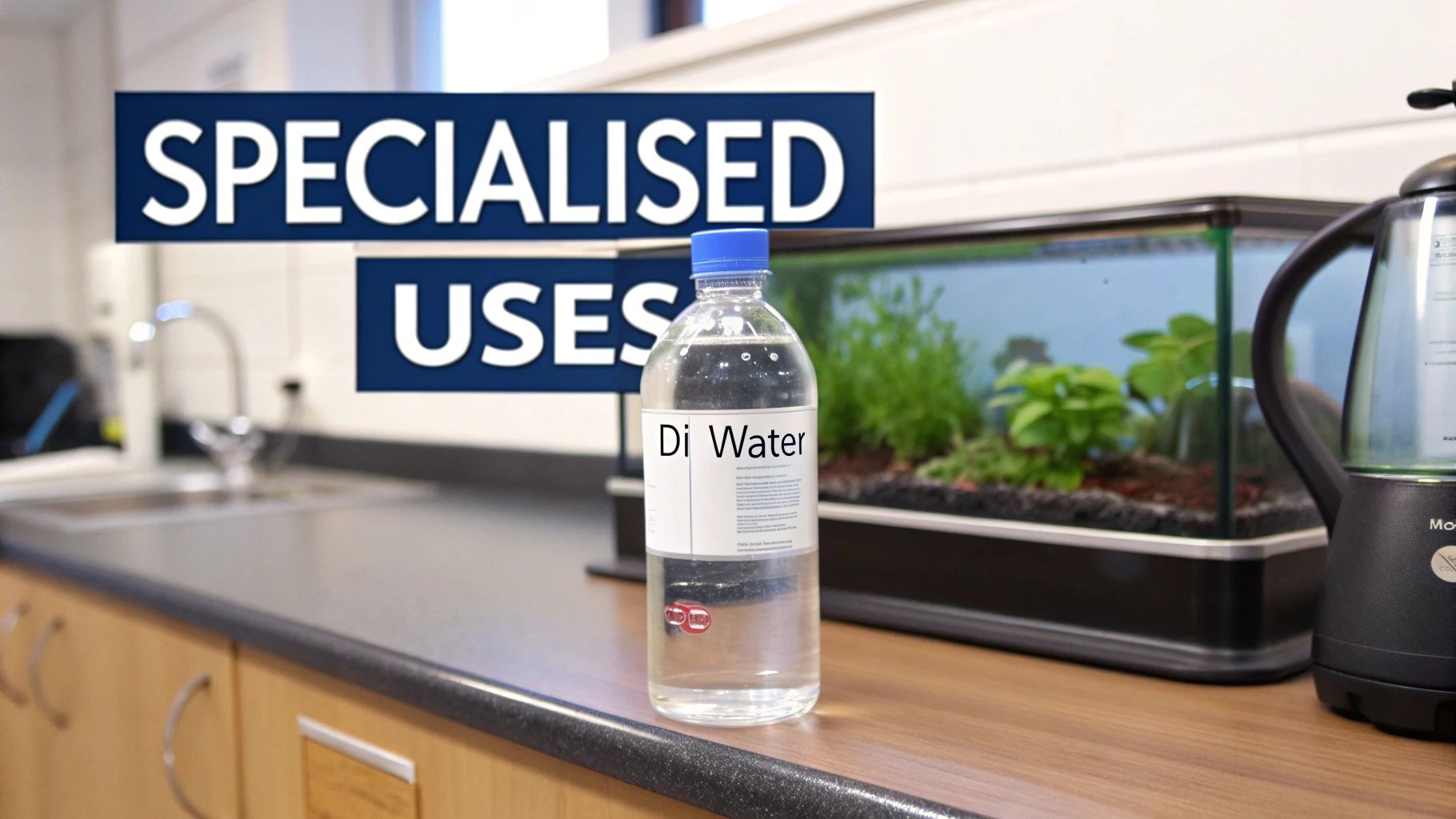
The unique, stripped-back nature of deionised water makes it an indispensable tool for everyone from dedicated hobbyists to large-scale industrial plants. Whether you're managing a delicate aquatic ecosystem or manufacturing high-precision electronics, the absence of dissolved solids is the key to maintaining control and achieving predictable outcomes. Let’s dive into some of the critical uses where this level of purity is paramount.
Creating Stable Environments for Aquaria
For any aquarium enthusiast, particularly those keeping sensitive marine life or delicate freshwater species, tap water can be a hidden enemy. It’s often loaded with chlorine, chloramine, heavy metals, and a mineral content that can fluctuate wildly, stressing or even killing the tank's inhabitants. Using deionised water gives you a clean, neutral base to work from.
Think of it as a blank canvas. By starting with pure H₂O, aquarists can carefully add back exactly what they need with precise salt mixes and supplements. This allows them to build the perfect water parameters for specific species, guaranteeing a stable and healthy home for their fish and corals.
- Prevents Algae Growth: Tap water is often full of phosphates and silicates, which are basically fertiliser for nuisance algae. DI water is free from these, helping to keep tanks cleaner for much longer.
- Ensures Consistency: It gets rid of the "postcode lottery" of tap water quality, giving you reliable, repeatable results every time you do a water change.
- Protects Sensitive Species: For delicate corals, discus fish, or shrimp, the contaminants lurking in tap water can be lethal. Deionised water is simply the safest foundation for their habitat.
Ensuring Flavour Consistency in Breweries
In the world of brewing, water is so much more than just an ingredient; it's the very soul of the beer. The mineral profile of the water—what brewers call its 'liquor'—has a profound effect on the flavour, aroma, and mouthfeel of the final pint. A brewer in a hard-water region like Kent would produce a completely different beer to one in soft-water Scotland, even if they followed the exact same recipe.
To achieve flawless consistency from one batch to the next, modern brewers often strip their source water back to its purest state using deionisation. This allows them to build a specific water profile from scratch, adding precise amounts of brewing salts like gypsum or calcium chloride to perfectly match a desired beer style, whether it's a crisp pilsner or a robust stout.
This meticulous level of control ensures a brewery’s flagship ale tastes exactly the same in January as it does in July, completely independent of seasonal changes in the local water supply.
High-Stakes Purity in Manufacturing
In high-tech manufacturing, the stakes couldn't be higher. For industries producing electronics, pharmaceuticals, or medical devices, even the tiniest mineral deposit can be catastrophic. That's why deionised water is an essential utility.
Take the manufacturing of a semiconductor, for instance. A single, microscopic speck of calcium left behind by evaporating tap water could short-circuit a delicate microchip, rendering it completely useless. The UK's deionised water systems market is expanding to meet this demand, now holding a significant 17.0% share of the European market. While driven by these high-tech industries, this growth also benefits smaller-scale professionals, like aquarists, who need a reliable source of pure water. You can learn more about the growing UK market for deionised water systems.
It’s a similar story in pharmaceutical production, where water purity is non-negotiable to prevent contamination and ensure the stability of medicines. Deionised water is used for everything from cleaning equipment to acting as a solvent in formulations—any process where mineral ions could interfere with critical chemical reactions. Its use guarantees that the final product meets the incredibly strict regulatory standards for safety and efficacy.
Getting Your Hands on Pure Water When You Need It
Knowing why you need deionised water is the easy part. For most professionals, the real headache is figuring out how to get a reliable, affordable supply, especially when you're flat out busy. The traditional route was to bite the bullet and install your own filtration system, but anyone who's gone down that path knows it comes with its own set of frustrations.
The initial price tag for an in-house system can be a bit of an eye-opener, and that’s just for starters.
These systems are needy. They demand constant attention. You’re forever changing filters, swapping out resin, and booking services just to keep the water quality where it needs to be. Let that maintenance slip, and you’re not just risking a shoddy finish on a job; you’re looking at a potentially hefty repair bill. Your time is much better spent out on the road, earning money, not playing plumber with your purification equipment.
On top of that, the water quality can be a lottery. As a resin bed gets older or a filter starts to clog, the TDS reading of your water slowly creeps up. You might not even notice it until you start seeing those tell-tale streaks and spots on what should have been a perfect finish. It's clear that a more modern, hassle-free approach is needed—one that delivers guaranteed purity without the operational migraines.
The Modern Alternative to In-House Systems
This is exactly why the 24 Pure Water network was created. We wanted to solve these all-too-common problems with a straightforward, pay-as-you-go solution. It gives professionals self-service access to ultra-pure deionised water, 24/7, from a growing network of filling stations. It’s the bridge between knowing why you need DI water and having a simple, effective way of getting it.
Forget about that huge upfront investment. With our model, you get crystal-clear pricing and the freedom to fill up whenever it suits you, whether that's at the crack of dawn or late at night. That flexibility is a game-changer for professionals with unpredictable schedules. You never have to worry about maintenance, resin changes, or quality control again—we handle all of that for you.
We guarantee a TDS reading of 000 PPM every single time you fill up. This takes all the guesswork out of the equation, ensuring you’re always equipped with the perfect tool for a flawless, spot-free finish on every job.
This on-demand approach saves businesses a serious amount of time and money. All the hours you’d normally sink into managing a complicated filtration system can be ploughed straight back into growing your business and looking after your clients.
Comparing Your Options
When you put the old way of doing things side-by-side with a modern network, the benefits really stand out. Let’s take a look at how a traditional in-house system stacks up against using the 24 Pure Water network.
In-House Filtration vs 24 Pure Water Network
Deciding on your pure water supply isn't just about the water itself; it's about what makes the most sense for your business operations. Here’s a cost-benefit analysis to help you see the difference.
| Factor | Traditional In-House System | 24 Pure Water Network |
|---|---|---|
| Initial Cost | High upfront investment (£1,000s). | Zero. Just the cost of the water you use. |
| Ongoing Costs | Resin, filters, servicing, repairs. | Simple, transparent per-litre pricing. |
| Maintenance | Your responsibility; time-consuming. | None. All managed centrally for you. |
| Water Quality | Can fluctuate; requires constant testing. | Guaranteed 000 PPM TDS at every fill. |
| Convenience | Fixed location; reliant on your system working. | 24/7 access at multiple nationwide locations. |
| Time Investment | Regular upkeep and monitoring needed. | Fill and go in minutes. |
Ultimately, it comes down to operational efficiency. One path involves ongoing management and hidden costs, while the other offers pure convenience.
Simple, Professional Access
The 24 Pure Water system is designed to be as simple as possible. We use a contactless key fob system that makes filling your tank quick and easy, and it handles all transactions and billing automatically. No fumbling for cash or dealing with clunky payment machines—just tap, fill, and get back on the road.
It's also perfect for businesses running multiple vans or teams. Our account management tools let you monitor water usage, track spending, and make sure every member of your crew has access to the pure water they need to deliver top-quality work. To see it in action, you can learn more about how our simple fob system works and makes the whole process effortless. Our focus is on making sure that getting hold of top-tier deionised water is never a barrier to your success.
Getting Handling and Storage Right
To get the best performance from your deionised water, you need to treat it with a bit of respect. Its absolute purity is its greatest asset, but that same quality makes it incredibly hungry for impurities from its surroundings. Proper handling and storage are non-negotiable if you want to keep that water at 000 PPM and ready to deliver a perfect finish every time.
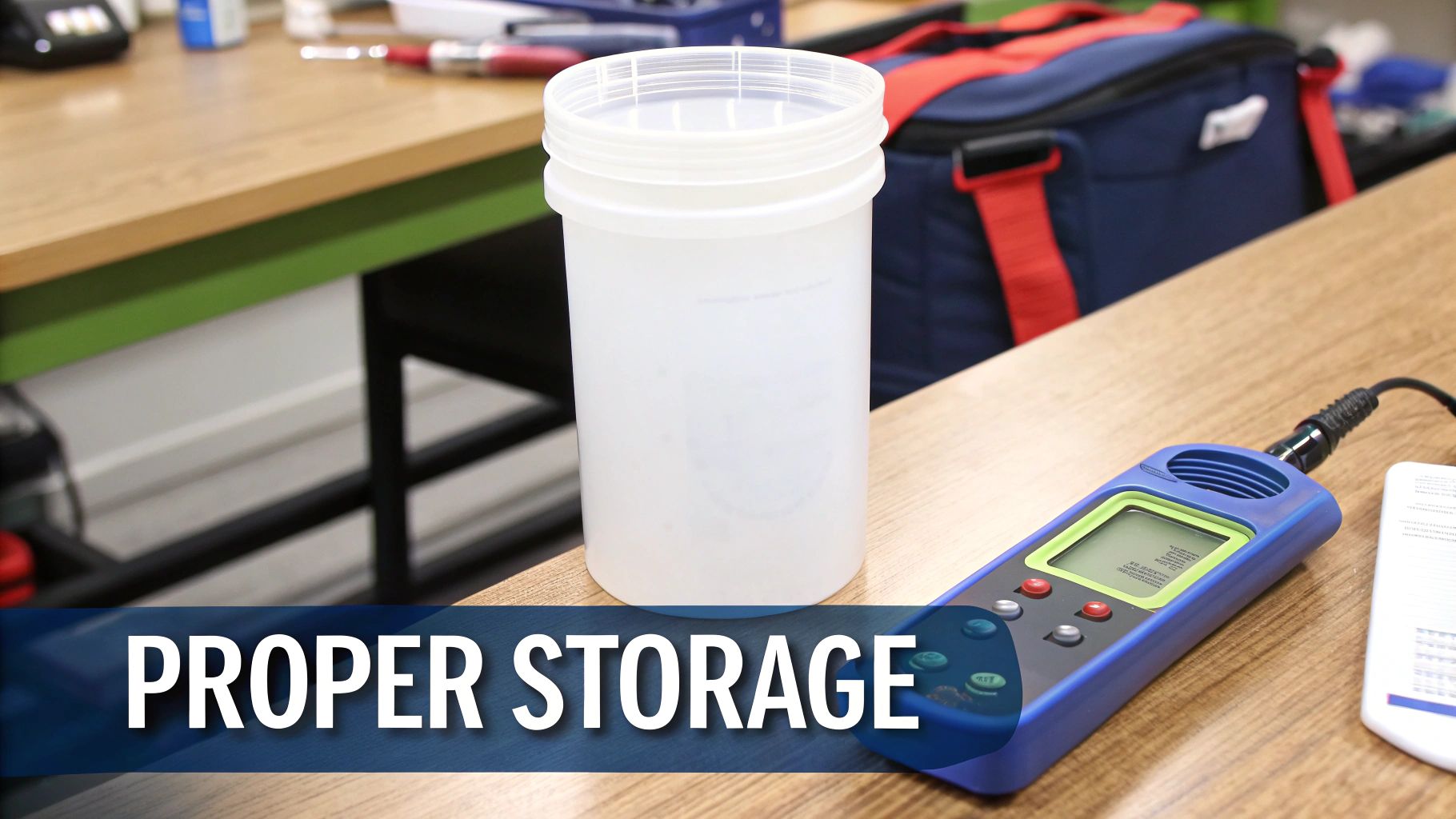
It helps to think of deionised water as an empty sponge – it’s desperate to soak up anything it comes into contact with. Leave it open to the air, and it will pull in carbon dioxide, which can make it slightly acidic. Store it in the wrong kind of container, and it will literally leach minerals right out of the material itself, completely undoing all the hard work of the purification process.
Choosing the Right Storage Containers
The single most important factor in keeping your water pure is the container you store it in. Not all plastics are created equal, and you have to be picky.
Your best bet is to stick with containers made from inert, high-grade plastics. High-Density Polyethylene (HDPE) is the go-to choice for a reason; it’s tough, it doesn’t leach, and it’s ideal for everything from large vehicle-mounted tanks to smaller jerry cans. Low-Density Polyethylene (LDPE) and Polypropylene (PP) are also solid options.
A Quick Word on Safety: While deionised water is completely safe to handle and won't harm your skin, it is not safe to drink. The deionisation process strips out essential minerals like calcium and magnesium that our bodies actually need.
The Do's and Don'ts of Handling DI Water
Sticking to a few simple rules will make sure your investment in pure water delivers consistently brilliant results. Here’s a straightforward guide to managing your supply properly.
-
Do keep your containers sealed tight. This is the easiest way to stop the water from absorbing CO₂ from the atmosphere and prevent dust and dirt from getting in.
-
Do test your water’s TDS regularly. A quick check with a handheld TDS meter before you start a job is all it takes to confirm you’re working with 000 PPM water.
-
Do use dedicated, clean equipment. Any funnels or hoses that touch your DI water should be clean and used only for that purpose to avoid cross-contamination.
-
Don't use unlined metal containers. Deionised water is a surprisingly effective solvent and can corrode some metals over time, leaching impurities and destroying its purity.
-
Don't top up your pure water tank with tap water. Ever. Even a splash will introduce hundreds of PPM in dissolved solids, ruining the entire batch.
-
Don't let water sit in your tank for weeks on end. For the best results, try to use your supply regularly and refill with a fresh batch to keep it at its best.
Following these simple guidelines protects the integrity of your deionised water, ensuring it's always ready to perform when you are.
Common Questions About Deionised Water
Even when you know the benefits, it's natural to have a few questions about how deionised water works in the real world. We get asked these all the time, so let's tackle the most common queries head-on. This should clear up any lingering doubts and help you get the best results, safely and confidently.
Is Deionised Water Safe to Drink?
This is easily the most popular question we hear, and the answer is a straightforward no. You shouldn't make a habit of drinking deionised water.
While a small, accidental mouthful isn't going to cause any immediate harm, it’s not meant for consumption. The deionisation process is so thorough that it strips out everything—including essential minerals like calcium and magnesium that our bodies need. People also find it has a very flat, unappealing taste. Think of it as a specialist tool for cleaning, not a source of hydration.
What Is the Difference Between Deionised and Distilled Water?
It's easy to see why people get these two mixed up, but deionised and distilled water are created through completely different processes. Knowing the difference makes it clear why one is better suited for certain deionised water uses.
-
Deionisation is a chemical process. Water flows through special ion-exchange resins which act like magnets, grabbing mineral ions (like sodium and calcium) and swapping them for hydrogen and hydroxyl ions. These then combine to form pure H₂O. It’s fantastic at removing dissolved solids but won’t remove non-ionic contaminants like bacteria.
-
Distillation is a physical process. You simply boil water, collect the steam, and condense it back into a liquid. This leaves nearly all impurities behind—minerals, microbes, the lot.
For professional cleaning like window washing or car valeting, deionised water is the undisputed champion. It gives you the purity you need for a spot-free finish without the high energy costs and slow production time of distillation.
Will Deionised Water Damage My Car's Paintwork?
Quite the opposite—it’s one of the best things you can use for a final rinse. This is a myth we’re happy to bust. Deionised water is completely safe for every part of your car, from the paint and chrome to the glass. It’s a secret weapon for professional detailers.
The real culprit for paint damage is tap water. When hard water evaporates, it leaves behind gritty mineral deposits (limescale spots) that can actually etch into your car's clear coat over time.
Because deionised water has zero mineral content, it simply evaporates and leaves nothing behind. This is what gives you that perfect, blemish-free shine and helps protect the paintwork in the long run.
How Do I Know if My Deionised Water Is Still Pure?
Good question. The purity can dip if the water isn't stored properly or if the deionisation resin is exhausted, so it's smart to test it before a job. The quickest and most reliable method is using a digital TDS (Total Dissolved Solids) meter.
These are cheap, pocket-sized gadgets that give you an instant reading in parts per million (PPM). Here’s how you use one:
- Make sure the meter's probe is clean.
- Turn it on and dip it into a sample of your water.
- Give it a second for the number to settle.
For any job where a perfect finish is the goal, you want that meter to read 000 PPM. If it shows anything higher, the water has picked up contaminants and will likely leave spots. A quick test takes seconds but guarantees you’re working with the right tool for a flawless result.
Ready to stop worrying about mineral spots and start delivering flawless results every time? Join the growing network of professionals who trust 24 Pure Water for on-demand, guaranteed 000 PPM deionised water. Find your nearest 24/7 filling station and discover a smarter way to work by visiting https://24purewater.co.uk.