Using deionised water for window cleaning is the trade secret to getting that flawless, streak-free finish every single time. It's all down to the fact that deionised water is incredibly pure, with all the dissolved minerals like calcium and magnesium completely removed. When it dries, it leaves absolutely nothing behind—just crystal-clear glass.
Why Pure Water Delivers a Flawless Finish
Have you ever spent ages cleaning a window, only to stand back and see a frustrating collection of spots and streaks? The problem probably isn't your technique; it's the water you're using. Standard tap water, particularly in the hard water regions common across the UK, is full of invisible minerals.
When this tap water evaporates on a glass surface, the pure H₂O turns to vapour, but the minerals—calcium, magnesium, and other dissolved solids—get left behind. These deposits are precisely what cause those familiar white spots and milky streaks that can spoil an otherwise perfect clean.
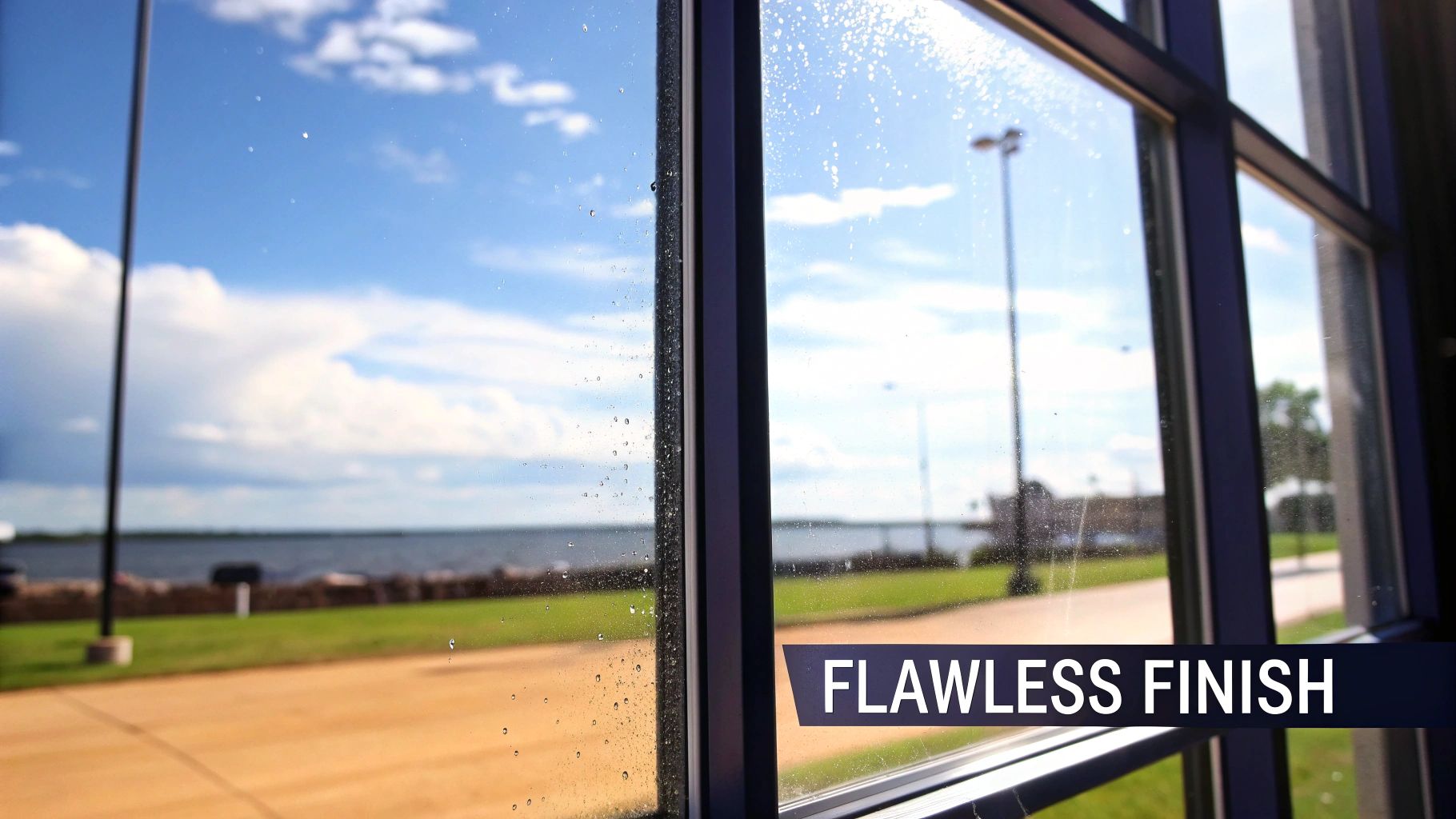
The Science of a Spotless Window
This is where the magic of deionised water comes in. Deionisation is a purification process that literally strips tap water of these mineral ions. You can think of it as a high-powered magnet that pulls out every last impurity. What you're left with is water in its purest form, often called 'hungry water' because it actively wants to grab and dissolve dirt and grime from surfaces.
When you clean with this ultra-pure water, something different happens:
- The pure water gets to work, loosening and lifting dirt right off the glass, frames, and sills.
- After a final rinse, you simply leave the water to dry naturally. No squeegee needed.
- Because there are zero dissolved solids, nothing remains when the water evaporates.
This simple yet powerful principle is what allows professional window cleaners to work without the traditional squeegee and cloths, achieving a far superior finish with a lot less hassle.
To really see the difference, let’s quickly compare the two.
Tap Water vs Deionised Water for Cleaning
This table breaks down exactly why one leaves spots and the other leaves a perfect shine.
| Feature | UK Tap Water | Deionised (Pure) Water |
|---|---|---|
| Mineral Content | Contains dissolved minerals (calcium, magnesium, etc.) | Minerals are removed; TDS reading is 0 PPM (parts per million) |
| Cleaning Action | Cleans the surface but leaves mineral deposits behind after evaporation. | 'Hungry' water actively attracts and absorbs dirt and grime. |
| Drying Process | Requires manual drying with a squeegee or cloth to prevent spots and streaks. | Dries naturally to a spot-free, streak-free finish. |
| Chemical Additives | Often requires detergents or cleaning solutions to help achieve a clear finish. | No detergents needed; the pure water does all the work. |
| End Result on Glass | Risk of visible water spots, smears, and a hazy or milky film, especially in sun. | A perfectly clear, polished, and residue-free surface every time. |
As you can see, the composition of the water itself is the critical factor. It's not about adding something to the clean; it's about taking the impurities out of the water first.
A Game-Changer for Professional Cleaning
Making the switch to a pure water system isn't just a small tweak to your method; it's a complete change in how you approach the job. It lets cleaners work faster and, more importantly, safer from the ground using water-fed poles. It also means you can deliver those consistently impressive results that build real client trust and keep them coming back.
Of course, if you're dealing with the fallout from years of tap water cleaning, you first need to tackle the existing build-up. For anyone struggling with stubborn mineral deposits, this guide on how to remove water spots from glass has some great practical tips.
Ultimately, using deionised water turns window cleaning from a manual chore into a more scientific process. This approach is not only more efficient but also better for the environment, as you can ditch the harsh detergents. For pros looking to make their workflow even smoother, seeing how our filling station system works can be a real eye-opener.
Choosing Your Water-Fed Pole System and Gear
Alright, let's move from the science of pure water to the tools of the trade. This is where the rubber meets the road—or rather, where the brush meets the glass. Picking the right water-fed pole system isn’t about splashing out on the most expensive kit you can find. It’s about making a smart investment that actually fits the kind of work you’ll be doing day in, day out.
Let's get into the essentials you'll need to start cleaning with deionised water for window cleaning. The pole is the centrepiece of your setup, the tool that gets that pure water from your van all the way up to windows several storeys high. The biggest decision you'll make here is the material, as it dictates the pole's weight, rigidity, and, of course, the price tag.
For any professional regularly tackling jobs above the ground floor—we're talking second or third-storey windows on homes or commercial buildings—carbon fibre poles are the gold standard. There's no getting around it. They are incredibly light and stiff, which means you'll feel less knackered at the end of the day and have far better control way up high. A stiff pole doesn't bend or whip around, giving you the precision you need for a perfect finish.
Picking the Perfect Pole
Now, if most of your work is on ground floors, bungalows, or the occasional first-floor job, an aluminium or hybrid pole (usually a mix of fibreglass and carbon) is a solid, budget-friendly option. Sure, they're heavier and have more flex than a full carbon fibre pole, which makes them a bit of a pain for high-reach work, but they are tough as old boots and offer great value.
A bit of hard-won advice: it’s better to have a shorter, top-quality pole you use every single day than a massive, unwieldy one that only gets dusted off once a month. Match the tool to your typical workday.
Once you’ve got the pole sorted, the next piece of the puzzle is the brush head. This is where the magic happens, and believe me, the right brush can make a world of difference to your speed and the quality of your results.
Selecting the Right Brush Head
The brush head does the dirty work—agitating and scrubbing away grime, bird mess, and cobwebs so the pure water can simply rinse everything clean. The type of bristle is what you really need to pay attention to, as different jobs call for different tools.
Soft, Flocked Bristles: Think of these as your daily drivers. The split ends are gentle on glass, so there’s minimal risk of scratching, but they're more than capable of lifting everyday dust and dirt. Perfect for regular maintenance cleans.
Medium or Stiffer Bristles: When you come up against stubborn green algae on a conservatory roof or built-up muck on frames and sills, you need something with a bit more bite. A stiffer bristle gives you that extra scrubbing power to shift grime without having to put your back into it.
Specialist Brushes: You’ll also find brushes with specific features, like pencil jets for a focused stream of water or fan jets for a wide, even rinse. Some are angled to get into awkward corners, which can be a lifesaver.
As a starting point, having at least two brushes—a soft one for general glass and a stiffer one for the tough stuff—is a smart move for any professional.
Hoses, Reels, and Connectors
Finally, you've got to connect it all. The hose, reel, and connectors might seem like minor details, but cheaping out here will come back to bite you. A good quality, non-kinking hose is non-negotiable if you want consistent water flow up to the brush.
Whether you go for a manual or electric reel comes down to your budget and how much you hate winding up hoses at 4 p.m. on a Friday. A manual reel is simple and bombproof. An electric one saves time and effort. Just make sure whatever you choose is built to handle the rigours of daily use.
When it comes to the small bits and pieces like connectors, stick with durable brass or high-grade plastic fittings. These things get dropped, stepped on, and dragged around, so quality here prevents leaks and failures that can bring your entire day to a halt. Your system is only as strong as its weakest link, so don't cut corners on the small stuff.
Getting Your Hands on a Reliable Pure Water Supply
Let's be honest, your fancy new water-fed pole is just an expensive stick without a steady supply of top-quality pure water. If you can't get it easily and consistently, your entire operation grinds to a halt. This leaves every window cleaner with a big decision: do you make your own pure water, or do you use a fill-and-go station?
Producing it yourself, usually with a deionisation (DI) resin tank in the van or a setup at your workshop, gives you ultimate control. You can make pure water whenever you like, right where you need it. But that control comes with a catch – you're now in the water production business. You have to constantly monitor the Total Dissolved Solids (TDS), faff about with changing the resin, and deal with the lost time and money if your system breaks down.
Making It Yourself vs. Buying It In
For many pros, the alternative is a no-brainer. Using a dedicated pure water filling station turns a daily chore into a simple pit stop. Companies like 24 Pure Water have built a model that takes all the hassle of production and quality control completely off your plate.
The real win here is a shift in focus. Instead of messing around with resin tanks and TDS meters, you can spend that time on the ladder, booking more jobs, and actually growing your business. You’re swapping an operational headache for more money in your pocket.
There’s a massive advantage in just being able to pull up to a station, tap a fob, and fill your tank with guaranteed 000 PPM water. It just makes the daily grind that much smoother, especially on those early starts or late finishes.
How a Filling Station Works in the Real World
Using a network of these automated stations is dead simple. The whole process is designed to get you in, filled up, and back out on the road as fast as possible.
You can just pull up a map on your phone to find the nearest spot. It's incredibly handy.

With dozens of locations popping up, you can easily plan a quick refill into your daily route without going out of your way.
The workflow is as straightforward as it gets:
- Find a Station: Use their app or website to find the closest 24/7 filling point.
- Park Up: Pull in right next to the self-service unit, day or night.
- Tap & Fill: Use your contactless key fob to start the pump.
- Pay Per Litre: You only get charged for the exact amount you take, and the rate is usually very competitive.
This kind of system is a game-changer if you value predictability and want to cut out the faff. While it’s hard to find exact figures on how many window cleaners have switched, the rapid growth of these filling networks tells you everything you need to know about professional demand.
Of course, for those running massive operations with huge water demands, other methods might come into play. Some companies look into things like whole house reverse osmosis systems to pre-filter water on a huge scale before the final DI stage.
In the end, it all comes down to what you value more: total control or total convenience. For the modern window cleaner, using a reliable filling station network is often the smartest, most cost-effective way to get a perfect, streak-free finish every single time. It's well worth looking into how 24 Pure Water filling stations specialise in ultra-pure water to see if it makes sense for your setup.
Mastering the Water-Fed Pole Technique
Having all the best kit is one thing, but it’s your technique that really makes the difference between an average job and a flawless one. Using a water-fed pole is more than just spraying a window; it’s a systematic approach to cleaning. You're physically breaking down the dirt and then using pure water to carry it all away, leaving nothing but gleaming glass. Getting this down is how you unlock the true power of deionised water for window cleaning.
The whole method really boils down to two key stages: agitation and rinsing. If you get these two right, you’ll be leaving behind that perfect, streak-free finish that keeps customers happy and builds your reputation.
The Art of Agitation
Before you can rinse anything away, you first have to get the dirt, dust, and grime moving. That's the agitation phase, and it’s where your brush gets to work. The aim here is to scrub the entire window unit—frames, glass, and sills—to make sure every last bit of dirt is dislodged.
I always start at the very top of the window. Work your brush back and forth along the top frame, then move on to the side frames. You have to pay close attention to the corners, as that’s where dirt and cobwebs love to build up. Once the frames are done, it's time for the glass. Use overlapping strokes, either vertically or horizontally, to ensure you don’t miss a single spot.
My Two Cents: Don't be shy with the pressure. You’re not trying to take the paint off, but you need enough force to physically lift the dirt off the surface. It's a bit like washing a muddy car—you've got to loosen the muck before you can rinse it clean.
Once the glass is agitated, a final scrub of the bottom sill completes the job. This top-to-bottom method is crucial because it ensures that when you rinse, all that loosened grime flows downwards and away, not just smeared around.
Executing the Perfect Top-Down Rinse
With all the dirt loosened up, the final rinse is your money-maker. This is where the purity of your DI water does its magic, guaranteeing that spot-free finish. The technique itself is straightforward, but it has to be done correctly.
Always, always start the rinse at the top. I find it’s best to hold the brush a few inches away from the glass, letting the water sheet over the surface. The goal is to create a 'wave' of pure water that literally pushes all the dirty, agitated water down and right off the window.
Work your way across the glass methodically from top to bottom, making sure to rinse the frames and sills as you go. One of the most common mistakes I see is people rinsing too fast. You have to give the pure water enough time on the glass to gather up and wash away every last particle. If you rush it, you’ll leave dirty water behind, and that will dry into spots every single time.
Navigating Tricky Spots and Common Pitfalls
Even with a perfect technique, you'll run into challenging situations. Here’s how I handle them:
- Deep Sills: After the main rinse, I give deep sills an extra blast of water to flush out any dirty water that’s pooled there.
- Leaded Windows: The lead lines are notorious for trapping dirt. A brush with pencil jets is fantastic for this, as you can direct a powerful, concentrated stream of water right into those crevices.
- Weep Holes: Be wary of weep holes in uPVC frames. Dirty water can sometimes dribble out long after you've finished, so a quick final rinse around these areas is a good habit to get into.
Avoiding a few common blunders will take your work from good to great. Keep your brush relatively flat against the glass to get maximum bristle contact. Most importantly, never let the glass start to dry before you’ve finished rinsing. Working in direct sun on a hot day can be a real battle, so tackle large windows in smaller sections to prevent premature drying.
It all comes down to this: a thorough agitation followed by a methodical rinse. Nail those two things, and you'll deliver that professional, streak-free shine on every single job.
Maintaining Your System and Water Quality
To get those consistently perfect results with deionised water, you need to be confident in two things: that your water is genuinely pure, and your gear is in top shape. Think of proactive maintenance not as a chore, but as a professional habit. It's what prevents costly downtime, guarantees that flawless finish, and ultimately protects your investment for years to come.
Skipping these simple checks is a classic false economy. A few minutes spent on maintenance can save you hours of frustration and protect your reputation on the job. The UK window cleaning market is a competitive space, and clients have come to expect a professional service every single time. Consistency is king.

Monitoring Your Water Purity
If there's one piece of kit you can't live without, it's a digital Total Dissolved Solids (TDS) meter. This little device is your window into the water's quality, giving you an instant verdict on whether it's ready for the job.
You're always chasing one number: 000 Parts Per Million (PPM). That magic zero means the water is completely demineralised and will evaporate without leaving a single spot behind. Even a seemingly low reading, say 005 PPM, can be enough to leave faint blemishes, especially on dark frames or glass baking in direct sunlight.
Your TDS meter isn’t just another tool; it’s your quality control manager. Get into the habit of checking your water before you start a job and right after you fill up. It’s a five-second check that saves you from the headache of a call-back.
For those of us who produce our own DI water with a resin vessel, the TDS meter is the only reliable way to know when the resin is spent. The moment that reading starts to creep up from 000 PPM, it’s time for a change. Trying to squeeze a bit more life out of depleted resin is a surefire recipe for streaky windows and an unhappy customer.
Essential Water-Fed Pole System Care
Your water-fed pole system puts in a hard shift, day in and day out. A bit of regular care goes a surprisingly long way, and these checks will drastically extend the life of your equipment without eating into your work time.
Here are a few essential habits to adopt:
- Flush Your Hoses: Before connecting your pole, let some water run through the hose for about 30 seconds. This simple step flushes out any debris that might have settled in the reel, stopping it from clogging up your brush jets later.
- Keep Brush Heads Clean: At the end of each day, give your brush head a proper rinse with pure water. It's amazing how much dirt and grit gets trapped in the bristles, and the last thing you want is to scratch the glass on your next job.
- Inspect Your Connectors: Do a quick visual check on all your hose connectors, pole clamps, and fittings. Make sure everything is tight and leak-free. A small drip might not seem like much, but it's wasting expensive pure water and can become a real annoyance.
- Protect Your Pole: Treat your pole with respect. When it’s not in use, store it properly instead of letting it rattle around in the back of the van. A carbon fibre pole is a precision tool, not a broom handle.
These simple checks ensure every drop of your precious deionised water is delivered cleanly and efficiently, helping you uphold that professional standard on every single job.
Your Questions About Pure Water Cleaning Answered
Even when you've got a handle on the gear and the basic techniques, it's normal to have a few questions buzzing around. After all, when you're thinking about changing the way you work, you want to be 100% sure. Let’s tackle some of the most common queries we hear from window cleaners about making the switch to pure water.
Is Deionised Water Safe for All Windows and Frames?
Absolutely. This is a big one, especially for anyone working on period properties or delicate surfaces. The beauty of deionised water is what it doesn't contain – there are no harsh chemicals, no detergents, nothing aggressive at all. It's just water, pure and simple.
This means it's perfectly safe for any type of glass you'll come across, from modern coated glass to older leaded windows. It's also incredibly gentle on frames. Whether you’re cleaning uPVC, traditional timber, or commercial aluminium, the water does its job without causing any damage, discolouration, or leaving behind any nasty chemical residue.
How Do Running Costs Compare to Traditional Methods?
It’s true that getting set up with a professional water-fed pole system is an initial investment. But the day-to-day running costs? They’re often surprisingly low. Think about traditional cleaning – you're constantly buying detergents, replacing applicators, scrims, and cloths. Those costs really add up.
With a pure water system, your main ongoing expense is the water.
By using a filling station like 24 Pure Water, you can budget perfectly. Our rate is around 4p per litre, so filling a standard 500-litre van-mounted tank works out at about £20.
When you factor in the massive amount of time you save by not having to squeegee and detail every window, plus the safety of working from the ground, the return on investment becomes clear. You can get more jobs done in a day, which easily covers the cost of the water.
Can I Use Deionised Water for Other Cleaning Jobs?
You certainly can. The very same qualities that make DI water brilliant for windows make it a fantastic tool for a whole host of other exterior cleaning jobs. Its ability to dry to a perfect, spot-free finish is a game-changer on any non-porous surface that usually shows up water marks.
Many pros add real value to their business by using their pure water systems for:
- Solar Panel Cleaning: Dirt and grime can seriously impact the efficiency of solar panels. A pure water clean leaves no residue behind, ensuring they get maximum sunlight.
- Conservatory Roofs: It’s the perfect solution for cleaning glass or polycarbonate conservatory roofs, rinsing away green algae and dirt with ease.
- Glass Balustrades & Balconies: These are notorious for showing every single streak. Pure water is the only way to get that crystal-clear, invisible finish.
- Car Valeting: As a final rinse after washing a car, it guarantees a spot-free finish on the paintwork and glass, delivering that showroom shine clients love.
This versatility means you get more bang for your buck from your equipment and can offer a broader range of premium services.
Why Is a TDS Reading of 000 So Important?
We've mentioned this a few times, but it’s worth hammering home just how vital this number is. TDS stands for Total Dissolved Solids, measured in Parts Per Million (PPM). A reading of 000 PPM on your meter is the gold standard for a reason: it's your proof that the water is completely pure.
When water this pure evaporates off a window, it leaves literally nothing behind. No minerals, no chalky deposits, and therefore, no spots or streaks. Even a tiny reading, like 005 or 010 PPM, contains enough microscopic solids to leave faint marks, especially on a warm, sunny day when the water dries quickly. Hitting and maintaining that 000 TDS reading is your absolute guarantee of a flawless job, every single time.
If you've got more specific questions about your own setup or the science behind it all, have a look at our extensive FAQs on pure water cleaning.
Ready to stop messing about with resin and guarantee a perfect 000 PPM result on every job? Sign up with 24 Pure Water today and get instant access to our nationwide network of 24/7 self-service filling stations. https://24purewater.co.uk