For any professional car wash or mobile valeter, a top-quality finish isn't just a nice-to-have; it's the bedrock of your business. The secret to that flawless, streak-free shine everyone's chasing? It comes down to the water you're using. Once seen as a luxury, advanced car wash water filtration is now a must-have tool for anyone serious about delivering incredible results and keeping their business thriving.
Why Pure Water Gives You the Competitive Edge
In the UK's crowded car care market, just getting a car clean doesn't cut it anymore. We're all feeling the squeeze from rising running costs, tighter environmental rules, and customers who expect more for their money. The old ways of doing things, often wasting tonnes of water, just aren't sustainable. It's time to work smarter.
This isn't just about ticking boxes for regulations; it's a smart business move. Let's be honest, the economic climate for our industry has been tough.
In the UK, the car wash industry saw its revenue shrink by an average of 5.5% each year over the five years leading up to 2024. After the massive hit during the pandemic, the bounce-back has been sluggish. Forecasts even predict another 5.9% drop in revenue for 2023-24 as households tighten their belts.
These numbers really bring home why we need cost-effective solutions that deliver a premium service. For a deeper dive into these market trends, you can check out the full industry analysis on Research and Markets.
So, What's the Deal with Deionised Water?
The real game-changer here is deionised water, or what most of us just call 'pure' water. Your standard tap water is full of dissolved minerals—think calcium, magnesium, all the stuff that causes limescale in your kettle. When this water dries on a car's paintwork, those minerals get left behind, creating those frustrating white spots and streaks.
Deionisation is simply a process that strips these minerals out. What you're left with is ultra-pure water that evaporates cleanly, leaving absolutely nothing behind. This means a perfect, residue-free finish on paint, glass, and chrome, every single time. For mobile valeters, in particular, this is huge—it completely gets rid of the need to spend ages hand-drying a vehicle.
Meeting Today's Challenges Head-On
Switching to a proper water filtration system helps you tackle several business headaches at once:
- Customer Expectations: When people pay for a professional job, they expect a showroom finish. Pure water gives them that consistently, helping build a loyal customer base and justifying your prices.
- Operational Efficiency: Imagine not having to hand-dry every car. You can get more jobs done in a day, which means more money in your pocket. For automated washes, it guarantees a high-quality result without extra labour.
- Environmental Responsibility: Modern filtration systems, especially those that reclaim water, slash your water usage. Being able to tell your customers you're an eco-friendly business is a massive selling point these days.
Ultimately, investing in better water isn't just about stopping a few spots. It's about building a more efficient, profitable, and reputable business. It's one of the key things that separates the professionals from the amateurs in this tough market.
How Car Wash Water Filtration Actually Works
To get that perfect, professional finish on a vehicle, the technology humming away behind the scenes is what really counts. Once you understand the core methods of car wash water filtration, you’ll see how you can turn ordinary tap water into your business's biggest asset. The main players you'll come across are Reverse Osmosis (RO), Deionisation (DI), and water reclamation.
Each system tackles water purity from a different angle, but they all share the same mission: to get rid of the impurities that cause water spots, damage your equipment, and drive up your running costs. Let’s get into how these systems actually work on the ground.
Reverse Osmosis: The Ultra-Fine Sieve
Think of a sieve so incredibly fine that it only lets pure water molecules squeeze through. That's the basic idea behind Reverse Osmosis (RO). This process uses high pressure to force tap water against a semi-permeable membrane, which acts as a microscopic gatekeeper.
This membrane is the star of the show, trapping a massive range of contaminants—salts, minerals like calcium and magnesium, and other dissolved solids. The pure water gets through and is ready for washing, while all the rejected gunk gets flushed away as wastewater (often called brine). It's a fantastic way to dramatically lower the Total Dissolved Solids (TDS) in your water supply.
Deionisation: The Mineral Magnet
If RO is a sieve, then Deionisation (DI) is more like a powerful set of 'ion magnets'. This process works by sending water through special resin beads that carry positive and negative electrical charges.
As the water flows past, these charged beads grab onto the mineral ions, effectively swapping them for pure hydrogen and hydroxyl ions. These new ions then just combine to form pure H₂O.
- Cation resin snags positively charged ions (like calcium and magnesium).
- Anion resin attracts negatively charged ions (like sulphates and chlorides).
The result is incredibly pure water with a TDS reading of virtually zero. This makes it the gold standard for that final, spot-free rinse. You can see how it works in our on-demand systems to deliver this exact quality.
Here's the key takeaway for any car care pro: deionised water is the secret to a finish that needs zero hand-drying. Because there are no dissolved minerals left, it evaporates completely cleanly, leaving nothing behind but a flawless shine on paint and glass.
This diagram highlights the business pressures that make smart water management so essential today.
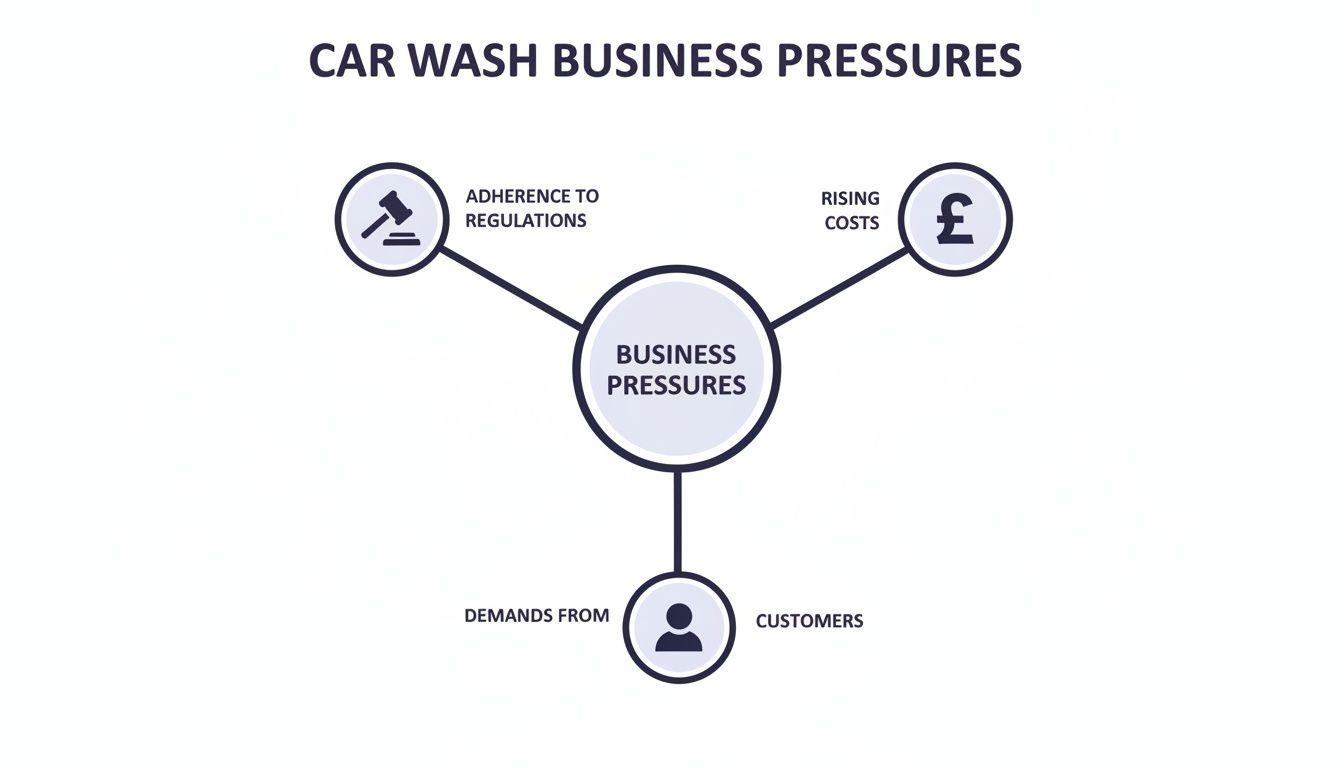
It’s clear how regulations, rising operational costs, and ever-higher customer expectations are all pushing businesses towards better solutions like advanced water filtration.
Water Reclamation: The Ultimate Recycler
Water reclamation is a more involved, multi-stage process designed to clean and reuse wash water. It's the cornerstone of any eco-friendly and cost-conscious operation. Essentially, it’s like having a mini water treatment plant on-site, specifically for your car wash. While individual systems can differ, they generally follow a similar set of steps.
A typical reclamation system involves:
- Collection: Used wash water is gathered in underground tanks.
- Settling: Heavier solids like grit and sludge are given time to sink to the bottom.
- Filtration: The water is then pumped through a series of filters to remove suspended particles, oils, and detergents. To really get a handle on how these work, checking out a guide to micron filters offers a deeper look at the technology.
- Treatment: Finally, the water is often treated to control bacteria and odours before it’s stored for reuse in the first few stages of the wash cycle.
This approach can slash a car wash's water consumption and utility bills. But it's crucial to remember that reclaimed water is only suitable for pre-soaks and high-pressure washing. The final rinse still needs pure water from an RO or DI system to guarantee that spot-free finish customers expect.
A Quick Comparison of Water Filtration Technologies
To help you see how these technologies stack up, we've put together a simple comparison table. This breaks down what each system does and where it shines.
| Technology | How It Works | Removes | Best For | Purity Level (TDS) |
|---|---|---|---|---|
| Reverse Osmosis | Pushes water through a semi-permeable membrane under high pressure, filtering out impurities. | 95-99% of dissolved salts, minerals, and larger contaminants. | General-purpose pure water for all wash cycles; pre-treatment for DI. | Low |
| Deionisation | Uses charged resin beads to attract and swap mineral ions for pure H₂O components. | Virtually all remaining mineral ions, including silica. | The final, spot-free rinse where absolute purity is essential. | Near Zero |
| Reclamation | A multi-stage process of settling, filtering, and treating used wash water. | Dirt, grit, oils, detergents, and larger suspended solids. | Reusing water for pre-soak and initial high-pressure wash cycles. | High (Untreated) |
Ultimately, the right choice often isn't about picking one over the other. Many of the most efficient car washes use a combination of these technologies to get the best results while keeping costs and environmental impact down.
Choosing Between On-Site Systems and On-Demand Services
When you're in the car care game, figuring out your water situation is one of the biggest decisions you'll make. Do you bite the bullet and invest in your own filtration kit, or do you go for the flexibility of a pay-as-you-go service? This isn't just a small choice; it fundamentally shapes your startup costs, your monthly outgoings, and how you run your business day-to-day.
To get it right, you need to be honest about the numbers and the responsibilities that come with each path. Both can get you that perfect, spot-free finish we’re all chasing, but they’re built for very different setups, scales, and budgets.
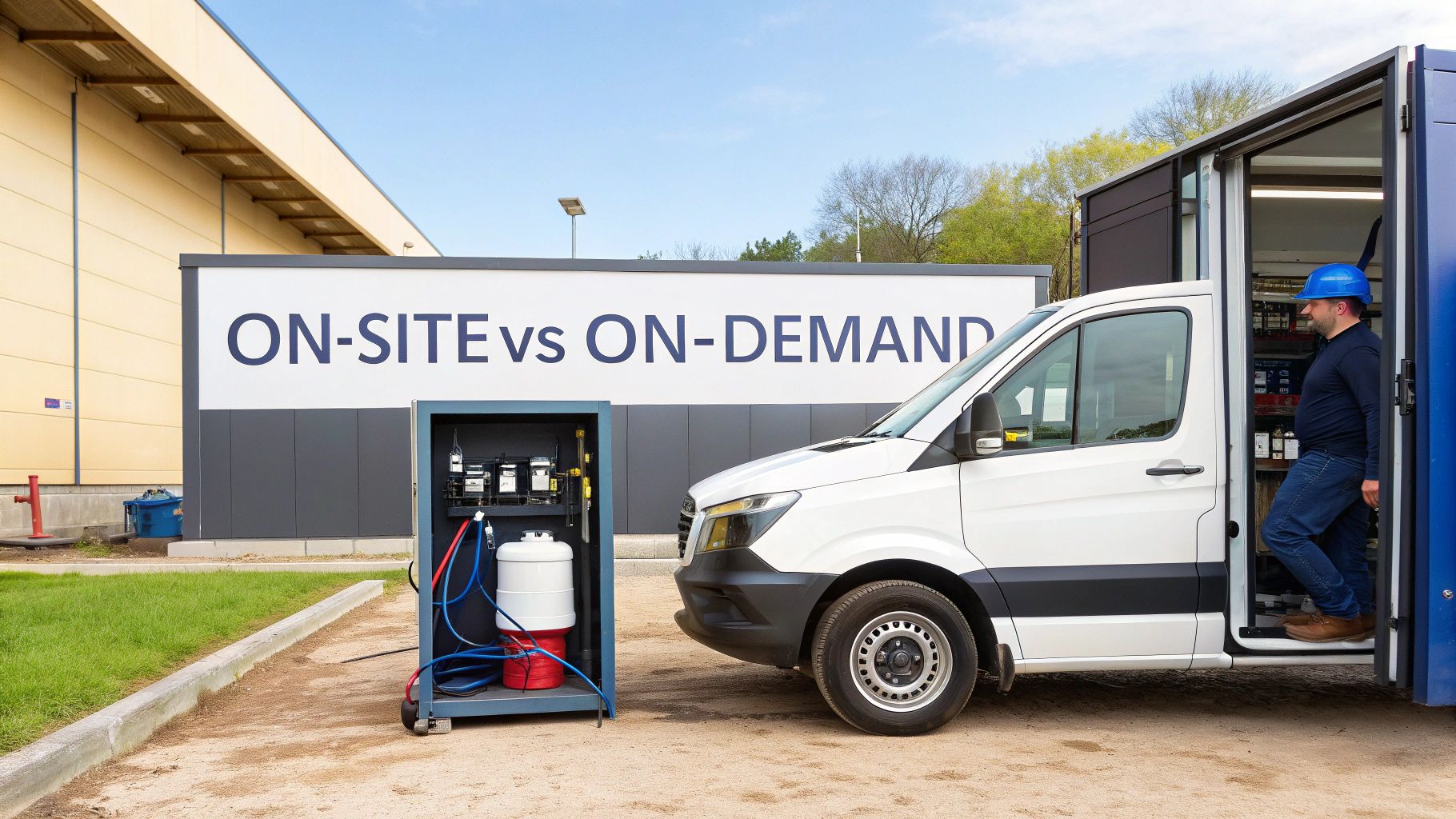
The Realities of Owning an On-Site System
Having your own Reverse Osmosis (RO) or Deionisation (DI) system on-site gives you total control over your water supply. For a busy, fixed-location car wash, that’s a massive plus. But let's be clear: that control comes with some hefty financial and operational baggage.
The initial outlay is the first major hurdle. A professional-grade system can easily set you back several thousand pounds just for the purchase and installation. And that's before you even think about where to put it. For smaller workshops or mobile guys working from home, finding the physical space can be a real headache.
And it’s certainly not a "fit and forget" bit of kit. The ongoing costs are where the true commitment lies.
- Consumable Costs: You’re constantly buying and replacing filters, membranes, and DI resin. These costs creep up, especially if you're busy.
- Time and Labour: Maintenance is a time sink. Someone has to keep an eye on performance, change out the parts, and figure out what’s wrong when it plays up.
- Unexpected Repairs: Like any machine, it will eventually break. A sudden repair bill can throw a spanner in your cash flow and leave you high and dry without pure water.
When you own the filtration gear, you essentially become your own water technician. You're on the hook for everything from the initial setup and routine maintenance to panicked emergency repairs. It adds a whole other layer of complexity to running your business.
The On-Demand Service Alternative
An on-demand service completely flips the script, and it’s a game-changer for mobile valeters, detailers, and smaller businesses. Instead of owning the machinery, you simply pay for the ultra-pure water you need, as and when you need it.
This approach has some seriously compelling perks that directly tackle the headaches of ownership. The biggest win? No massive upfront investment.
With a pay-as-you-go service, there is zero capital outlay. You don’t have to find thousands of pounds for equipment. That cash can go straight back into other crucial parts of your business, like marketing or better tools.
A Direct Comparison of Your Options
To lay it all out, let's put the two models side-by-side.
| Feature | On-Site Filtration System | On-Demand Service (e.g., 24 Pure Water) |
|---|---|---|
| Initial Cost | High (thousands of pounds) | £0 |
| Maintenance | Your responsibility (costly and timely) | None (handled by the service provider) |
| Running Costs | Variable (electricity, consumables, water) | Fixed per-litre price (e.g., 4p per litre) |
| Water Quality | Your responsibility to monitor and maintain | Guaranteed professional-grade purity |
| Accessibility | Limited to your single business location | Nationwide 24/7 access via a network |
| Space Required | Significant physical footprint | None (just space for your water tank) |
For a mobile pro whose van is their office, the on-demand model is almost always the more practical and wallet-friendly choice. You tap into a network of reliable pure water sources without any of the ownership hassles. Services like 24 Pure Water have built a network of 24-hour self-service filling stations, which you can access with a simple app. This means you can top up wherever a job takes you.
This kind of flexibility lets you get on with what you do best—delivering brilliant results for your clients—knowing that the quality of your most important tool, your water, is always taken care of.
Meeting UK Water Regulations and Boosting Your Green Credentials
For any car wash operator in the UK, a sparkling finish is only half the job. You’ve also got to navigate a dense maze of environmental regulations, where a wrong turn can lead to hefty fines and a damaged reputation. This is precisely where modern car wash water filtration and reclamation systems stop being a 'nice-to-have' and become an absolute necessity for staying compliant and showing customers you care.
Let's be clear: managing your water properly isn't just about trimming your utility bills. It's about proving you're a responsible business that's serious about protecting the local environment—a value that more and more of your customers are looking for.
Staying Compliant with UK Environmental Laws
In the UK, the Environment Agency watches business wastewater—or trade effluent—like a hawk. The run-off from a car wash is a chemical cocktail of oils, detergents, road grime, and heavy metals. You simply can't let that flow into surface water drains without a proper permit. It’s illegal, and the penalties can be severe.
It's a similar story if you draw large amounts of water from a source like a borehole, which requires an abstraction licence. A good water reclamation system cuts your reliance on mains water so drastically that it makes staying within legal limits much, much easier.
By installing a water reclamation system, you are taking a proactive step towards meeting your legal obligations. It ensures that the water you discharge (if any) is treated, and it significantly cuts down the amount of fresh water you need to abstract, keeping you on the right side of the regulations.
This isn’t just about dodging legal trouble. It's about positioning your business as a leader in sustainable practices.
The Environmental and Marketing Pay-off
Beyond avoiding fines, smart water management gives you a powerful story to tell. People are more aware than ever of their environmental footprint and are actively choosing to spend their money with businesses that share their values. Your investment in filtration can really start to pay for itself in your marketing.
Advanced closed-loop systems are changing the game for UK car washes, allowing operators to recover up to 95% of their water—a huge leap from the old 75% benchmark. This technology really took off across Europe once regulations were updated to permit recycled water for vehicle washing, a move that massively cut consumption. When you think that a traditional car wash can gulp down as much as 60 gallons of water per vehicle, you can see the enormous impact. For a deeper dive into market trends, check out Technavio's industry analysis.
By putting your green credentials front and centre, you can attract that growing crowd of eco-conscious customers.
Turning Green Practices into Gold
So, how do you translate your environmental commitment into a real business advantage? It’s all about getting the message out there. Weave your sustainable practices into the very fabric of your brand.
Here are a few simple ideas to get you started:
- On-site Signage: Put up clear, bold signs explaining how much water you save. Something like, "We recycle over 90% of our water to protect local rivers" is simple and effective.
- Website and Social Media: Create a page on your website dedicated to your environmental policy. Share updates on social media about your water-saving milestones or your switch to biodegradable soaps.
- Customer Interaction: Get your team comfortable with mentioning your eco-friendly approach. A quick, friendly comment at the point of payment can leave a fantastic lasting impression.
This isn't just about feeling good; it's smart business. When you shout about your commitment to sustainability, you stand out from the competition and build a loyal customer base that's looking for more than just a clean car. They’re looking for a business that cares.
The Science of a Spot-Free Finish
Let's get down to what really matters: how the science of pure water translates into a flawless finish on a car. If you're a professional detailer, you know the pain of finishing a wash only to watch stubborn white spots appear as the vehicle dries. These aren't random marks; they're the ghost of your water source, and understanding where they come from is the first step to getting rid of them for good.
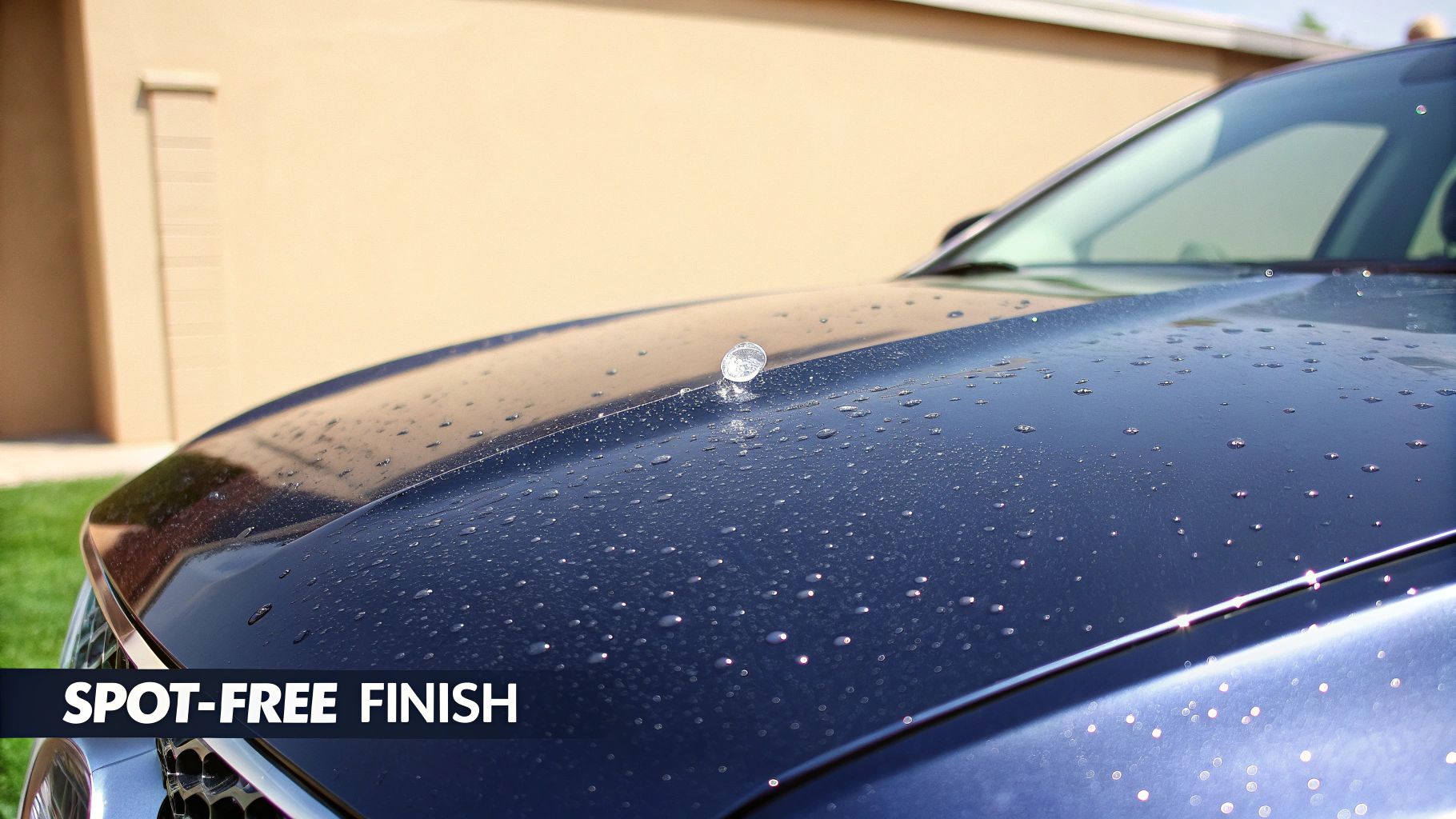
The culprit behind these annoying water spots is just mineral residue. Your standard tap water is full of what we call Total Dissolved Solids (TDS) – mostly minerals like calcium and magnesium. When a drop of this water evaporates from a car's surface, the pure H₂O vanishes into the air, but all those heavier minerals get left behind as a chalky deposit.
Eliminating the Residue Problem Entirely
This is where deionised water becomes your secret weapon. By using a proper car wash water filtration system, you can strip out nearly all of those dissolved solids, producing water with a TDS reading of zero. This ultra-pure water is a completely different beast when it comes to drying.
When you do your final rinse with zero-TDS deionised water, there is literally nothing left to leave a mark. As the water evaporates, it disappears completely. The result? A perfect, streak-free shine on paintwork, glass, and chrome, with no manual drying needed.
For a mobile valeter or detailer, this isn’t just a small improvement; it completely changes your workflow. The time you save by not having to meticulously hand-dry every vehicle is immense, and that time can be spent on the next job, directly boosting your daily earnings.
Of course, the best offence is a good defence. Knowing how to remove hard water stains is a useful skill, but using pure water in the first place prevents them from ever forming.
The Tangible Return on Investment
This scientific edge gives you a clear and measurable return on your investment. When you can guarantee a flawless, spot-free result every single time, you elevate the quality of your service. This lets you confidently position your business at a premium level and charge accordingly.
It also taps directly into what customers want today. The UK car wash market is becoming more environmentally conscious, with a 2023 report showing that over 62% of urban consumers prefer services that use recycled water and eco-friendly products. For detailers, using mineral-free H₂O from a source like 24 Pure Water's network—at just 4p per litre—delivers those streak-free results without harsh chemicals, hitting that green sweet spot for your clients.
By embracing the science of pure water, you’re not just cleaning cars better. You're saving time, increasing your earning potential, and building a reputation for a quality finish that will set you leagues apart from the competition.
Your Checklist for Choosing the Right Water Solution
Deciding on the best water strategy for your car wash comes down to one thing: being honest about what your business actually needs. There’s no magic bullet here. The right choice for a bustling tunnel wash is miles apart from what a mobile valeter needs to get the job done.
This checklist is designed to walk you through the key questions, helping you find that perfect fit. By working through these points, you can line up the reality of your day-to-day operations with the most logical and profitable water solution. It's all about making the technology fit your business model, not forcing your business to fit the technology.
Analysing Your Business Model
First things first, let's look at the very nature of your operation. Your daily workflow and physical setup are the biggest clues as to whether an on-site system or an on-demand service makes the most sense.
Are you a fixed-site or mobile operator? If you’ve got a permanent spot, installing your own system is definitely on the table. But for mobile valeters and detailers, the sheer flexibility of a pay-as-you-go service like 24 Pure Water is almost always the smarter, more practical move. It completely removes the hassle of lugging heavy, cumbersome equipment from job to job.
What is your daily wash volume? A high-volume automatic wash that sees hundreds of cars a day could well justify the hefty investment in a full-scale water reclamation and RO system. On the flip side, a detailer focused on two or three premium jobs a day will find an on-demand pure water source infinitely more cost-effective.
Evaluating Resources and Commitment
Next up, it’s time for a reality check on your resources—and I’m not just talking about money. Think about your available space and, crucially, your time. A filtration system isn't a one-off purchase; it’s an ongoing operational commitment you need to be ready for.
Choosing your water solution is a strategic business decision. It directly impacts your initial capital expenditure, ongoing operational costs, and the amount of time you can dedicate to your core service versus system maintenance.
Think long and hard about these questions before you part with a single penny:
Do you have the capital and space? On-site systems demand a significant upfront investment, often running into thousands of pounds, and that’s before you find a dedicated, secure spot to install it. If cash is tight or you're short on space, this can be an immediate non-starter.
How much time can you realistically dedicate to maintenance? Owning a system means you’re on the hook for everything—monitoring performance, changing filters, swapping out resin, and troubleshooting every little problem that pops up. You have to ask yourself: do you genuinely have the time and technical know-how for all that, or is your time better spent actually serving customers?
If your answers are leaning towards limited capital, tight space, and a strong desire to avoid maintenance headaches, then an on-demand service is the clear winner. It gives you access to guaranteed ultra-pure water with zero capital outlay and no maintenance duties whatsoever, freeing you up to focus entirely on growing your business and delivering those flawless, spot-free results.
Your Questions Answered: Car Wash Water Filtration
Getting into the weeds of water filtration can spark a lot of questions. Let's tackle some of the most common ones I hear from car wash operators and detailers to help you figure out the best path for your business.
What Are Total Dissolved Solids and Why Do They Matter?
Think of Total Dissolved Solids (TDS) as all the invisible stuff dissolved in your tap water – mainly minerals like calcium and magnesium. For car washing, high TDS is public enemy number one because it’s the direct cause of those annoying water spots.
When a drop of ordinary tap water dries on a car's paintwork, the water evaporates but leaves those mineral deposits behind. That's your water spot. By using ultra-pure, deionised water with a TDS reading of 0, there's nothing left to leave behind. The water just disappears, giving you a flawless, spot-free finish without ever needing to touch the car with a drying towel.
Is Installing My Own Filtration System Cheaper in the Long Run?
It's a tempting thought, but owning a system often comes with a sting in the tail. The initial outlay for purchase and installation can easily run into thousands of pounds. But the real costs are the ones that creep up on you.
You've got the ongoing expense of replacing filters and membranes, the electricity to run the system, and significant water wastage—especially with RO systems that can pour a lot of brine down the drain. For most mobile detailers and smaller businesses, a pay-as-you-go service ends up being far more economical. You completely sidestep the huge initial investment, maintenance headaches, and all those hidden running costs.
For a deeper understanding of filtration, our FAQs page covers a wide range of topics that can help clarify your options and the technology behind them.
Can I Use Recycled Water for the Final Rinse?
I wouldn't recommend it. Water reclamation systems are fantastic for the environment and great for pre-washes or the main wash cycle, but they just aren't designed to get rid of the microscopic dissolved minerals that lead to spotting.
To guarantee that perfect, streak-free finish, the final rinse absolutely must be done with ultra-pure water from a Deionisation (DI) or Reverse Osmosis (RO) system. A common and very effective strategy is to use recycled water for the heavy lifting and then switch to pure water for that crucial final rinse.
How Do I Find a Reliable Pure Water Source Near Me?
When you're mobile, you need a reliable source you can count on, wherever the job takes you. By far the easiest way to solve this is to tap into a dedicated network of self-service filling stations.
Services like 24 Pure Water offer a UK-wide network of stations that are open 24/7. Everything is run through a simple mobile app that shows you the nearest station, lets you manage your account, and gives you instant access to pure, deionised water whenever you need it. It takes the guesswork out of the equation.
Ready to stop worrying about water quality and focus on delivering flawless results? Join the 24 Pure Water network today and gain 24/7 access to ultra-pure water across the UK. Sign up now at https://24purewater.co.uk and see the difference for yourself.