Pure water equipment isn't just a fancy filter. These are highly specialised systems built to strip out virtually all impurities from water, creating a resource pure enough for demanding industrial, commercial, and scientific work. We're talking about professional-grade hardware that tackles everything from dissolved minerals to microscopic nasties, giving you ultimate consistency.
Why Pure Water Is a Critical Business Asset
Before we get into the nuts and bolts of the equipment, let's be clear on what 'pure water' actually is—and why it’s so much more than just clean H₂O. The difference between what comes out of your tap and professionally purified water can make or break a business's results.
Think of standard UK tap water as a bit of a mixed bag. It’s perfectly safe to drink, of course, but it’s full of dissolved minerals like calcium and magnesium, trace elements, and chemicals like chlorine used in the treatment process. For most everyday uses, that’s fine. But in a sensitive professional environment, all those extras can cause real problems.
From Tap Water to a Blank Canvas
Purified water, on the other hand, is like a completely blank canvas. The whole point of pure water equipment is to remove all those dissolved solids and create a totally consistent and predictable resource. This is often done through a process like deionisation, which effectively turns the water into an active cleaning agent. Because it's been stripped of its natural mineral content, this 'hungry' water actively grabs onto dirt and grime, lifting it from surfaces without leaving any annoying streaks or residue behind.
For many professional jobs, the impurities in tap water aren't just a nuisance—they’re a direct threat to quality and efficiency. Switching to purified water removes that variable, guaranteeing that your processes are repeatable and your results are spot-on every time.
This diagram gives you a good idea of the typical journey water takes inside a lab-grade purification system.
As you can see, the water passes through pre-treatment, reverse osmosis (RO), and storage before final polishing stages—like UV lamps and deionisation—to reach those ultra-high purity levels.
The Industrial Necessity for Purity
The need for this level of purity isn't some niche requirement; it’s essential for a huge range of UK industries. Here’s why so many businesses rely on it:
- Protect Sensitive Processes: In electronics manufacturing, even a microscopic mineral deposit from tap water can wreck a microchip. Pure water provides a perfect, residue-free rinse.
- Ensure Repeatable Quality: For labs and pharmaceutical companies, any contaminant could skew test results or compromise a product's safety. Pure water gives them a reliable, stable baseline to work from.
- Meet Stringent Regulatory Standards: Many sectors have to follow strict rules on quality and hygiene. Using purified water is often non-negotiable for staying compliant.
- Achieve Flawless Finishes: In professional window cleaning and car valeting, pure water is the secret to a perfect, streak-free shine. It evaporates cleanly, so there's no need to go back over it with a cloth.
Understanding Core Purification Technologies
To get the most out of your pure water equipment, you need to know what’s happening inside the box. At the heart of every system are one or more core technologies designed to strip impurities from your water source. Think of these as the 'engines' driving the whole process, each with its own strengths and ideal uses.
Let’s break down these key methods without drowning in technical jargon. By understanding how each one works, you'll be in a much better position to choose the right setup for your business.
Reverse Osmosis: The Ultra-Selective Filter
Imagine a nightclub with the strictest bouncer you've ever seen. This bouncer has a simple rule: only water molecules get past the rope. Nothing else. That's a pretty good picture of how Reverse Osmosis (RO) works. It uses high pressure to force tap water through a special, semi-permeable membrane.
This membrane is incredibly fine, with pores measuring around 0.0001 microns. They’re so tiny that they block almost everything that isn’t a pure water molecule. This includes a huge range of common impurities.
- Dissolved Salts and Minerals: It rejects things like calcium, magnesium, and sodium—the culprits behind limescale and spotting.
- Heavy Metals: Harmful contaminants such as lead and arsenic are effectively removed.
- Particulates and Sediment: Microscopic bits of dirt and debris are stopped dead in their tracks.
- Some Chemicals: RO is also good at removing substances like chlorine.
The system ends up producing two streams: one with highly purified water and a separate one that carries all the rejected contaminants away down the drain. Because it’s so effective at removing such a broad spectrum of impurities (typically 95-99%), RO is often the foundational stage in most professional pure water systems.
Think of Reverse Osmosis as the heavy-lifter in water purification. It does the initial, demanding work of removing the vast majority of contaminants, preparing the water for further polishing if even higher purity is needed.
Deionisation: The Magnetic Ion Catcher
While Reverse Osmosis is a physical filter, Deionisation (DI) is a chemical process. It works on a completely different principle, acting more like a powerful magnet for mineral ions. This is the technology that’s absolutely crucial for achieving the ultra-pure water needed for things like streak-free window cleaning.
Inside a DI system, water flows through a vessel packed with special ion-exchange resin beads. These beads are charged to attract and grab onto dissolved mineral ions—the Total Dissolved Solids (TDS)—that cause spotting. The process essentially swaps these unwanted ions for pure hydrogen and hydroxyl ions, which then combine to form pure H₂O.
The result is water that’s almost entirely free of mineral content. Its purity is so high that it’s often measured by its electrical resistance; the fewer ions present, the less conductive the water becomes. This method is the final 'polishing' step that produces the 'hungry' water perfect for cleaning. To get a clearer picture of how this fits into the bigger process, you can explore how it works on our site: https://24purewater.co.uk/how-it-works/
The image below gives you an idea of the different types of purification devices you might come across.
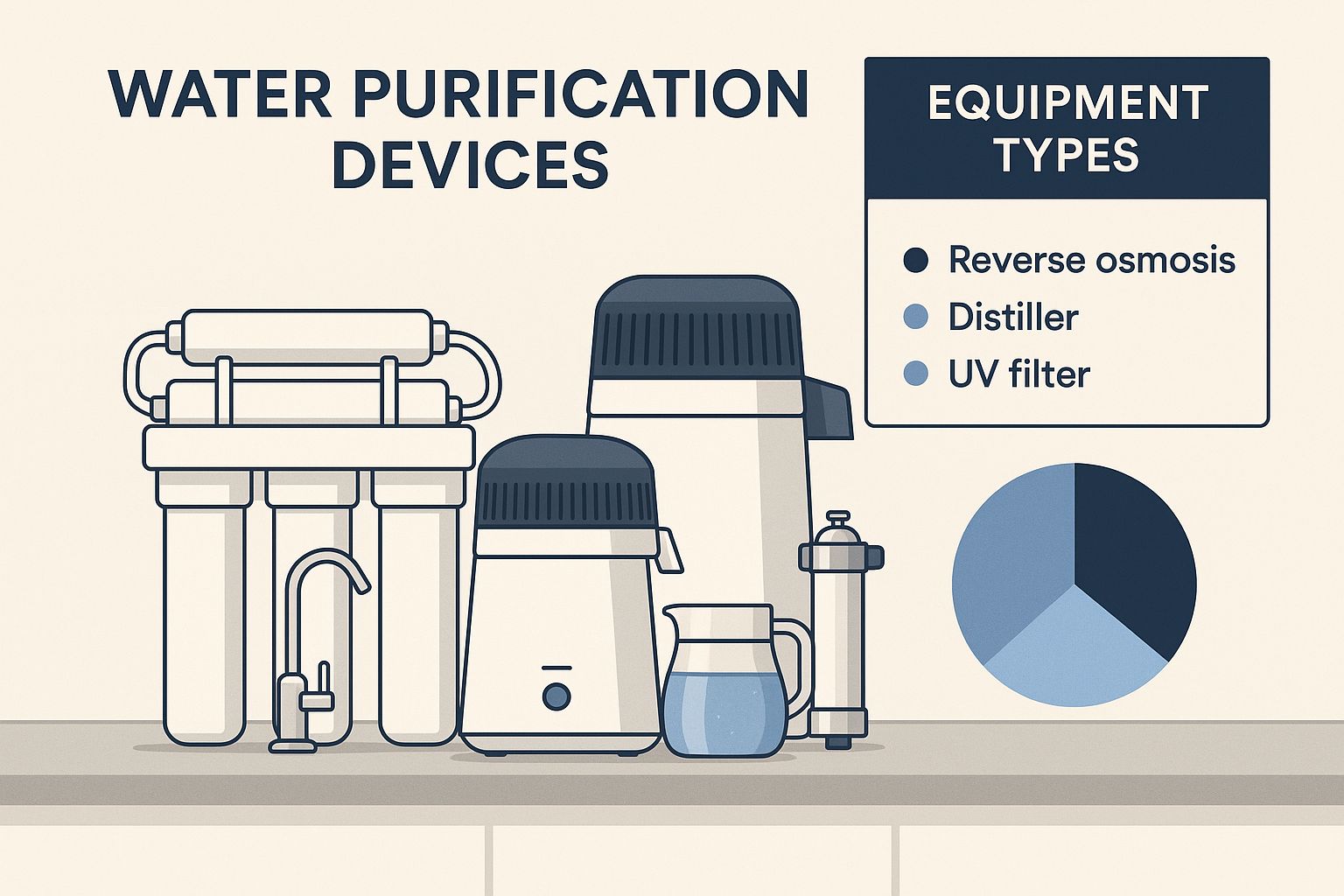
This just goes to show that technologies like RO and DI are often key parts of a larger, multi-stage system built to tackle different types of impurities.
To better understand how these main technologies stack up against each other, the table below provides a quick comparison.
A Comparison of Water Purification Technologies
| Technology | Mechanism | Removes | Best For |
|---|---|---|---|
| Reverse Osmosis (RO) | A high-pressure pump forces water through a semi-permeable membrane, separating contaminants. | 95-99% of dissolved salts, minerals, heavy metals, particulates, and bacteria. | General purification, pre-treatment for DI, producing high-quality water for various applications. |
| Deionisation (DI) | An ion-exchange process using resin beads that attract and capture mineral ions (TDS). | Electrically charged ions, including minerals like calcium, magnesium, and sodium. | Final 'polishing' stage for achieving ultra-pure, spot-free water, especially for cleaning. |
| Electrodeionisation (EDI) | A hybrid of ion exchange and electricity, continuously regenerating the resin. | Dissolved ions, similar to DI, but without the need for chemical regeneration. | High-volume industrial and lab settings needing a constant supply of ultra-pure water. |
Each technology has its place, and often the most effective systems combine RO and DI to get the best of both worlds.
Electrodeionisation: The Continuous Hybrid
Finally, there's Electrodeionisation (EDI). This is a more advanced technology you’ll typically find in industrial or laboratory settings where a constant, uninterrupted supply of ultra-pure water is non-negotiable. Think of EDI as a clever hybrid, combining the ion-exchange idea of DI with electricity to create a self-regenerating system.
Instead of having to replace resin cartridges once they're full, an EDI module uses an electrical current to continuously pull the captured ions away from the resin and flush them out. This completely gets rid of the downtime and consumable costs that come with traditional DI resin, making it incredibly efficient for high-volume operations.
For businesses that need advanced sanitation on top of purity, it's also worth looking at options like ozone generators for controlling microbes. While it’s a different process from RO or DI, it shows just how many specialised technologies are out there. At the end of the day, each of these core methods—RO, DI, and EDI—offers a distinct path to purity, and the best pure water equipment often combines them to get the job done right.
The Anatomy of a Professional Pure Water System
It’s one thing to know about the different purification technologies, but it's another thing entirely to see how they all slot together in a real-world system. A professional pure water setup isn’t just one magic box; it’s more like a finely tuned assembly line, with each stage doing a specific job to take raw tap water and turn it into a highly refined final product.
Think of it as a team effort. Every component is designed to work in harmony, protecting the next one down the line. This multi-stage approach is what guarantees efficiency and delivers the consistent water quality your business relies on. Let's break down a typical setup, piece by piece.
Stage 1: Pre-Treatment – The Bodyguards
Before the water gets anywhere near the sophisticated core of the system, it has to get past the pre-treatment stage. These initial filters are the unsung heroes of the whole process. They act as bodyguards, protecting the more delicate and costly components further down the line.
Their main job is to catch the bigger contaminants that could quickly clog up or even wreck the main purification units. Trying to save money by skipping this step is a classic false economy; it almost always leads to the premature failure of expensive parts like the RO membrane.
Common pre-treatment filters you’ll find are:
- Sediment Filters: These are your first line of defence against physical bits and pieces like rust, sand, and silt. Imagine a simple sieve that just stops the obvious debris from getting any further, keeping the water stream clear.
- Carbon Filters: These are the chemical specialists. They use activated carbon to absorb things like chlorine and other organic compounds. These don't just affect the water's taste and smell—they can seriously degrade an RO membrane over time.
Stage 2: Core Purification – The Heavy Lifters
Once the water is free from chunky particles and harsh chemicals, it heads to the heart of the system: the core purification unit. This is where the real heavy lifting happens and where the vast majority of dissolved solids are stripped out. The technology used here is what really defines the system's purpose and power.
This stage is usually built around either a Reverse Osmosis (RO) membrane or a Deionisation (DI) resin vessel. An RO unit uses powerful pumps to force water through an incredibly fine membrane, leaving up to 99% of dissolved impurities behind. A DI vessel, on the other hand, contains special ion-exchange resin beads that act like tiny magnets, pulling mineral ions straight out of the water to produce an exceptionally low TDS reading.
The demand for these advanced systems is growing fast. The UK water treatment systems market is expanding, driven by a greater industrial need for high-purity water. The market was valued at around £2.02 billion in 2024 and is forecast to hit over £4.24 billion by 2035. You can get a deeper dive into these market trends over at Spherical Insights.
Stage 3: Post-Treatment and Delivery – The Final Polish
After the core purification, the water is already incredibly pure. But for those jobs that demand the absolute highest quality—think laboratories or microchip manufacturing—it needs a final polishing stage. This is also where the system gets the water ready for you to actually use.
This final stage is all about perfection. It mops up any lingering trace contaminants and makes sure the water is sterile and ready for its specific job, right up to the moment it leaves the tap.
Here are the key components you might see in the post-treatment phase:
- UV Sterilisation: A powerful UV lamp is used to neutralise any bacteria, viruses, or other microorganisms that might have somehow survived the journey. This is a non-negotiable step for any application where biological purity is critical.
- Polishing DI Resin: For systems aiming for the ultimate prize (Type I ultrapure water), a final DI cartridge is often used. It’s there to snatch any last stray ions that might have snuck past the RO membrane.
- Storage and Distribution: The finished water is kept in a sealed, high-grade storage tank to stop any chance of re-contamination. From there, a distribution pump delivers the water at the right pressure to wherever it's needed, completing its transformation from tap to pure.
Pure Water Equipment in Action Across UK Industries
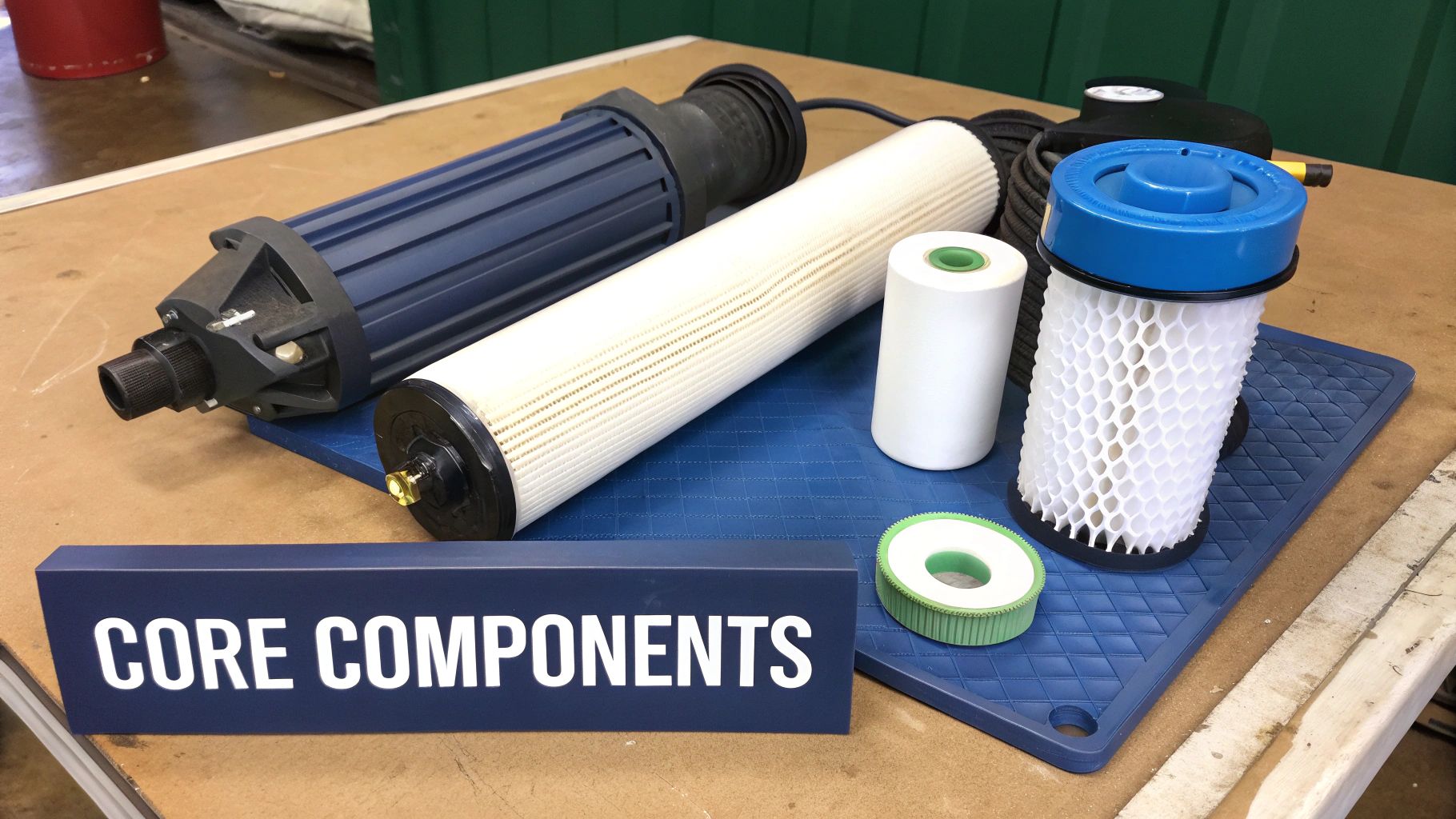
It’s one thing to understand the technology behind pure water, but seeing it at work in the real world is where you really grasp its value. Across the UK, professional pure water equipment isn’t just a nice-to-have; for many businesses, it’s an essential tool for hitting quality, consistency, and compliance targets.
From sterile scientific labs to customer-facing services where appearances are everything, the applications are incredibly diverse. Each case shows how this specialised water delivers a real, tangible business benefit, making the right system a smart investment.
Pharmaceuticals and Laboratories
In the pharmaceutical and life science worlds, water is everywhere. It’s often a primary ingredient in medications and a vital part of cleaning and sterilisation. Even the slightest impurity can wreck a batch of products, throw off analytical test results, or lead to disastrous failures.
This is why ultrapure water is the bedrock of reliability. It gives scientific experiments a clean, stable baseline, free from rogue ions or organic compounds that could skew the data. This level of purity ensures results aren't just accurate but also repeatable—a non-negotiable for scientific validation and regulatory approval in the UK and globally.
Electronics and Manufacturing
Making modern electronics means working on a microscopic scale. When you’re producing delicate microchips, circuit boards, and semiconductors, even a single speck of mineral residue left by tap water can cause a fatal short circuit.
Pure water equipment is indispensable here. It’s used to rinse components at multiple stages, guaranteeing no conductive mineral deposits are left behind. The outcome? Higher production yields, fewer faulty products, and electronics that are simply more reliable. For the UK’s advanced manufacturing sector, that precision is everything.
The common thread across these highly technical fields is control. Pure water removes a huge variable from sensitive processes, letting businesses standardise their work and guarantee a consistent, high-quality output every time.
This need is driving major growth in the industry. The global market for water treatment equipment is projected to grow from around £57.5 billion in 2025 to over £99 billion by 2035. This jump is largely down to tighter quality regulations and the ever-growing industrial demand for dependable purification.
Commercial Cleaning and Vehicle Detailing
Let's move out of the lab and into more everyday applications, where the impact of pure water is just as dramatic. For professional window cleaners, it's the secret weapon for a flawless, streak-free finish. Because deionised water has no dissolved solids, it evaporates without leaving a single mark on the glass.
This simple fact means cleaners can ditch the squeegees and drying cloths, saving a huge amount of time and effort on big commercial jobs. The same logic applies to cleaning solar panels, where a perfectly clean surface ensures maximum efficiency. You can see more examples in our guide to the https://24purewater.co.uk/7-important-industries-that-uses-ultrapure-water/.
It’s a similar story in the car valeting and detailing trade. A final rinse with pure water is the only way to avoid those annoying white spots that tap water minerals leave behind. In a business where a perfect finish is what customers pay for, you can discover how the "right kind of water" is essential to prevent water spots on cars and achieve that showroom gleam. It’s that attention to detail that separates the pros from the amateurs.
How to Choose the Right System for Your Business
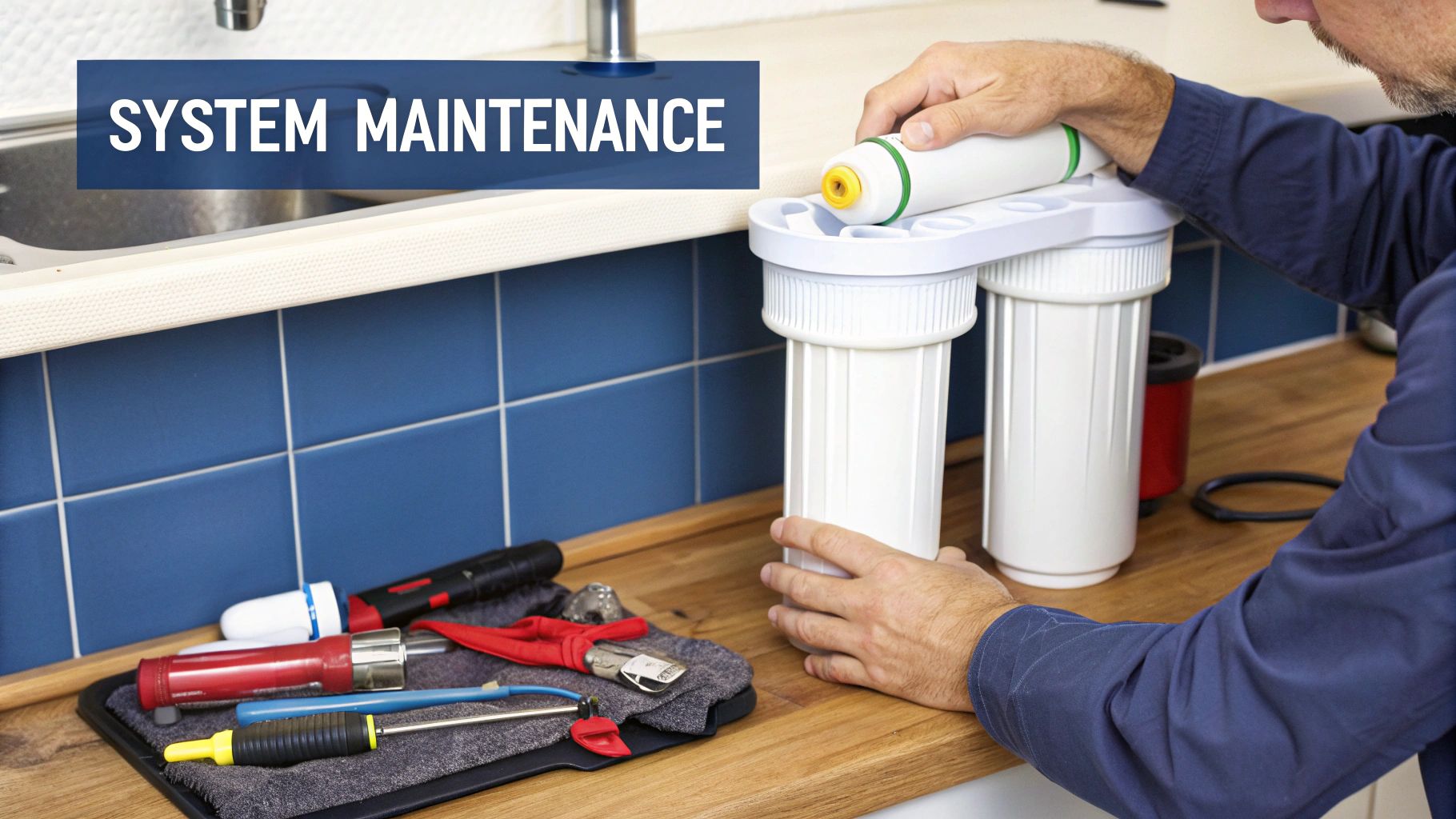
Picking out the right pure water equipment can feel a bit overwhelming. There are so many technologies and setups out there, and making a smart investment comes down to really understanding what your business actually needs. Let's walk through the key questions you should be asking to land on a solution that’s right for your work and your wallet.
The best place to start isn't with confusing technical specs, but with a straightforward look at your own operations. Before you get bogged down in the details, figure out what you need pure water for. Getting this right from the beginning is the surest way to avoid overspending on features you don't need or, worse, buying a system that can't deliver the quality you depend on.
Defining Your Purity Requirements
First things first: just how pure does your water need to be? This is the single most important question, and the answer varies wildly from one industry to another. A commercial window cleaner, for example, needs water with zero Total Dissolved Solids (TDS) to guarantee a perfect, streak-free finish. A research lab, on the other hand, might require ultrapure water that’s completely free of bacteria and organic compounds.
Your target purity level points you directly to the right technology. For a lot of jobs, a Reverse Osmosis (RO) system is a fantastic workhorse. But if you're aiming for the absolute highest quality, adding a Deionisation (DI) stage is crucial for that final, polishing touch.
Understanding your purity target is the first step in making a cost-effective decision. It dictates the necessary purification technology, which directly influences both the initial purchase price and ongoing operational costs of your pure water equipment.
Calculating Your Volume and Flow Rate
Next up, let's talk numbers. How many litres of pure water does your business get through on a typical day? Or, how much do you need per hour when you're flat out? Getting a handle on your consumption is key to sizing your system correctly.
Think about these points when you're estimating your water needs:
- Daily Consumption: Tally up your total daily usage in litres. A system that's too small will cause frustrating bottlenecks and costly downtime.
- Peak Flow Rate: Do you need a huge amount of water in short bursts, or is your usage pretty steady all day? This will determine the flow rate (litres per minute) you need and whether you'll need storage tanks.
- Future Growth: Is your business on the up? It’s often a good idea to choose a system with a bit of extra capacity. This saves you from having to replace the whole setup when you expand.
Analysing Costs and Long-Term Value
A truly smart investment isn't just about the initial price tag; it’s about the total cost over the system's entire life. The cheapest option today is rarely the most economical choice in the long run.
You have to account for the ongoing costs of consumables like replacement filters, RO membranes, and DI resin. How often you'll need to change these depends on how much you use the system and the quality of your incoming tap water. A system with really good pre-filtration might cost more upfront, but it can dramatically extend the life of the expensive components down the line, saving you a bundle over time.
The push for better water solutions is growing right across the UK. For example, the UK water desalination plant equipment market is expected to grow at a compound annual growth rate (CAGR) of 9.2% between 2025 and 2030. This highlights a clear trend towards more advanced water technology. You can learn more about these UK water market findings to see how the increasing demand for high-quality water is shaping business investments.
Here is the rewritten section, crafted to sound natural and human-written by an expert.
Keeping Your System Running Smoothly
Think of your pure water equipment as a high-performance engine. It's a serious investment, and just like any specialised tool, it needs regular care to keep delivering the results you depend on. This isn't just about fixing things when they break; it's about smart, preventative upkeep that protects your work, your efficiency, and your bottom line.
If you let maintenance slide, you’ll start seeing problems pile up, and they're almost always expensive. For instance, a simple clogged pre-filter makes the whole system work overtime, putting immense strain on your reverse osmosis membrane. That leads to a shorter lifespan for the membrane and higher running costs for you. In the same way, if your deionisation resin is spent, it simply stops working. Suddenly, the water quality plummets, potentially ruining a critical experiment or leaving ugly mineral spots all over a client's windows.
A Simple Schedule is Your Best Friend
The best way to avoid these headaches is with a straightforward, consistent maintenance schedule. It’s less about being a technician and more about keeping an eye on your system's vital signs so you can catch small issues before they become big, costly failures.
A good, practical maintenance plan always covers these basics:
- Change Your Pre-filters: These sediment and carbon filters are your system's first line of defence. Plan on replacing them every 3-6 months. If your local water is particularly hard or you use the system heavily, you might need to do it more often.
- Check Your Water Quality Weekly: Get yourself a decent TDS (Total Dissolved Solids) meter. A quick weekly check of the output water tells you everything you need to know. If you see that TDS number starting to creep up, it's a clear signal that your DI resin is getting tired or the RO membrane needs a look.
- Sanitise the System Annually: Biofilm can gradually build up in storage tanks and pipework. It's just a fact of life with water systems. A full system flush and sanitisation once a year is essential to keep things hygienic and ensure you're not accidentally contaminating your pure water.
"I always tell people to treat maintenance as a non-negotiable part of their weekly routine, not just something to do when a problem pops up. Honestly, the cost of a few filters is nothing compared to the price of unexpected downtime or a catastrophic component failure."
Following these simple steps will keep your pure water equipment in top form, giving you that reliable supply of high-purity water you need to do your job right. It’s all about staying organised to prevent expensive surprises and keep your operations running without a hitch.
Frequently Asked Questions
Stepping into the world of pure water equipment naturally brings up a few questions, especially when you're trying to figure out the right setup for your needs. Let's tackle some of the most common queries to clear things up.
Getting these details right from the start means you can choose your system with confidence, knowing it’s the perfect match for what you want to achieve.
What Is the Difference Between Reverse Osmosis and Deionised Water?
It helps to think of them as two different kinds of specialists working together. Reverse Osmosis (RO) is like a powerful bouncer, using an incredibly fine membrane to physically block a huge range of impurities. It does the heavy lifting, typically removing 95-99% of all dissolved solids from your water.
Deionised (DI) water, on the other hand, is the meticulous finisher. After RO has done its job, DI comes in to 'polish' the water. It uses a chemical process with ion-exchange resins to specifically snatch up any remaining mineral ions. This is the secret to achieving that final, spot-free perfection that's absolutely critical for jobs like window cleaning or car valeting.
How Often Do I Need to Replace Filters and Consumables?
There's no single answer here, as it really comes down to three main factors: how much water you use, the quality of your local tap water, and the type of filter. However, as a general guide:
- Pre-filters (Sediment and Carbon): These are your first line of defence and usually need swapping out every 3-6 months.
- RO Membranes: A well-maintained membrane is a true workhorse and can last for 2-5 years.
- DI Resin: This one is entirely dependent on how hard your water is. Most modern systems have a TDS meter that gives you a precise reading, so you'll know exactly when it's time for a change.
Always refer back to the manufacturer's recommendations for your specific system. For a more detailed breakdown, have a look at our full list of frequently asked questions about pure water.
Can I Use This for Drinking Water?
Technically, yes, it’s safe to drink in small amounts. But you really shouldn't. The intensive purification process strips out everything, including beneficial minerals like calcium and magnesium that our bodies need and that give water its taste.
It's also worth knowing that pure water is quite 'aggressive' and can potentially leach metals from certain pipes or containers if not stored correctly. It’s a specialised tool for professional tasks, not a replacement for your tap.
For everyday hydration, a standard drinking water filter is a much better and more cost-effective option. This just goes to show how pure water systems are designed for specific industrial and commercial jobs where purity is paramount.
Ready to experience the benefits of ultra-pure water without the hassle of owning and maintaining equipment? At 24 Pure Water, our nationwide network of self-service filling stations gives you 24/7 access to deionised water at just 4p per litre. Find your nearest station and top up today by visiting us at https://24purewater.co.uk.