Ever wondered how professional window cleaners get that perfect, streak-free finish every single time? The secret isn't some magic spray; it's the water itself. A professional pure water system is the engine behind that flawless shine, taking ordinary tap water and stripping it down to its purest form.
Think of your tap water as a cup of tea. It's mostly water, but it's also got tea leaves, maybe some milk and sugar dissolved in it. A pure water system is like a microscopic strainer that removes everything but the water, leaving behind nothing but H₂O.
What Makes Water Pure for Professional Use?
To really get why pure water is so effective, you first have to understand what’s in your everyday tap water. Straight from the tap, UK water is perfectly safe to drink, but it's packed with dissolved minerals like calcium and magnesium, plus a bit of chlorine to keep it clean. These are what we call Total Dissolved Solids (TDS).
When that water dries on a surface—like a window or a car's paintwork—the H₂O evaporates, but all those minerals get left behind. The result? Those frustrating white spots and streaks that ruin an otherwise perfect job.
A pure water system is designed to solve this exact problem. By filtering out virtually all of those dissolved solids, it produces water that’s hungry to get back to its natural, impure state. This 'hungry' water actively pulls dirt, grime, and dust off surfaces without needing any chemical detergents. It's a natural cleaning powerhouse.
Measuring Purity with a TDS Meter
In the professional cleaning world, we measure water purity by its TDS level, in parts per million (ppm). A simple handheld TDS meter checks the water's electrical conductivity—the more minerals in the water, the more conductive it is, and the higher the ppm reading.
Here’s a quick comparison to put it into perspective:
Tap Water vs Pure Water at a Glance
| Characteristic | Typical UK Tap Water | Professionally Purified Water |
|---|---|---|
| TDS Reading (ppm) | 100 – 400+ ppm | 0 ppm |
| Mineral Content | High (Calcium, Magnesium) | Virtually non-existent |
| Cleaning Ability | Leaves mineral spots | Acts as a natural solvent |
| Drying Result | Streaks and watermarks | Spotless, streak-free finish |
As you can see, the goal for any professional is to hit that magic number: 0 ppm.
Hitting 0 ppm is the gold standard. This ultra-pure, demineralised water not only cleans brilliantly but also dries to a crystal-clear finish. It’s a complete game-changer for window cleaners, car valeters, and anyone maintaining solar panels.
This is why systems like pure water waterfed pole washing are so incredibly effective. They feed this 0 ppm water directly up a pole to a brush head, allowing operators to scrub and rinse windows from the safety of the ground, knowing the glass will dry perfectly without a squeegee in sight. It saves time, delivers better results, and is far safer than balancing on a ladder.
How Water Purification Technologies Actually Work
Getting tap water down to that perfect 0 ppm professional standard isn't magic; it's all about advanced filtration. While there are a few ways to do it, the industry really leans on two powerhouse technologies: Reverse Osmosis (RO) and Deionisation (DI). Getting your head around how these two very different processes work is the key to understanding why a professional system is so effective.
Think of them as a one-two punch for impurities. Reverse osmosis does the heavy lifting, acting like a physical gatekeeper, while deionisation is the finisher, working more like a chemical magnet. Most high-end systems use them in sequence to get that flawless, streak-free result.
This diagram shows the basic idea—turning mineral-loaded tap water into the pure stuff.
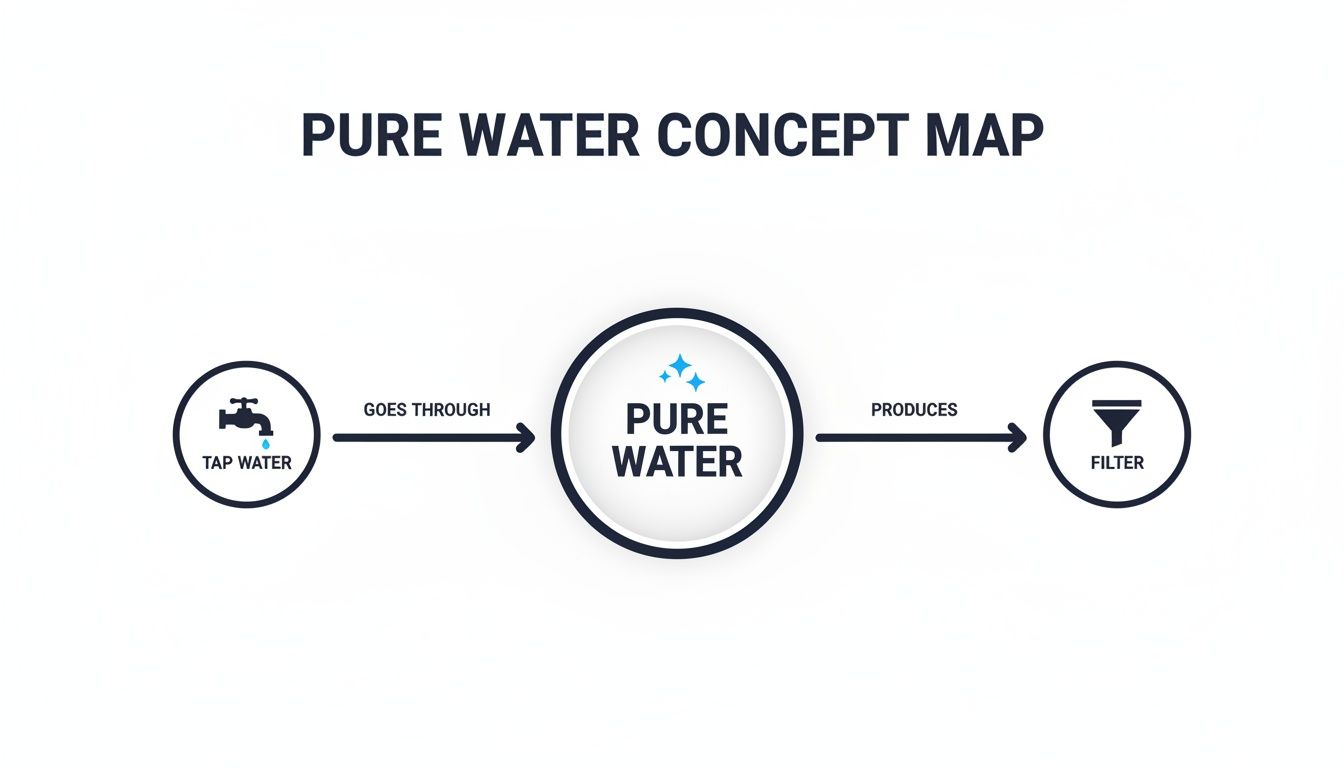
It’s a simple concept, really. An effective filtration process is the only thing standing between spotty tap water and perfectly pure water.
Reverse Osmosis: The Microscopic Sieve
Imagine you're trying to push muddy water through a coffee filter. The water gets through, but the grit and mud stay behind. Reverse Osmosis (RO) is based on the exact same idea, just on an incredibly small, molecular level.
An RO system uses pressure to force tap water against a semi-permeable membrane. This isn't just any filter; its pores are so tiny that only water molecules (H₂O) can squeeze through. All the larger dissolved minerals, salts, and other contaminants are physically blocked and left behind.
- What goes in: Pressurised tap water, full of minerals.
- What happens: The water is pushed through the RO membrane.
- What comes out: Two streams are produced. One is purified water, and the other is a concentrated waste stream (called brine) that carries away all the rejected minerals.
This method is a real workhorse, capable of removing up to 98% of all dissolved solids from your water. For most setups, the RO stage is the primary filter that does the bulk of the purification. If you're curious about the specifics of our setups, you can see more on how it works at 24 Pure Water.
Deionisation: The Magnetic Sponge
RO is brilliant, but it’s not always perfect. A few pesky ions can sometimes sneak through. That's where Deionisation (DI) steps in to polish the water to absolute perfection. It’s best to think of DI resin as a kind of magnetic sponge that’s incredibly hungry for any leftover mineral ions.
A DI tank or vessel is filled with tiny resin beads that hold an electrical charge. As the almost-pure water from the RO system passes over them, any remaining charged mineral ions (like calcium or magnesium) get stuck to the beads like iron filings to a magnet.
It's a clever swap, really. This ion exchange process grabs the unwanted mineral ions and, in their place, releases harmless hydrogen and hydroxide ions. These two instantly combine to form a pure water molecule (H₂O), effectively trading the 'bad' ions for neutral ones.
For jobs where absolutely no compromise is allowed, a mixed-bed DI system is the tool of choice. This combines two different types of resin—one for positive ions and another for negative ions—to make sure nothing gets through. This is the final, crucial step that takes the water from nearly pure all the way down to an absolute 0 ppm TDS. It's this level of purity that makes things like deionized water for car wash perfection possible, guaranteeing a finish with zero spots.
Who Actually Benefits from Using Pure Water?
The science behind a professional pure water system is fascinating, but where you really see its value is in the flawless results it delivers across a surprisingly wide range of jobs. From gleaming windows on a high street to the pristine paintwork on a luxury car, the benefits of using mineral-free water are tangible, practical, and frankly, profitable. This isn't just about cleaning; it's about delivering a level of quality that makes you stand out.
The demand for purified water is definitely on the rise. While the UK's water utilities industry is huge, the move towards purified products is telling. Purified water makes up around 44.65% of revenue in the bottled water market, which shows that businesses and the public are increasingly choosing water free from contaminants for all sorts of specialist tasks. You can dig into the UK's water utility market trends on ibisworld.com if you want to see the numbers for yourself.

Window and Solar Panel Cleaners
For anyone cleaning windows or solar panels, pure water is a total game-changer. As we've covered, pure water is a natural magnet for dirt, actively pulling grime away from surfaces.
This means cleaners can scrub windows and panels with a water-fed pole and just rinse them off. Because the water has a TDS reading of 0 ppm, there are zero minerals left behind to cause those ugly spots or streaks as it evaporates.
The result is a perfect, crystal-clear finish every single time, without ever having to reach for a squeegee. This not only gives a better result but makes the job faster and safer, letting you work from the ground.
Car Detailers and Valeters
In the world of car detailing, the smallest blemish can ruin an otherwise perfect finish. Water spots, left behind by minerals in tap water, are a constant headache for valeters chasing that showroom shine.
A final rinse with pure water is the industry's secret weapon. After washing and polishing, a gentle spray with deionised water guarantees that as the car dries, nothing is left on the paintwork or glass. It's the key to a completely spotless, gleaming car that customers will definitely notice.
Specialist Aquarists and Aquatic Life
It’s not all about cleaning, though. Pure water is vital for creating a stable, healthy home for fish and other aquatic life. Tap water is full of chlorine, heavy metals, and shifting mineral levels that can be seriously harmful to sensitive fish, corals, and plants.
Expert aquarists rely on reverse osmosis (RO) and deionised (DI) water to get things just right. By starting with completely pure water, they can then add back the precise minerals and trace elements their specific setup needs, whether that’s a delicate reef tank or a lush freshwater aquarium. You just can't get that level of control with tap water.
Critical Industrial and Laboratory Applications
Plenty of other sectors rely on the consistency that only a pure water system can guarantee. The list of important industries that use ultra-pure water is long and varied. In labs, it stops experiments from being contaminated. In manufacturing, it ensures the quality of everything from electronics to pharmaceuticals. Basically, any process where mineral deposits could cause damage or compromise the final product needs pure water.
Owning a System vs. Using a Filling Station
When it comes to getting pure water for your business, you're at a crossroads. Do you set up your own water production plant in your garage, or do you let someone else handle the technical side of things? Let's break down the two main options: investing in your own pure water system or relying on the convenience of a 24/7 filling station.
Each path has its own set of pros and cons, and the best choice really boils down to your business size, your budget, and frankly, how much you enjoy tinkering with equipment.
For many, the idea of having a system on-site is tempting. You've got total control. Need water at 3 a.m. for an early start? Just turn on the tap. This kind of autonomy is a big deal, especially if you're a high-volume business that wants to keep the entire operation under one roof.
But that control doesn't come for free. The initial investment for a solid Reverse Osmosis (RO) and Deionisation (DI) setup can easily run into thousands of pounds. And that’s just to get started.
The True Cost of Owning a System
When you buy the equipment, you're also buying a part-time job as a maintenance technician. It’s not a "set it and forget it" piece of kit.
- Filter Replacements: Those RO membranes and DI resin beads don't last forever. They're consumables that need regular replacing to keep your water at that perfect 0 ppm.
- Maintenance Downtime: What happens when a pump gives out or a filter gets clogged? Your water supply grinds to a halt. That means jobs are delayed and you're losing money until you can get it fixed.
- Constant Monitoring: You become responsible for checking your water’s TDS levels. It’s another task on your to-do list, and it's non-negotiable if you want to deliver professional results.
This hands-on approach requires a bit of technical know-how and the patience to troubleshoot when things inevitably go wrong. You’re no longer just a window cleaner or car valeter; you’re a water purification expert, too.
It all comes down to one question: do you want to be in the business of making pure water, or do you want to focus 100% on using it to serve your customers?
The Filling Station Alternative
The other option is much simpler: let a specialist handle the production. Using a network of 24/7 pure water filling stations completely removes the burden of water purification from your shoulders. It’s a pay-as-you-go model built for convenience and efficiency.
The biggest win here is the zero capital investment. You don't have to shell out thousands for equipment you then have to install and look after. You just pay for the water you need, when you need it, turning a huge upfront cost into a simple, predictable business expense.
This approach also means maintenance is no longer your problem. Forget about changing filters or worrying about breakdowns. The quality is guaranteed by the station owner, so you know you're getting consistent 0 ppm water every single time you fill up. You can find our specialist ultra-pure water filling stations dotted around the country, ready whenever you are.
It’s also worth noting the bigger picture. With recent headlines about the UK's water industry, from financial troubles at major suppliers to pollution incidents, relying on the mains supply can feel like a bit of a gamble. For professionals whose reputation depends on pristine water quality, sourcing it from a guaranteed pure, independent provider offers some much-needed peace of mind.
To help you weigh it all up, here’s a straightforward comparison of the two approaches.
On-Site System vs Filling Station: A Cost and Convenience Comparison
| Factor | Owning a Personal System | Using a 24-Hour Filling Station |
|---|---|---|
| Initial Cost | High (£1,000s for a professional setup) | Zero (no equipment to buy) |
| Ongoing Costs | Variable (filter/resin replacement, repairs, electricity) | Predictable (pay-per-litre) |
| Maintenance | Your responsibility (time, effort, and technical skill required) | None (handled entirely by the provider) |
| Downtime Risk | High (system failure stops your water supply) | Low (multiple stations available for backup) |
| Convenience | On-site, on-demand production | 24/7 access at various locations; just fill and go |
| Time Investment | Significant (monitoring, maintenance, troubleshooting) | Minimal (only the time it takes to fill your tank) |
| Water Quality | Your responsibility to monitor and maintain | Guaranteed by the specialist provider |
Ultimately, a choice is yours. Owning a system gives you ultimate control but demands a significant investment of time and money. Using a filling station, on the other hand, offers a simple, hassle-free way to get the pure water you need, letting you focus completely on growing your business.
Keeping Your Pure Water System in Top Nick: Maintenance and Troubleshooting
A professional pure water system is a game-changer, but just like any specialist bit of kit, it needs a bit of TLC to keep performing at its best. Whether you're running your own setup or just storing water from a filling station, knowing the basics of maintenance and troubleshooting will save you a world of hassle. It’s the key to avoiding unexpected downtime and getting that perfect, streak-free finish every single time.
Think of it as preventative care. A few simple checks can stop tiny issues from snowballing into expensive problems, turning your system from a reliable workhorse into a constant source of frustration.
Key Maintenance for System Owners
If you're making your own pure water, you're the one in charge of quality control. Staying on top of these tasks will not only extend the life of your equipment but also guarantee your water stays at that magic 0 ppm.
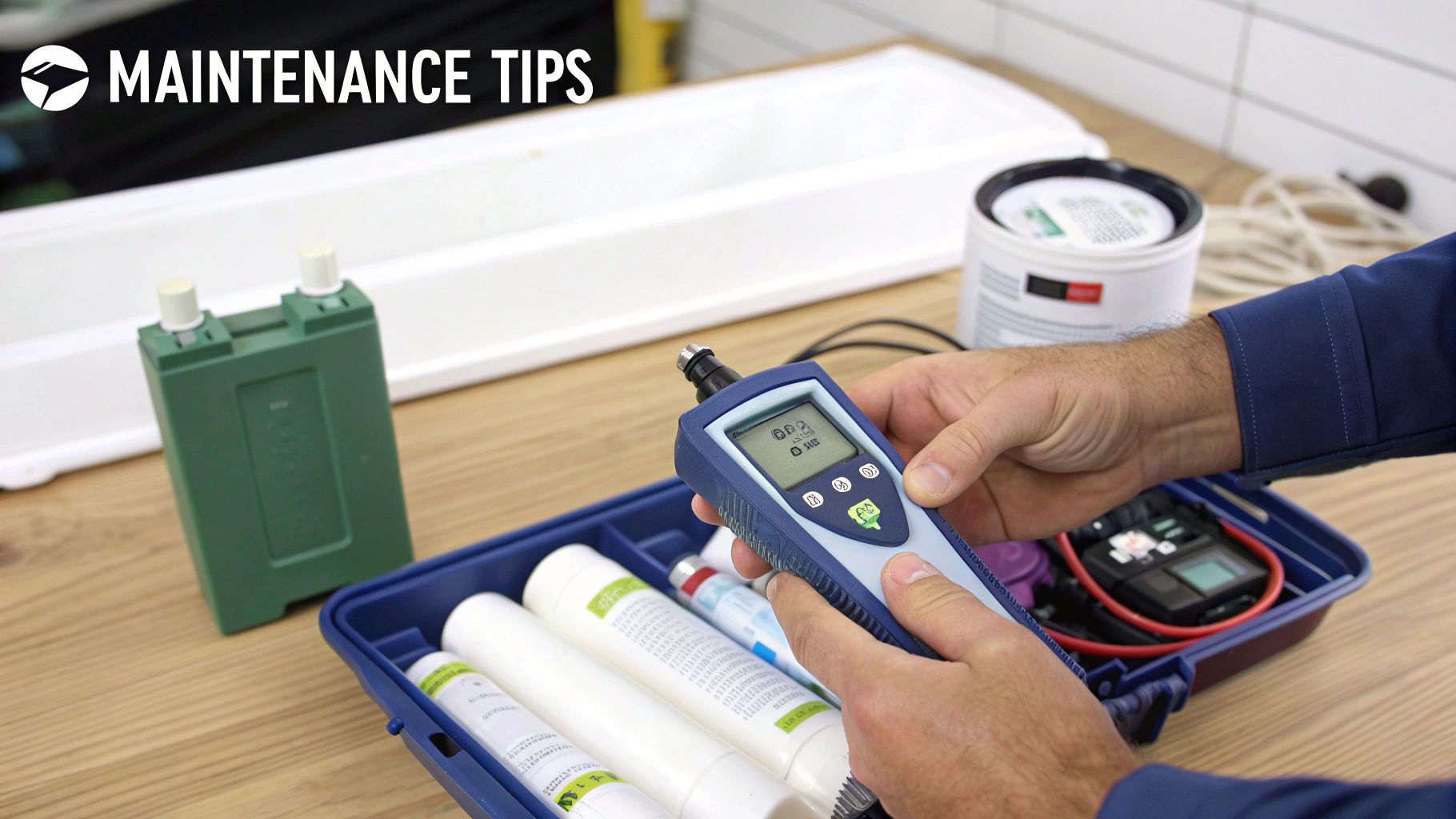
- Keep a Close Eye on TDS Readings: This is non-negotiable. Get a digital TDS meter and test your output water daily. The second that reading nudges above 0 ppm, it’s a clear sign your DI resin has given its all and needs to be replaced.
- Give Your RO Membrane a Good Flush: Your reverse osmosis membrane is the heart of the system, and it works best when it's clean. Flushing it for a few minutes before or after you make water washes away the gunk and mineral build-up that can clog its tiny pores. This one simple step can dramatically extend its working life.
- Change Your Pre-Filters on Schedule: The sediment and carbon filters are your RO membrane's bodyguards, protecting it from grit, sludge, and chlorine. Stick to the manufacturer's schedule—usually every three to six months—but you might need to change them more often if your local tap water is particularly hard or full of sediment.
Troubleshooting Common Problems for All Users
Even if you grab your water from a filling station, things can still go wrong with your delivery gear. Here are a couple of common headaches and what’s likely causing them.
Problem 1: Weak Pressure at the Pole
If the water is just trickling out of your brush head, don't panic. The fix is often dead simple. First, check your hose reel for any obvious kinks or twists. If that looks fine, have a look at the jets on your brush head – they can easily get clogged with tiny bits of debris. A quick poke with a pin is usually all it takes to get things flowing properly again.
Problem 2: Algae Growing in Your Tank
Spotting a green tinge in your water is a sure sign you've got an algae problem. It loves sunlight, so the best way to prevent it is to keep your tank stored in a dark place, like inside your van or a garage. If it’s already appeared, you’ll need to drain the tank, give it a good scrub, and rinse it out with a sterilising solution to kill off any spores and stop it from coming back.
It's worth remembering why this final purification step is so crucial. In the UK, authorities report that nearly 19% of all treated water is lost to leaks before it even gets to our taps. The water you start with has been on quite a journey. By maintaining your system, you’re ensuring that final, critical stage of purification is always working perfectly. You can read more about this in the latest UK water resources performance analysis on GOV.UK.
Frequently Asked Questions
Even after getting to grips with what pure water systems can do, you probably still have a few questions. Let's tackle some of the most common ones we hear, giving you straight answers to help you figure out what's best for you.
How Often Should I Replace DI Resin?
There's no single answer to this – the life of your deionisation (DI) resin depends entirely on two things: how hard your local water is and how much pure water you're getting through. If you're in an area with a high level of Total Dissolved Solids (TDS), your resin is going to get used up much more quickly.
The best way to know for sure is to keep a digital TDS meter handy. Test the water coming out of your system regularly. The moment that reading climbs above 0 ppm, it’s time for a change. For a professional using it daily, this could be every few weeks; for a hobbyist, it might last several months.
Is Pure Water Safe to Drink?
If you accidentally swallow a mouthful, it's not going to do you any harm. However, you absolutely shouldn't be drinking it regularly. The purification process is so thorough that it strips out all the good stuff our bodies need, like calcium and magnesium.
The pure water used for cleaning is designed for one job: to be incredibly effective at cleaning. It's not meant for hydration. Stick to tap or bottled water to make sure you're getting the essential minerals your body needs.
Can I Build My Own Pure Water System?
Technically, yes, you could piece together a DIY system, and for some enthusiasts, that's part of the fun. But for any kind of professional work, it’s just not a practical route. Professional systems are designed for reliability, efficiency, and the kind of high-volume output a business needs.
When you start adding up the cost of good quality parts, the time spent on maintenance, and the very real risk of it failing mid-job, a DIY rig quickly loses its appeal. For most businesses, the guaranteed performance of a professionally built unit or a filling station service is a much smarter investment.
Why Is Pure Water a Better Cleaner Than Soap?
It all comes down to basic chemistry. When you strip water of all its dissolved minerals, it becomes chemically unstable and incredibly hungry. It actively wants to grab onto and dissolve any impurities it touches – think dirt, dust, and pollen on a window.
This means it literally pulls the grime off a surface and holds onto it, so it can be rinsed away completely. Soaps and detergents often leave a slight, sticky film behind, which actually attracts more dirt later on. Pure water, on the other hand, just evaporates and leaves absolutely nothing behind but a perfect, streak-free finish.
Ready to get guaranteed 0 ppm water without the hassle of owning and maintaining a system? 24 Pure Water has a nationwide network of 24/7 self-service filling stations. Find your nearest station and see the difference it makes on your next job.