When we think of water, the kind that flows from our taps usually comes to mind. Yet, for a vast range of professional and specialist applications across the United Kingdom, ordinary tap water simply isn't good enough. The dissolved minerals and impurities it contains, while harmless for drinking, can cause streaks, damage sensitive equipment, ruin delicate chemical processes, and reduce operational efficiency. This is where deionised (DI) water steps in. By removing these mineral ions, we are left with an ultra-pure liquid that has become an indispensable tool in industries from automotive valeting to advanced scientific research.
This comprehensive guide is designed for professionals who demand flawless results. We will explore the most critical uses of deionised water, detailing exactly why its purity is non-negotiable for achieving superior outcomes and maintaining operational excellence. Forget a simple list; we will provide actionable insights into specific applications, including professional window cleaning, car detailing, solar panel maintenance, and industrial manufacturing.
You will learn not only where DI water is used but why it is essential and how to implement it effectively. We will cover practical usage tips, contamination warnings, and storage advice to help you maximise its benefits. This article provides the detailed knowledge needed for any business that relies on consistent, high-quality water to deliver exceptional outcomes and drive its success forward.
1. Professional Window Cleaning
For professional window cleaners, achieving a flawless, streak-free finish isn't just a goal; it's a non-negotiable standard. This is where deionised (DI) water becomes an indispensable tool. Unlike tap water, which contains dissolved minerals like calcium and magnesium, DI water has had these impurities stripped away. When tap water evaporates on glass, it leaves behind these minerals, creating unsightly white spots and streaks. Deionised water, being pure H₂O, evaporates completely, leaving nothing behind but crystal-clear glass.
This method, often called the 'reach and wash' system, typically involves using a water-fed pole. These telescopic poles pump DI water up to a soft-bristled brush, allowing cleaners to scrub windows from the safety of the ground. The pure water loosens dirt, and a final rinse washes it away. Because the water is deionised, there's no need to squeegee the glass dry, saving significant time and labour, especially on large commercial buildings or hard-to-reach residential windows. The result is a pristine finish that stays cleaner for longer, as there is no sticky soap residue left to attract fresh dirt.
Real-World Applications
The impact of this technique is most visible in high-stakes environments where appearance is paramount:
- High-Street Retail: Chains rely on DI water systems to maintain showroom-quality windows that attract customers.
- Commercial Property Management: Companies managing glass-fronted office towers use it to uphold a premium corporate image.
- Luxury Residential Cleaning: In competitive property markets, a spotless exterior can be a key selling point, making DI water the standard for high-end homes.
Pro Tips for Window Cleaners
Maximising efficiency is key to profitability. For professionals using DI water, strategic planning can make a significant difference:
- Route Planning: Before scheduling jobs, use the 24 Pure Water mobile app to locate the nearest filling station and plan your route to minimise travel time.
- Efficient Filling: Visit stations during off-peak hours to avoid queues and get back on the road faster.
- Cost Management: Take advantage of trade discounts offered by suppliers like 24 Pure Water for volume purchases, reducing your cost per litre.
- Consistent Supply: Maintain a regular filling schedule to ensure your van is always stocked, allowing you to take on more jobs daily without interruption.
2. Mobile Car Valeting and Detailing
For professional car valets and detailers, delivering a showroom-quality finish is the benchmark of their service, and deionised (DI) water is a cornerstone of achieving that perfection. Tap water is laden with dissolved minerals such as calcium, magnesium, and sodium. When this water evaporates on a car's paintwork, it leaves behind these mineral deposits, resulting in ugly water spots and streaks that are difficult to remove and can even etch into the clear coat over time. Deionised water, having been purified of these minerals, evaporates cleanly, leaving absolutely nothing behind.
This purity makes DI water invaluable for the final rinse stage of a car wash. Mobile detailers can rinse a vehicle and allow it to air-dry, even in direct sunlight, without any risk of water spotting. This completely eliminates the need for contact-drying with a towel, which is a major source of swirl marks and micro-scratches on delicate paintwork. Furthermore, for advanced services like ceramic coating or paint protection film (PPF) application, a perfectly decontaminated and pure surface is essential. Using DI water for the final preparation wipe-down ensures that expensive protective coatings bond correctly to the paintwork, maximising their durability and performance.
Real-World Applications
The pristine results from using deionised water are critical in the premium automotive sector, where flawless presentation is non-negotiable:
- High-End Detailing: Mobile services in affluent areas use DI water to justify premium prices for ceramic coatings, often costing £300 or more.
- Car Dealerships: Forecourts rely on pure water systems for pre-sale vehicle preparation, ensuring every car looks immaculate under showroom lights.
- Fleet Management: Companies use it to maintain a high standard of appearance across their corporate vehicle fleets, protecting their brand image.
- Luxury Car Rentals: High-value vehicle rental firms ensure a perfect, spot-free finish to meet the expectations of discerning clients.
Pro Tips for Valets and Detailers
For professionals, efficiency and quality go hand-in-hand. Integrating DI water strategically can significantly enhance business operations:
- Guarantee Flawless Results: Use 24 Pure Water stations for your final rinse tank to guarantee a spotless finish every time, a powerful selling point.
- Plan Ahead: Schedule fills at a local station before heading to major detailing jobs to ensure you have an adequate supply for the day.
- Market Your Quality: Actively promote your use of pure water and offer a 'spot-free finish guarantee' to differentiate your service from competitors.
- Manage Costs: Take advantage of trade accounts to get volume discounts on your water purchases, lowering the overheads on each job.
- Educate Your Clients: Explain why DI water is superior and how it protects their investment, reinforcing the value and professionalism of your service.
3. Solar Panel Cleaning and Maintenance
For solar panels to operate at peak efficiency, they must be completely clean. Any layer of dust, bird droppings, or grime can significantly obstruct sunlight, directly reducing energy output. Tap water, however, is a poor choice for cleaning, as its dissolved minerals leave behind a white, scaly residue upon evaporation. This mineral build-up, known as limescale, can reduce a panel's photovoltaic output by as much as 15-25%, defeating the purpose of the investment. Deionised water, free from these minerals, is the professional standard for this vital maintenance task.
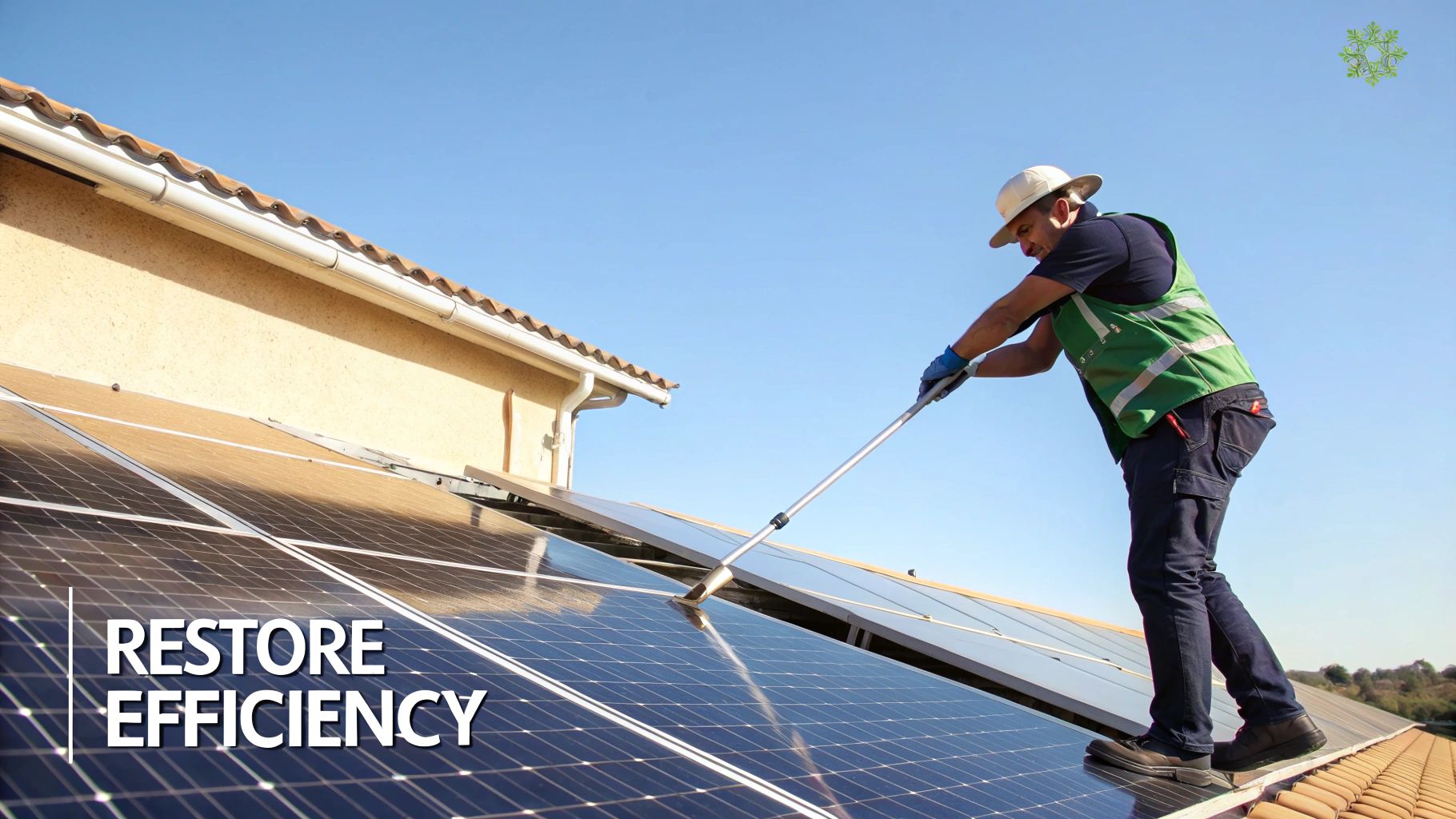
Professional solar maintenance companies use DI water with water-fed poles and soft-bristle brushes to gently remove dirt without scratching the panel's surface or damaging delicate anti-reflective coatings. The pure water effectively loosens and rinses away all contaminants. Because it is 100% pure H₂O, it evaporates without leaving any residue, ensuring the panels can absorb the maximum amount of solar radiation. Regular DI water cleaning is a critical component of renewable energy asset maintenance, ensuring the system delivers its promised return on investment.
Real-World Applications
The financial impact of using deionised water for solar panel cleaning is clear across various sectors where energy efficiency is a priority:
- Commercial Solar Farms: Large-scale installations across UK farms have reported output gains of over 20% following a thorough clean with DI water.
- Retail and Industrial Properties: Businesses with extensive rooftop solar arrays rely on regular DI water maintenance to return their systems to design efficiency and lower their energy bills.
- Renewable Asset Management: Firms managing solar investments implement quarterly DI water cleaning schedules to protect asset value and guarantee optimal performance for their clients.
Pro Tips for Solar Panel Cleaners
For maintenance professionals, efficiency and demonstrating value are crucial for building a successful business. Incorporating these strategies can maximise results:
- Optimal Timing: Schedule cleaning for early mornings or late afternoons to prevent the water from evaporating too quickly and to avoid thermal shock to the panels on hot days.
- Document Performance: Use an energy output meter to record readings before and after cleaning. This data provides tangible proof of the value of your service to clients. For optimal energy output and lifespan, a comprehensive understanding of proper solar panel cleaning is essential, emphasising techniques that ensure a streak-free and efficient system. You can learn more in this Solar Panel Cleaning: A Complete How-To Guide.
- Smart Logistics: Leverage the 24 Pure Water mobile app to plan routes between distributed solar installations, locating the nearest filling stations to minimise travel and downtime.
- Build Partnerships: Collaborate with solar panel installers to offer maintenance packages at the point of sale, securing long-term service contracts.
4. Aquarium and Aquatic Systems Management
For dedicated aquarium hobbyists and professional aquatic facilities, creating a stable, healthy environment is paramount. This is where deionised (DI) water becomes an essential component for success. Tap water is full of minerals like calcium and magnesium, along with variable levels of nitrates, phosphates, and heavy metals. These substances drastically affect water parameters such as general hardness (GH), carbonate hardness (KH), and pH, which can stress or harm sensitive aquatic life. Deionised water provides a clean, neutral starting point, free from these unpredictable impurities.
Using pure DI water allows aquarists to take complete control of their tank's chemistry. Instead of fighting the inconsistent composition of tap water, they can build their desired water profile from the ground up by adding precise amounts of remineralising products. This control is crucial for breeding delicate species like discus or shrimp, growing demanding aquatic plants in high-tech "aquascapes," or maintaining saltwater reef tanks where stability is non-negotiable. The purity of DI water ensures that the only elements present are those the aquarist intentionally adds, eliminating guesswork and creating the perfect ecosystem.
Real-World Applications
The benefits of using pure water are most evident in specialised aquatic setups where precision is key:
- Professional Breeding Facilities: Operations breeding high-value or sensitive species rely on DI water to replicate specific natural habitats and maximise breeding success.
- Planted Aquarium Enthusiasts: Aquascapers, inspired by pioneers like Takashi Amano, use DI water to prevent algae-fuelling impurities and perfectly tailor nutrient levels for lush, award-winning layouts.
- High-End Aquarium Retailers: Shops use deionised water to maintain the health and vibrancy of their delicate livestock, ensuring fish and invertebrates are in prime condition for customers.
- Public Aquariums: Large-scale facilities depend on pure water to manage complex, sensitive ecosystems and protect valuable aquatic specimens.
Pro Tips for Aquarists
Maintaining a consistent supply of pure water is crucial for a thriving aquarium. Strategic planning can simplify the process and improve results:
- Remineralise Properly: After a water change with DI water, always add a quality remineralising product (like Seachem Equilibrium or Brightwell Aquatics Remineraliz) to restore essential minerals for fish and plant health.
- Regular Testing: Consistently test your water parameters (pH, GH, KH) with reliable test kits to ensure you are maintaining a stable and ideal environment.
- Plan Your Fills: Use the 24 Pure Water mobile app to find the nearest filling station, whether you're at home or visiting a local fish store, ensuring you never run out.
- Cost-Effective Volume: For larger tanks or multiple systems, take advantage of trade discounts at 24 Pure Water to lower your overall costs for water changes.
5. Brewery and Beverage Production
For brewers and beverage producers, water isn't just an ingredient; it's the canvas upon which every flavour is painted. This is why deionised (DI) water is fundamental in the industry, offering a perfectly neutral starting point. Tap water contains a unique profile of minerals and compounds that can drastically alter taste, yeast health, and chemical reactions during production. By removing these variables, DI water provides a 'blank slate', giving producers complete control over the final product's character and consistency.
This control is crucial for style replication. For example, a crisp Czech pilsner requires very soft water, while a classic Burton-on-Trent IPA needs higher levels of sulphate to accentuate hop bitterness. Using DI water allows brewers to add precise amounts of brewing salts like gypsum (calcium sulphate) and calcium chloride to build a specific water profile from the ground up. This ensures that every batch matches the desired flavour, aroma, and mouthfeel, eliminating inconsistencies caused by fluctuating municipal water supplies. This meticulous approach is one of the key uses of deionised water in achieving commercial-grade quality.
Real-World Applications
The ability to build a water profile from zero is a game-changer across the beverage industry:
- Craft Breweries: DI water allows small breweries to perfect signature styles and consistently replicate award-winning recipes, regardless of their geographical location.
- Commercial Beverage Producers: Large-scale producers of soft drinks, seltzers, and kombucha rely on DI water to guarantee product uniformity across different production facilities.
- Home Brewing Communities: Dedicated home brewers use pure water to elevate their craft, moving beyond basic kits to create beers that rival professional quality.
Pro Tips for Brewers
Precise water chemistry is the key to repeatable, high-quality brewing. Here's how to leverage DI water effectively:
- Test and Verify: Invest in a reliable water chemistry testing kit to confirm the purity of your base water before adding minerals.
- Use Proven Profiles: Utilise established software or resources like Bru'n Water to calculate the exact mineral additions needed for specific beer styles.
- Plan Your Supply: Schedule regular fills at a 24 Pure Water station to coincide with your brewing calendar, ensuring you never run out mid-production. Learn more about how pure water is essential for breweries.
- Document Everything: Keep a detailed log of the water profile for every batch. This data is invaluable for troubleshooting and perfectly replicating successful brews.
6. Manufacturing and Industrial Processes
In high-precision manufacturing and industrial environments, the mineral content found in standard tap water is not just an impurity; it's a critical risk to product quality, equipment longevity, and process efficiency. This is why deionised (DI) water is a non-negotiable component across diverse sectors. Its absolute purity, free from dissolved mineral ions like calcium and magnesium, prevents the contamination and damage that regular water can cause.
When ordinary water is used in industrial processes, the minerals it contains lead to scaling in pipes, boilers, and cooling systems, which drastically reduces thermal efficiency and can cause equipment failure. In sensitive applications like electronics or pharmaceuticals, these ionic impurities can contaminate products, leading to defects, reduced yields, and costly waste. Deionised water eliminates these risks. By using pure H₂O, manufacturers ensure that their processes, from rinsing delicate microchips to formulating life-saving medicines, are performed with predictable and consistent results.
Real-World Applications
The requirement for ultra-pure water is fundamental in sectors where precision is paramount:
- Electronics & Semiconductor Manufacturing: DI water is used to rinse silicon wafers and other components, as even the smallest mineral deposit can render a microchip useless.
- Pharmaceutical Production: It serves as a solvent, a cleaning agent, and a core ingredient in many formulations where purity directly impacts safety and efficacy.
- Automotive Assembly: Pure water is vital in pre-treatment and paint processes to ensure flawless adhesion and finish, preventing defects caused by mineral spotting. You can learn more about the important industries that use ultrapure water in our detailed guide.
- Power Generation: Used in cooling towers and steam turbines to prevent scale build-up, which improves efficiency and extends the life of critical infrastructure.
Pro Tips for Industrial Use
For manufacturers, maintaining a consistent supply of DI water is crucial for uninterrupted production:
- Conduct a Water Quality Audit: Identify the specific stages in your manufacturing line that are most sensitive to mineral content to prioritise the use of DI water.
- Establish a Reliable Supply: Work with a supplier like 24 Pure Water to arrange bulk delivery contracts and reliable schedules that align with your production demands.
- Implement On-Site Storage: Install appropriate storage tanks to create a buffer supply, ensuring that production can continue without interruption, even during peak demand.
- Train Staff on Handling: Ensure all personnel understand the importance of water purity and follow correct procedures for handling and dispensing to avoid re-contamination.
- Integrate into Quality Assurance: Document water purity metrics as a key performance indicator within your quality management system to maintain high standards.
7. Laboratory and Scientific Research
In the world of scientific research and laboratory analysis, precision is everything. The smallest impurity can skew experimental results, invalidate findings, and compromise months of work. This is why deionised (DI) water is a fundamental requirement in any scientific setting. Tap water contains a cocktail of minerals, ions, and organic compounds that can interfere with chemical reactions and contaminate sensitive instruments. By removing these charged ions, deionised water provides a pure, stable, and predictable solvent, ensuring that experimental outcomes are influenced only by the variables being studied.
This ultra-pure water is critical for everything from preparing chemical solutions and calibrating instruments to cleaning glassware and running analytical procedures like chromatography. Because DI water is essentially a blank slate, it prevents the introduction of unwanted variables. For example, trace minerals in tap water could act as catalysts or inhibitors in a chemical reaction, or create background noise in a spectrophotometer reading. Using DI water eliminates this risk, forming the bedrock of reproducible and reliable scientific inquiry.
Real-World Applications
The integrity of research across numerous fields depends on the consistent purity of deionised water:
- University Chemistry Labs: Students and researchers rely on DI water for accurate titrations, creating standard solutions, and performing sensitive analytical tests.
- Pharmaceutical Manufacturing: Quality control labs use it to verify product purity, prepare formulations, and ensure that equipment is free from contaminants that could affect drug stability.
- Medical Research Facilities: In biology and medical labs, DI water is essential for preparing buffers, cell culture media, and conducting molecular biology experiments where ionic contamination could be detrimental.
- Environmental Testing: Labs use DI water as a reference standard and for diluting samples when analysing soil and water for pollutants, ensuring the tests themselves don't introduce impurities.
Pro Tips for Laboratory Use
Maintaining water purity is non-negotiable for research integrity. Implementing strict protocols can safeguard experimental accuracy:
- Ensure Consistent Supply: Source high-purity deionised water from a reliable supplier like 24 Pure Water to guarantee consistency between batches, which is vital for long-term studies.
- Proper Storage: Store DI water in containers made from appropriate materials, like borosilicate glass or specific inert plastics (e.g., HDPE), to prevent leaching and re-contamination.
- Regular Quality Checks: Routinely test the resistivity or conductivity of your water supply to verify its purity level is suitable for your specific application.
- Document Everything: For full reproducibility, always document the source and measured purity of the water used in your experimental methods section. For a deeper understanding of water purity standards, you can learn more about the differences between deionised and ultrapure water.
- On-Site Systems: For high-volume labs requiring constant access to pure water, investing in specialised laboratory water purification equipment can provide an efficient, on-demand supply tailored to specific research needs.
8. Cosmetic and Personal Care Manufacturing
In the world of cosmetics and personal care, the purity of every ingredient is paramount to product quality, safety, and performance. Deionised (DI) water is the unsung hero in this industry, serving as the solvent base for countless formulations. Unlike tap water, which contains minerals and salts, DI water is pure H₂O. These impurities in tap water can destabilise emulsions, interfere with the effectiveness of preservatives, alter a product's pH, and affect its texture and feel on the skin. Using deionised water ensures that the final product is stable, safe, and consistent from one batch to the next.
From lotions and serums to shampoos and conditioners, water is often the primary ingredient listed on the label. By using DI water, formulators have complete control over the chemical composition of their products. This purity prevents unwanted chemical reactions between dissolved minerals and active ingredients, ensuring the efficacy of key components like vitamins, antioxidants, and peptides. For manufacturers, this is a non-negotiable step to meet strict regulatory standards, guarantee a long shelf life, and deliver the sensory experience promised to consumers.
Real-World Applications
The requirement for pure water is universal across the beauty industry, impacting brands at every level:
- Premium Skincare Brands: High-end companies rely on DI water to create sensitive skin serums and treatments where even trace minerals could cause irritation or reduce efficacy.
- Natural and Organic Cosmetics: Manufacturers in this niche use DI water to uphold their commitment to purity and avoid unintended mineral or chemical contaminants.
- Contract Manufacturers: Large-scale facilities producing for multiple brands use DI water as a universal standard to guarantee batch-to-batch consistency across diverse product lines.
Pro Tips for Formulators
For cosmetic manufacturers, maintaining water quality is a critical part of the production process. A strategic approach to sourcing and handling is essential:
- Sourcing Consistency: Source your deionised water from a reliable supplier to ensure consistent purity for every batch, preventing formulation failures.
- Purity Verification: Regularly test the ionic conductivity of your water supply to confirm it meets the required purity standards for cosmetic production.
- Proper Storage: Always store DI water in sealed, food-grade containers to prevent re-contamination from airborne particles or the container material itself.
- Bulk Supply: For volume operations, consider a bulk supply arrangement through a service like 24 Pure Water to ensure a constant, cost-effective source of high-purity water.
Deionised Water Applications: 8-Point Comparison
| Item | Implementation complexity | Resource requirements | Expected outcomes | Ideal use cases | Key advantages |
|---|---|---|---|---|---|
| Professional Window Cleaning | Medium — requires water‑fed poles and training | Moderate — DI fills, poles, squeegees, transport | Streak‑free, spot‑free glass; faster dry times | Retail fronts, office façades, luxury homes | Chemical‑free finish, premium appearance, reduced callbacks |
| Mobile Car Valeting and Detailing | Medium — mobile systems and technique needed | Moderate — DI water, pressure/foam systems, storage | Showroom paint finish; optimal coating adhesion | Mobile detailers, dealerships, luxury rentals | Prevents spots, extends coatings, enables premium pricing |
| Solar Panel Cleaning and Maintenance | Medium–High — safety, access and logistics | High — large DI volumes, poles, access equipment | Restored panel output; measurable kW gains | Solar farms, commercial rooftops, industrial arrays | Increases energy yield, protects anti‑reflective coatings |
| Aquarium and Aquatic Systems Management | Medium — requires remineralisation knowledge | Low–Moderate — regular DI fills, test kits, additives | Stable pH/KH/GH; improved fish and plant health | Breeding facilities, planted tanks, public aquaria | Precise parameter control; enables sensitive species success |
| Brewery and Beverage Production | High — water profiling expertise required | Moderate–High — DI supply, analysis tools, mineral salts | Consistent flavour profiles; reduced off‑flavours and haze | Craft breweries, commercial beverage producers, recipe dev | Blank slate for profiling; reproducible batch quality |
| Manufacturing and Industrial Processes | High — integration, storage and QA systems | High — continuous high‑volume DI supply, infrastructure | Lower scaling/corrosion; improved yields and reliability | Electronics, pharma, automotive, semiconductor fabs | Prevents contamination, extends equipment life, compliance |
| Laboratory and Scientific Research | High — purity grades and strict protocols | Moderate–High — certified DI supply, storage, monitoring | Accurate, reproducible analytical and experimental results | University labs, medical research, QC and analytical labs | Eliminates water variables; supports accreditation and data integrity |
| Cosmetic and Personal Care Manufacturing | High — formulation control and hygiene protocols | Moderate–High — DI supply, testing, food‑grade storage | Stable emulsions; consistent texture, shelf life and efficacy | Skincare brands, contract manufacturers, small‑batch labs | Prevents phase separation; preserves preservative effectiveness |
Integrating Pure Water Into Your Professional Workflow
Across a surprisingly vast spectrum of industries, from the meticulous detail of mobile car valeting to the precise formulations of cosmetic manufacturing, one common thread emerges: the pivotal role of water purity. As we have explored, the uses of deionised water are not just niche applications; they are fundamental to achieving superior results, ensuring operational consistency, and protecting valuable equipment. The common denominator in every application, whether it's achieving a flawless, spot-free finish on a window or preventing mineral scale build-up in sensitive industrial machinery, is the elimination of dissolved mineral ions.
These ions, while harmless in tap water, become contaminants that can tarnish surfaces, alter chemical reactions, and degrade performance. For professionals, moving from standard tap water to deionised (DI) water is a strategic upgrade. It elevates the quality of your service from 'good' to 'exceptional', transforming a standard clean into a professional-grade finish that speaks volumes about your commitment to quality. The difference is tangible, visible, and directly impacts customer satisfaction and your business's reputation.
Key Takeaways: From Theory to Professional Practice
Mastering the use of deionised water involves more than just understanding its chemical properties; it is about integrating it seamlessly and efficiently into your daily workflow. Here are the core principles we have covered:
- Consistency is King: DI water removes the variable of water hardness. Whether you are in a hard water area of Kent or a soft water region in Scotland, your results will be identical, ensuring predictable and repeatable outcomes for every job.
- Performance Enhancement: In cleaning applications, the aggressive nature of pure water allows it to dissolve and lift dirt more effectively, often reducing the need for harsh detergents and chemicals. This is not only better for the environment but can also lower your long-term operational costs.
- Asset Protection: For equipment ranging from automotive batteries and cooling systems to industrial humidifiers and laboratory sterilisers, mineral scale is a primary cause of inefficiency and failure. Utilising deionised water is a form of preventative maintenance, safeguarding your investments and minimising downtime.
- Purity Guarantees Quality: In product manufacturing, be it a craft beer or a high-end face cream, DI water acts as a neutral, pure base. It ensures that the final product's flavour, texture, and stability are defined by your chosen ingredients, not by unwanted minerals.
Your Actionable Next Steps: Securing a Reliable Supply
The critical challenge for many small and medium-sized businesses is not the 'why' but the 'how'. How do you access a reliable, affordable, and convenient supply of ultra-pure deionised water without the significant capital outlay of an in-house reverse osmosis system or the logistical hassle of bulk deliveries? This is where the modern, decentralised model proves its worth.
The strategic shift is towards pay-as-you-go accessibility. Professionals today need a solution that fits their dynamic schedules, allowing them to refill tanks early in the morning, late at night, or whenever the need arises between jobs. This is the operational advantage offered by self-service, 24-hour filling stations. By leveraging a network like this, you can effectively outsource your water purification needs, paying only for what you use, when you use it.
Ultimately, the diverse uses of deionised water all point to a single, powerful conclusion: control over your most fundamental resource is control over the quality of your work. By making a conscious choice to use ultra-pure water, you are not just cleaning a window or topping up a battery; you are investing in excellence, efficiency, and the professional standard that sets your business apart.
Ready to elevate your professional services with a consistent, cost-effective supply of ultra-pure water? Discover the convenience of the 24 Pure Water network, offering 24/7 self-service access to deionised water across the UK. Find your nearest filling station and start benefiting from flawless, spot-free results today by visiting 24 Pure Water.