Of all the tasks that come with keeping fish, regular water changes are without a doubt the single most important thing you can do to keep them healthy. This simple routine is the key to diluting and removing the nitrates that build up over time—the final, unavoidable byproduct of fish waste. If you let them accumulate, you’re just asking for stressed fish, rampant algae, and a general decline in water quality.
Why Water Changes Are the Heart of a Healthy Aquarium
Let's be honest, changing your aquarium's water can sometimes feel like a chore. But once you understand why it's so critical, you start to see it as a rewarding part of successful fishkeeping. It’s about so much more than just making the water look clean; it’s about actively managing the invisible chemistry that your fish live and breathe in.
At the heart of it all is the nitrogen cycle. In a nutshell, fish waste and uneaten food break down into highly toxic ammonia. Thankfully, beneficial bacteria in your filter convert this into another nasty compound, nitrite. Then, a second type of bacteria steps in and turns the nitrite into the much less harmful nitrate.
Managing the Final Byproduct
Your filter is the absolute hero when it comes to dealing with ammonia and nitrite, but it doesn't do a thing to remove the nitrate that’s produced at the end of the cycle. This compound just builds up, day after day. Think of it like a bin in your kitchen; you can keep putting things in it neatly, but eventually, it needs to be emptied.
High nitrate levels are a huge source of chronic stress for fish. This can weaken their immune systems, stunt their growth, and even make their colours look dull and washed out. On top of that, nitrates are a fantastic food source for algae, so if you're suddenly battling a green takeover, there’s a good chance your nitrates are out of whack.
Regular water changes are the most effective and reliable way to physically remove and dilute nitrates. You're essentially hitting a reset button on your aquarium’s chemistry, creating a much more stable and healthy home for your fish.
The Standard for a Healthy Tank
Performing regular water changes is just fundamental to maintaining a thriving little ecosystem in a glass box. For most UK aquariums, a consistent schedule is the best way to keep nitrates down while also replenishing essential minerals that get used up over time.
In fact, most experienced keepers would recommend a weekly 25% water change as a solid baseline for supporting fish health and keeping a lid on algae-fuelling byproducts like phosphates. You can find more expert advice on this widely accepted routine over at Fishkeeper.co.uk. This simple habit is your best defence against what's often called "Old Tank Syndrome"—that slow, creeping decline in water quality that can eventually lead to disaster.
Finding the Right Water Change Rhythm for Your Tank
Forget any rigid, one-size-fits-all rules you might have heard about water changes in aquariums. The perfect schedule isn't set in stone; it’s a living rhythm that’s completely unique to your tank. The old idea that every aquarium needs the exact same routine is, quite frankly, a myth.
Think about it: a lightly stocked, heavily planted 200-litre tank with CO2 injection has vastly different needs than a 60-litre setup packed with messy goldfish. One system is actively consuming nitrates, while the other is a non-stop nitrate factory. Realising this is the first step to moving beyond guesswork and creating a maintenance plan that actually works for your fish.
What Really Shapes Your Schedule?
Your aquarium is its own little ecosystem, and figuring out its maintenance needs means learning to 'read' the tank. Several interconnected factors come into play here.
Before you even think about a schedule, take a look at these key variables:
- Tank Size: Smaller tanks are much less forgiving. Pollutants like nitrate can skyrocket in a 30-litre nano tank far quicker than in a big 300-litre system. This makes frequent, consistent water changes absolutely critical for smaller setups.
- Stocking Density: This is probably the biggest factor of all. More fish means more waste, which directly translates to a faster build-up of nitrates. A tank stocked to its full capacity is going to need a much more hands-on approach than one with just a few inhabitants.
- Type of Fish: Let's be honest, some fish are just messier than others. Big cichlids or goldfish produce a huge amount of waste compared to a tiny shoal of neon tetras. On top of that, very sensitive species like discus or fancy shrimp demand exceptionally clean water, which often means more frequent changes are a necessity.
Starting with a Sensible Baseline
For most aquarists in the UK, the classic advice of a 25% weekly water change is a brilliant place to start. It’s a solid routine that works well for the average, sensibly stocked community tank. But you absolutely must treat this as a starting point, not a golden rule.
Your most important tool for nailing this down isn't the calendar—it's a reliable liquid test kit. Let your water parameters, especially the nitrate level, tell you what to do. Weekly testing shows you exactly how fast nitrates are accumulating and tells you if that 25% change is hitting the sweet spot, falling short, or even overkill.
If you’re testing your water just before a change and finding that nitrates are consistently creeping above 40ppm (parts per million), you’ve got two choices: increase the volume you change, or do it more often. On the flip side, if you have a lush planted tank where the nitrates barely ever show up on a test, you might find you can relax the schedule a bit.
Recommended Starting Water Change Schedules for Common UK Setups
To give you a better starting point, here’s a quick guide for some popular aquarium types. This is just a guideline, of course – always let your own water tests have the final say.
| Aquarium Type | Stocking Level | Recommended Weekly Change | Key Considerations |
|---|---|---|---|
| Planted Community | Light to Moderate | 20-30% | Plants will consume some nitrates, potentially allowing for slightly smaller or less frequent changes. |
| Goldfish Tank | Heavy | 40-50% | Goldfish are high-waste producers, requiring aggressive dilution of nitrates to stay healthy. |
| African Cichlid Tank | Moderate to Heavy | 30-40% | Often kept in crowded conditions to manage aggression, leading to a high bioload. |
| Shrimp or Nano Tank | Light | 10-20% | These small tanks are sensitive to large parameter swings, so smaller, regular changes are ideal. |
Ultimately, a good water change routine is proactive, not reactive. It's about consistently removing pollutants before they ever have a chance to build up to dangerous levels, keeping your aquatic environment stable and your fish thriving.
Your Essential Water Change Toolkit
Having the right gear on hand can turn a water change from a dreaded chore into a quick, satisfying task. Let's be honest, nobody enjoys wrestling with dodgy equipment. A well-prepared kit makes the whole process smoother for you and a lot safer for your fish.
At the top of the list is a decent gravel vacuum, sometimes just called a siphon. This is your workhorse. It doesn't just pull out old water; it gets right into the gravel or sand to suck up all the gunk – fish waste, leftover food, and all sorts of other detritus. Just make sure you get the right size for your tank. A massive siphon in a tiny nano tank will drain it in seconds, while a small one in a 200-litre tank will have you there all afternoon.
You'll also need a couple of dedicated buckets. I can't stress this enough: these buckets must only ever be used for your aquarium. Never let them see a drop of soap, bleach, or any other household cleaner. Even the tiniest residue can be catastrophic for your fish. A pair of standard 10-litre buckets is a good place to start for most setups.
Must-Have Accessories for a Safe Swap
Beyond the basics, a few bits and bobs are non-negotiable for keeping your fish safe and stress-free during a water change. Think of these as your safety net.
- A quality water conditioner: UK tap water is treated with chlorine or chloramine to make it safe for us to drink. For fish, these chemicals are highly toxic. A good water conditioner neutralises them in a flash, making tap water aquarium-safe. Don't skip this step.
- An accurate thermometer: Dumping water in that's too cold or too hot is a classic way to shock your fish, which can be fatal. You need a reliable thermometer to ensure the new water temperature is a close match to the tank's – aim for a difference of no more than a degree or two.
Gearing Up for Bigger Tanks
If you're running a larger tank, say anything over 150 litres, you’ll quickly realise that lugging buckets of water back and forth is a real back-breaker. This is where you might want to upgrade your kit.
A Python-style water changer can be a game-changer. It's essentially a long hose that connects right to your tap. It cleverly uses the pressure from the tap to create a siphon, draining the tank without you having to lift a thing. Then, you just flick a switch, and it starts refilling directly. No more buckets.
A quick heads-up on Python systems: they can be a bit wasteful with water, as you often need to leave the tap running to keep the siphon going. Still, for the sheer convenience on a big tank, many aquarists swear by them.
Finally, for those of us keeping particularly sensitive fish or aiming for absolutely perfect water conditions, using ultra-pure water is a popular option. If that's a route you're considering, it’s worth checking out the convenience of 24/7 ultra-pure water filling stations. It's a great way to get consistently pure water without the faff of installing a home filtration unit. Get these simple tools together, and you're all set for success.
A Practical Walkthrough of a Stress-Free Water Change
Right, you’ve got your gear sorted, so let's get down to business. A water change shouldn't be a chore you dread. In fact, once you get a simple, repeatable routine down, you'll find it's a quick and rewarding part of keeping fish. It's all about building confidence through a smooth, efficient process that leaves your tank—and its inhabitants—thriving.
Getting Your New Water Ready
First things first: preparation. Grab your dedicated aquarium buckets and fill them with tap water, getting close to the volume you plan to take out. Now for the most important bit: add a good quality water conditioner. Follow the instructions on the bottle to the letter; this will neutralise the chlorine and chloramine that are harmful to your fish and filter bacteria.
While the conditioner is doing its thing, you need to match the temperature. Pop a thermometer in the bucket and add a splash of hot or cold water as needed. You're aiming to get the new water within a degree or so of your tank's current temperature to avoid shocking your fish.
Before a single drop of water leaves the tank, do a quick safety check and switch off all your equipment. That means the filter, heater, any wavemakers, and air pumps. A filter trying to run dry can burn out its motor, and a heater exposed to air can overheat and crack. It’s a simple step that prevents expensive mistakes.
Mastering the Art of Gravel Vacuuming
Now for the hands-on part. Submerge your gravel vacuum in the tank, letting the tube fill with water completely. This makes starting the siphon a breeze. Once the water is flowing into your empty bucket, you can start cleaning.
Push the wide end of the vacuum about an inch or so into the gravel. You'll immediately see all the gunk—fish waste, uneaten food—get sucked up into the tube. Keep it in that spot until the water running through the tube looks mostly clear, then lift it out, move over a few inches, and plunge it in again. This method gets the substrate clean without causing a major landslide in your aquascape.
My Two Cents: Don't go overboard and try to vacuum the entire substrate every single time. You'll end up removing too many of the beneficial bacteria that call your gravel home. I like to mentally split the tank floor into thirds and just clean one section thoroughly with each weekly water change.
The Gentle Refill: How to Add Water Without Causing Chaos
Once you’ve siphoned out enough old water, it's time to add the fresh, treated water you prepared earlier. The golden rule here is to be gentle. Just dumping a bucket of water in will stir up a storm, stress your fish, and undo all your hard work.
Here are a few tried-and-tested tricks for a calm refill:
- Pour onto décor: Aim the flow of water onto a large rock or a solid piece of bogwood. This breaks the force of the water beautifully.
- Use a colander: A clean kitchen colander held at the surface works wonders. Pour the water into it, and it will sprinkle down gently.
- The plate method: Float a clean plastic plate on the surface and pour onto that. The water spreads out instead of jetting down to the bottom.
These are the simple, effective tools that make the whole job straightforward.
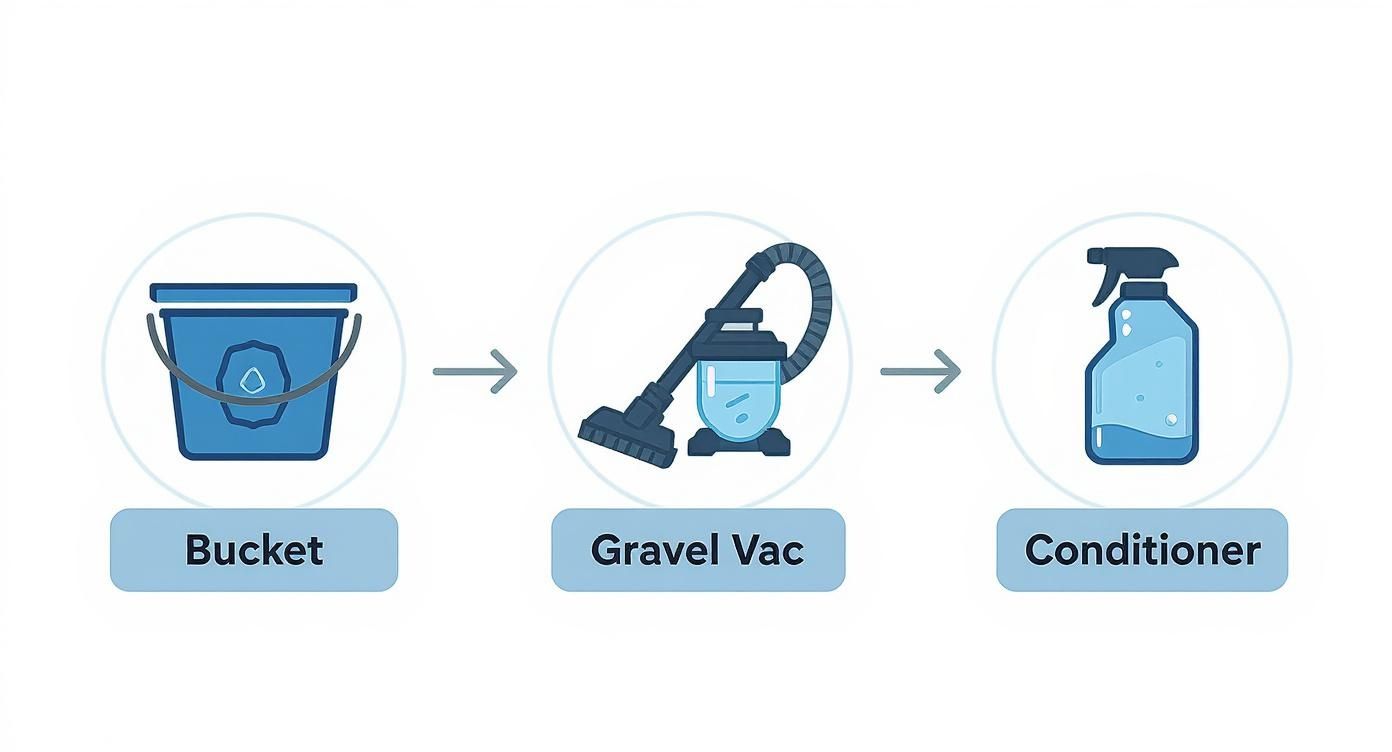
As the image shows, each tool has its moment in the spotlight, from siphoning and cleaning to making the new water safe for your fish.
One last tip: if you have tiny inhabitants like fry, shrimplets, or nano fish, stretch a piece of an old pair of tights over the end of your siphon and secure it with a rubber band. It’s a simple hack that stops any little ones from getting an unwanted trip down the tube.
With the tank full, you can go ahead and switch all your equipment back on. Sit back and watch your fish enjoy their sparkling clean home.
Tackling UK Tap Water Variations and Challenges
Let's talk about tap water. Many guides on aquarium maintenance seem to assume it's a perfect, neutral starting point. But here in the UK, what comes out of your tap can vary wildly, and that has a huge impact on your tank's health. We've got everything from the famously soft water in Scotland to the 'liquid rock' you'll find in parts of Southern England. Just assuming your tap water is fine is a recipe for long-term, frustrating problems.
The first rule of fishkeeping should be: know your source water. You can find detailed quality reports on your local water authority's website, which gives you a good baseline for things like pH, hardness, and even nitrates. But treat that as a snapshot in time. I always recommend testing your tap water yourself every couple of months, because treatment methods and even the source can change without warning.
The Problem of High Nitrates at the Source
For most of us, a water change is our primary tool for lowering nitrates. So what do you do when the fresh water you're adding is already loaded with them? This is a surprisingly common headache for keepers in certain parts of the country.
Water quality across the UK isn't uniform, and this can completely change how you approach your maintenance. For instance, it's not unusual for tap water nitrate levels to be as high as 30 to 50 parts per million (ppm) in and around Greater London. This puts you in a bizarre situation where doing a water change might actually make your nitrate problem worse, not better.
Practical Solutions for Difficult Tap Water
If you discover your tap water is working against you, don't panic. You're not stuck. There are some really effective ways to get back in control of your aquarium's chemistry. It really boils down to two approaches: dilution or purification.
- Using Reverse Osmosis (RO) Water: For anyone wrestling with high nitrates or incredibly hard water, RO is a total game-changer. This process strips almost everything out of the water. You can then blend this pure water with your tap water to bring those unwanted minerals or nitrates down to a much safer level.
- Full Remineralisation: If you're keeping very sensitive fish like discus, or delicate invertebrates like crystal shrimp, using 100% RO water is often the way to go. This gives you a completely clean slate. From there, you add specific remineralising salts to build the water back up to the precise parameters your inhabitants need to thrive.
A critical point when using purified water: "pure" doesn't mean "safe" for fish. Pouring straight RO or deionised water into your tank is dangerous because it lacks the essential minerals and buffers that fish and invertebrates need for their basic biological functions. Our guide on why ultrapure water isn't drinking water goes into the science behind this.
Of course, the most immediate danger in tap water for any aquarist is chlorine or chloramine. These disinfectants are added to make water safe for us to drink, but they're toxic to fish and will wipe out your tank's beneficial bacteria in a heartbeat. Understanding the effects of chlorinated water is vital. This is non-negotiable: you must always use a good quality water conditioner to neutralise these chemicals before the water goes anywhere near your aquarium.
Making Your Hobby More Environmentally Conscious
We all love this hobby, but it's worth taking a moment to think about its environmental footprint. It’s easy to forget just how much water an aquarium can get through, and that consumption has a real impact on both your household bills and the planet.
Just think about the numbers. In the UK, a modest 50-litre tank can use 156 litres a year for water changes, while a larger 400-litre setup might need a staggering 31,200 litres. This translates into a carbon footprint of between 85.3 and 635.2 kg of CO₂e every single year, just from one tank. These figures really highlight the importance of being mindful.
Simple Steps for Sustainable Fishkeeping
This isn't about making you feel guilty! It's about finding small, smart ways to make a difference. The single best thing you can do is to stop pouring old tank water down the drain.
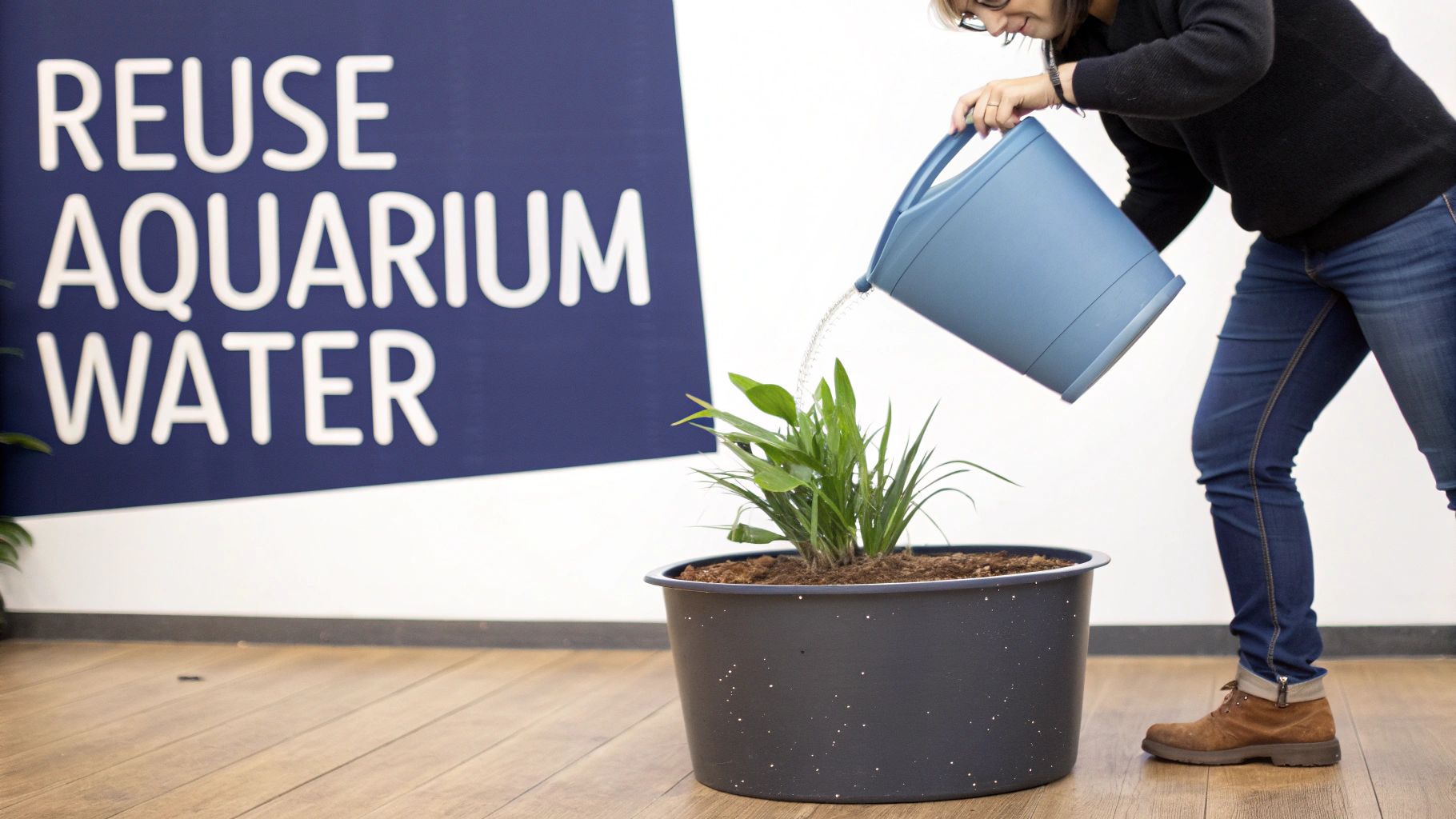
The water you siphon out during a change is liquid gold for your plants. It's packed with nitrates and other goodies that act as a brilliant natural fertiliser. Your houseplants and garden will absolutely thrive on it.
By simply watering your plants with old aquarium water, you're turning a waste product into a valuable resource. It's a win-win.
If you're keen to take things a step further, you can look into the benefits of choosing reusable pet products as well. Small adjustments like these help us enjoy our passion for fishkeeping more responsibly. And for those who want to get their water changes right from the start with a pure base, our UK-wide filling station locations are always available.
Answering Your Water Change Questions
Let's wrap up by tackling some of the most common questions that come up when we talk about water changes. These are the things that often trip people up, so hopefully, these answers will help you build a confident and effective maintenance routine.
Can I Do a 100% Water Change to Fix a Problem?
This is a classic "break glass in case of emergency" scenario. Unless you've accidentally contaminated the tank with a chemical or are dealing with a similarly catastrophic event, a 100% water change is almost always a bad idea.
The sudden, drastic shift in water parameters is incredibly stressful for fish and can easily send them into shock. You're also effectively resetting your tank's entire ecosystem, which can trigger a dangerous ammonia spike as the beneficial bacteria struggle to recover. It's much safer—and more effective—to stick with controlled partial changes of 25-50% for nearly all situations.
Should I Clean My Filter at the Same Time?
Definitely not. This is one of the most common mistakes new hobbyists make. Your filter media is the heart of your aquarium's biological filtration, housing the vast majority of the beneficial bacteria that keep your water safe.
Cleaning the filter and doing a large water change simultaneously is a double whammy for your tank's microbiome. It can remove too many of these crucial bacteria at once, potentially crashing your nitrogen cycle.
A good rule of thumb is to stagger these big tasks. Rinse your filter media—always in old tank water you've siphoned out, never straight from the tap—about a week before or after your water change. This gives your ecosystem time to stabilise between disturbances.
How Long Should I Let New Water Sit?
Thankfully, the days of leaving buckets of water sitting out for 24 hours are long gone. Modern water conditioners are incredibly efficient and work almost instantly to neutralise the chlorine and chloramine that make tap water unsafe for fish.
The old advice was based on the idea of letting chlorine evaporate, but that method doesn't work for the more persistent chloramine used by most UK water suppliers today. All you need to do is treat your new water with a quality dechlorinator, get the temperature right, and it’s good to go.
Want to nail your water parameters from the get-go? For ultimate control and peace of mind, nothing beats starting with a pure foundation. 24 Pure Water offers ultra-pure, deionised water from our 24/7 self-service filling stations across the UK. Give your aquatic life the consistent, safe environment they deserve. Find out more at 24 Pure Water.