A water tank for car detailing is the heart of any serious mobile setup. Think of it as your portable, self-sufficient water supply. Having a tank on board means you're no longer tethered to a client's garden tap, giving you total control over water quality and projecting an image of pure professionalism from the moment you arrive.
The Foundation of Your Mobile Detailing Business
Picture this: you pull up to a client's pristine home or a high-end office complex, completely ready to go. You don't need to ask for a hosepipe, you don't need to check their water pressure, and you don't leave a trace. That’s the freedom a proper water tank gives your business. It's the one piece of kit that elevates you from a weekend enthusiast to a fully-fledged, professional mobile detailer.
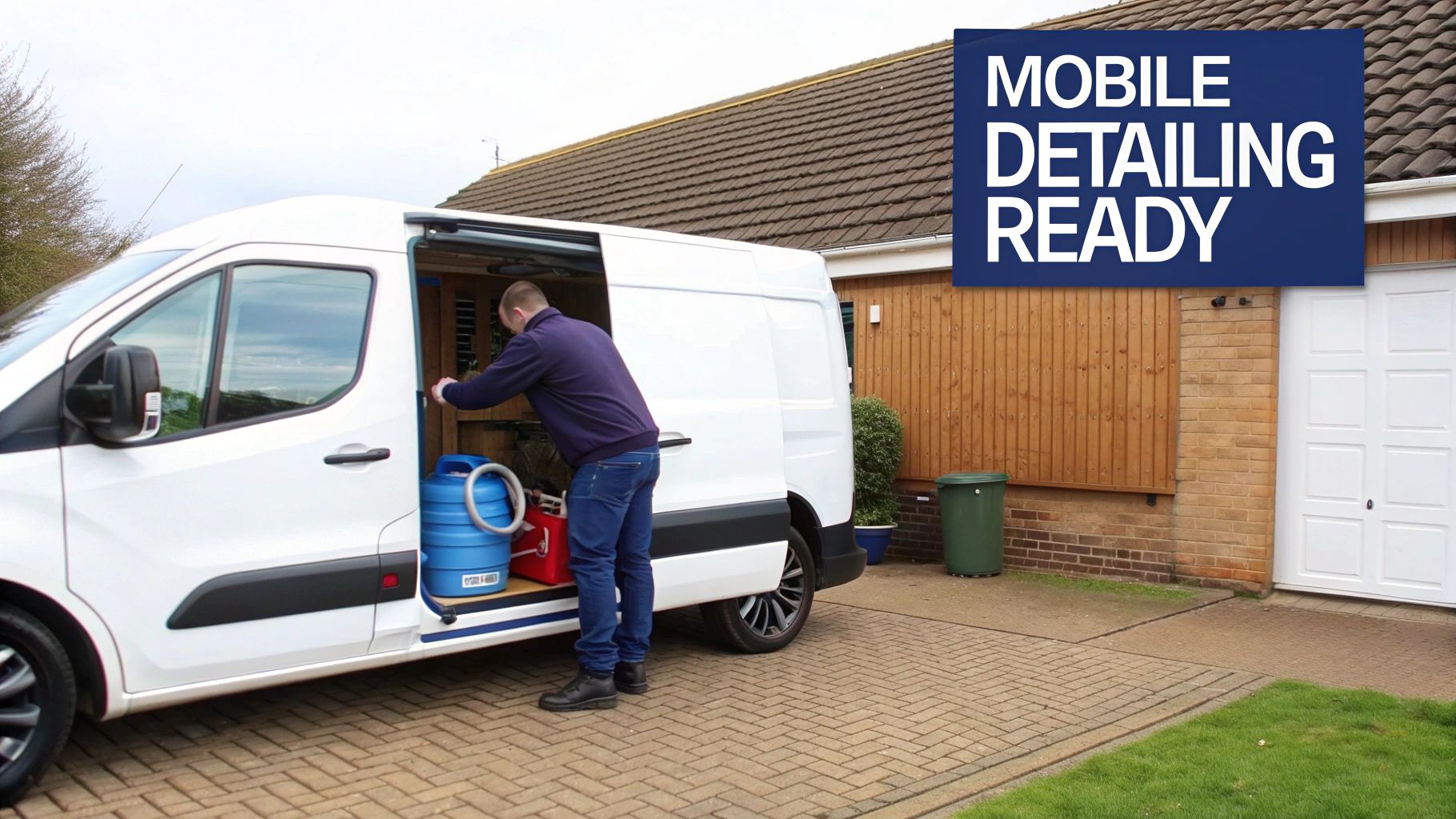
The mobile detailing scene in the UK is booming, with forecasts showing a compound annual growth rate of 8.2% between 2025 and 2035. Tanks are a massive part of this growth, letting detailers work anywhere, from city centres to remote locations, without worrying about water access or drainage. In fact, an estimated 70% of mobile detailers in the UK rely on polyethylene tanks, typically ranging from 100 to 400 litres, as the backbone of their operation.
Why a Water Tank Isn't Just an Option—It's Essential
Having your own water supply is about so much more than just convenience; it’s about taking control of your results and your reputation. Here’s why it’s a non-negotiable part of your setup:
- Professionalism is Everything: Turning up with all your own gear, including water, immediately shows clients you're a serious, well-prepared business.
- Guaranteed Quality: You dictate the purity of your water. This is crucial for avoiding the hard water spots and mineral streaks that plague results when using a customer's tap water. Using a pure water source is a cornerstone of professional car detailing services.
- Work Absolutely Anywhere: A tank unshackles you. You can take bookings in apartment block car parks, on rural estates, or anywhere in between, without ever needing to find a water source.
- The First Step to Compliance: In the UK, managing your trade effluent is a legal requirement. Having a tank is the first and most critical step towards a responsible wastewater management system.
Choosing the right water tank for your car detailing setup is one of the biggest decisions you'll make when starting out. It impacts your daily workflow, the quality of your finish, and even your legal standing. Getting this right from the start sets the entire tone for your business.
Choosing the Right Tank Size and Capacity
Picking the right water tank for your detailing setup is about more than just finding the biggest one that’ll squeeze into your van. Think of it as the fuel tank for your business—it literally determines how many jobs you can get through before you have to stop and refuel. Get this right, and you're setting yourself up for a smooth, profitable day. Get it wrong, and you'll constantly be scrambling for a tap.
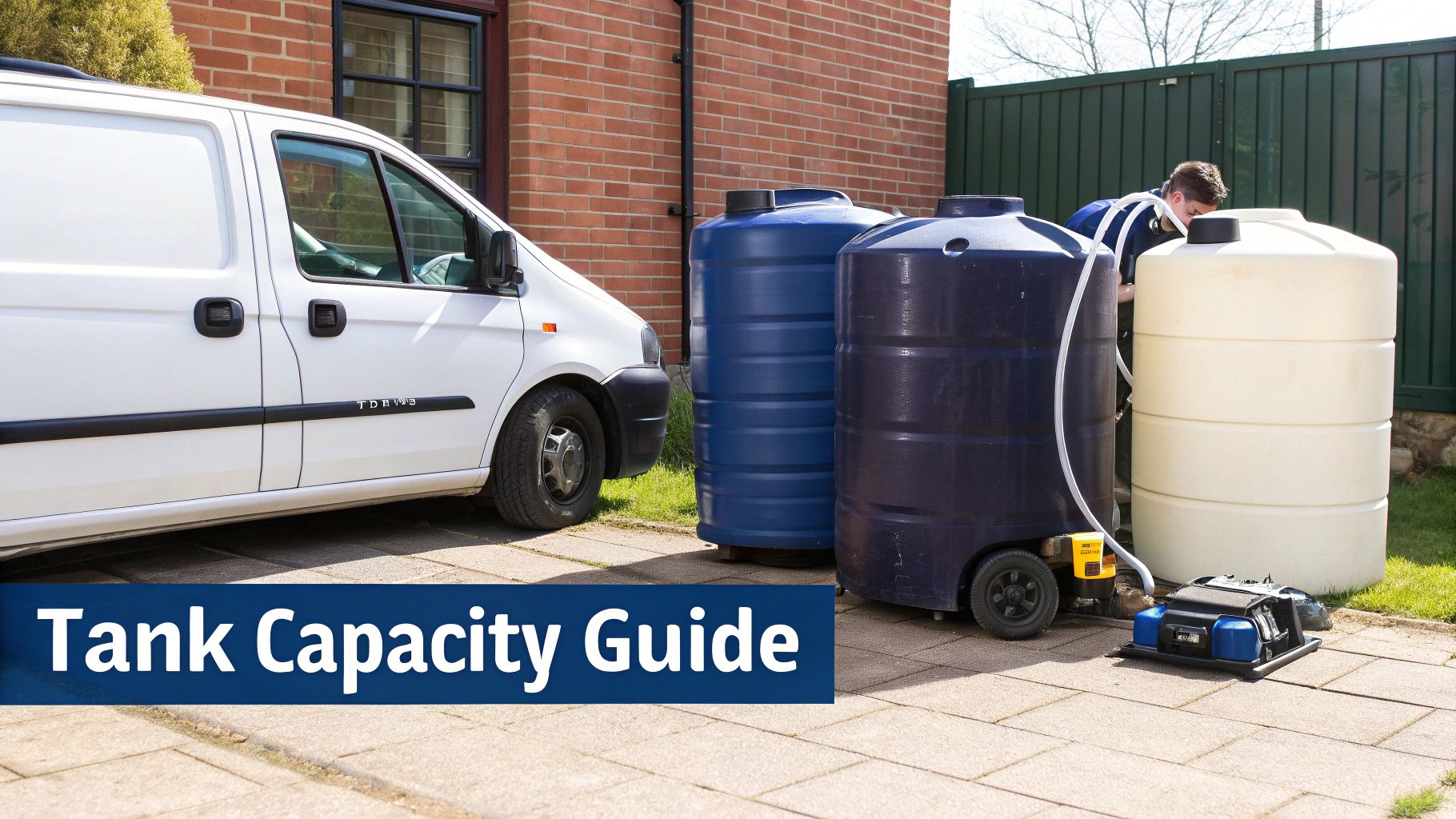
The capacity you need is completely tied to the services you actually offer. A small 100-litre tank might be fine if you're only doing quick maintenance washes or jobs that are mostly focused on interiors. But if your bread and butter is full-on exterior deep cleans, you’ll burn through that in no time.
This becomes really obvious when you fire up a pressure washer, which can guzzle anywhere from 5 to 10 litres of water per minute. A single, proper exterior wash on a large SUV could easily use 80-100 litres. That means a small tank might only get you through one job, forcing you to waste valuable time hunting for your next refill.
Matching Tank Size to Your Services
To make a smart choice, you need to be honest about your water usage on a typical day. Think about how many cars you aim to detail and what's involved in each service. Here’s a simple breakdown to get you started.
- 100-150 Litres: This is really for the part-timer or someone who uses it as a top-up for waterless or rinseless washes. It’s nice and lightweight, but pretty much useless for heavy pressure washing.
- 200-350 Litres: This is the sweet spot for a lot of full-time mobile detailers. A tank this size should comfortably let you complete 2-4 full exterior washes, giving you a great balance between what you can achieve in a day and the weight you’re carrying.
- 400-500+ Litres: We're in high-volume territory now. This is for the pros tackling big commercial vehicles or packing their diaries back-to-back. It gives you maximum range, but you absolutely need a van with the payload to handle that much weight safely.
The goal is simple: pick a tank that lets you finish a full day’s work without the nagging worry of running dry. I always recommend factoring in a little buffer—you can bet some jobs will unexpectedly use more water than you planned for.
The UK's hand car wash and valeting industry pulls in around £1.8 billion a year, and mobile operators are a massive part of that. Exterior work is where the money is, and that depends on having enough water—usually from 200-500 litre tanks—to run a pressure washer without hooking up to a client's mains supply. This self-sufficiency is also key to staying compliant with UK water conservation rules overseen by the Environment Agency. You can dig into more stats on the UK car wash market over on IBISWorld.
Refill Strategy and Water Quality
Finally, think about your refill plan. If you head back to base every night, a tank that just covers your daily average might be perfect. But what if you don't? Your access to good, clean water on the road can completely change the game.
For instance, knowing you can pull into a network of 24/7 self-service filling stations for ultra-pure water might mean you can get away with a slightly smaller tank. This reduces your van's weight while guaranteeing you deliver a perfect, spot-free finish for every single client. Thinking strategically like this from the start is what builds an efficient business.
Understanding Tank Materials and Designs
Choosing the right water tank for your detailing setup is about more than just how much water it holds. The material and design have a massive impact on your van's safety, the tank's durability, and how smoothly your day-to-day work goes. Remember, this tank isn't just a simple container; it's a hefty weight that fundamentally changes how your van handles on the road.
You'll find that the vast majority of tanks used by mobile detailers are made from Polyethylene. It has become the industry standard for a few solid reasons: it’s surprisingly tough, doesn't weigh a ton, and won't break the bank. While you might occasionally see fibreglass tanks, they're generally heavier and more expensive, making them a rare sight in most detailers' vans.
Polyethylene also has a couple of other tricks up its sleeve. Darker coloured tanks, like black or dark blue, are brilliant at blocking sunlight, which helps stop algae from growing inside and keeps your water quality high. Better yet, it’s a doddle to drill into and fit whatever plumbing connections you need, giving you total freedom to customise your system.
Why Baffles are Non-Negotiable
Picture this: 400 kilograms of water (that’s 400 litres) suddenly shifting from one side of your van to the other as you go around a roundabout. That's a huge, uncontrolled force known as 'water surge', and it can make your vehicle dangerously unstable in an instant. This is exactly why a baffled tank isn't just a good idea—it's essential.
A baffled water tank is designed with internal walls that divide the main container into smaller, linked-up sections. These baffles are lifesavers, literally. They break up the wave of water, stopping that violent sloshing motion when you brake or turn. It's the same principle used in massive fuel tankers you see on the motorway; it's all about stability.
For any professional mobile detailer, a baffled tank is a fundamental piece of safety equipment, not an optional extra. The stability it adds is absolutely crucial for safe driving, making it the only sensible choice for a vehicle-mounted water tank.
Smart Designs to Maximise Your Van’s Space
The good news is that tank manufacturers know that space inside a work van is precious. Beyond the classic rectangular tank, they've come up with some really clever designs that let you carry plenty of water without sacrificing your entire load area.
Here are a few of the most popular space-saving shapes you'll come across:
- Upright Tanks: These are tall, slim tanks that fit neatly against the van’s bulkhead or side walls, taking up very little floor space.
- Flat Tanks: Often called low-profile tanks, these are designed to sit under a false floor. This is a fantastic way to hide your water supply completely, giving you a perfectly flat, usable load bed on top.
- Wheel Arch Tanks: These are brilliantly designed to mould perfectly over the rear wheel arches, turning what is normally a completely wasted, awkward area into practical water storage.
Picking a design that works with your van's layout, not against it, is the key to building a mobile setup that’s both highly organised and incredibly efficient.
Installation, Plumbing, and Best Practices
So, you've picked out the perfect water tank for your detailing rig. That's a great first step, but a tank is just a box of water until you get it properly plumbed and installed. Getting this part right is what turns that container into the reliable, beating heart of your mobile setup. Let’s walk through how to build a robust system you can count on, job after job.
Before you even think about connecting a single hose, you have to secure the tank. This is absolutely non-negotiable from a safety standpoint. Think about it: a full 400-litre tank is a hefty 400 kilograms. If you have to slam on the brakes, that tank becomes a massive, unsecured projectile. Always use heavy-duty ratchet straps or, even better, metal bands that are bolted directly through the floor into your van’s chassis. Don't just screw them into the plywood floor.
With the tank safely locked down, the plumbing itself is pretty logical. The water needs to get from the tank outlet, run through a filter to protect your gear, get pressurised by a pump, and then finally make its way to your pressure washer or hose reel. Every piece in that chain has a vital role to play.
Getting the Plumbing Right
Putting your system together isn't complicated, but it does require a few essential parts. Understanding what each one does and how they connect is the secret to a leak-free, high-performing setup.
To help you get everything you need in one go, here’s a quick checklist of the core components for a standard detailing van installation.
| Component | Function | Pro Tip |
|---|---|---|
| Tank Outlet & Ball Valve | The starting point. This fitting allows water to exit the tank. The ball valve acts as a master shut-off switch. | Always install the ball valve immediately after the tank outlet. This lets you isolate the tank for maintenance or prevent leaks during travel. |
| Inline Water Filter | A simple mesh or sediment filter that sits between the tank and the pump. | An absolute must-have. This cheap component will save your expensive pump from getting wrecked by any small bit of debris in the tank. |
| 12v Water Pump | The engine of your water system. It draws water from the tank and pushes it out under pressure. | Pay attention to the flow rate (litres per minute) and pressure (PSI) ratings. Match them to what your pressure washer requires. |
| Hoses & Fittings | The pipes that connect everything together. | Use kink-resistant hoses that are the right diameter for your pump. Hoses that are too narrow will starve the pump and kill performance. |
Getting these parts right and connecting them securely is the key to a system you can rely on day in and day out.
The journey from a basic container to a professional water supply follows a clear path, starting with the right materials and design.
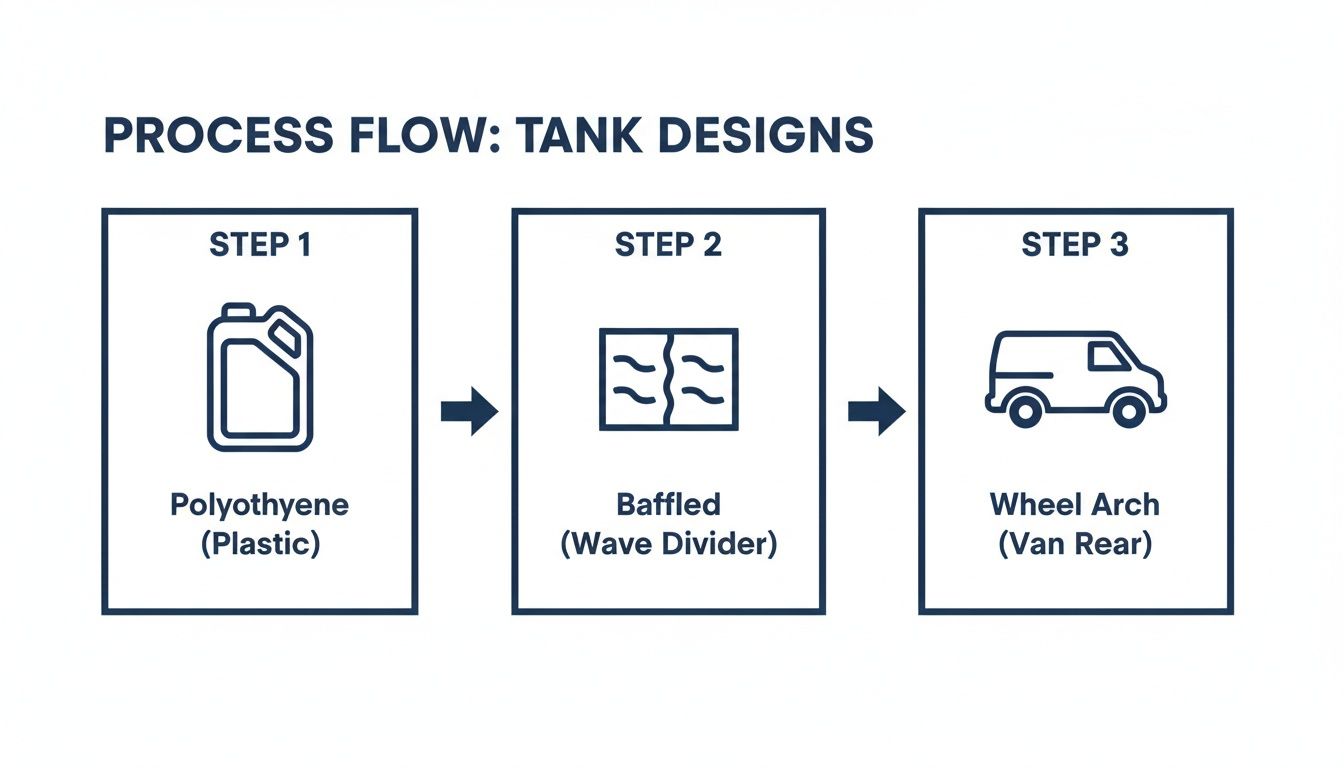
As you can see, choosing a tough polyethylene tank with a smart, baffled design is the foundation. Only then can you move on to building a flawless plumbing system.
Pro Tips for a Leak-Proof Setup
A truly professional installation is all about the details. Try to keep your hose runs as short and straight as you can – every bend and extra metre of hose creates a little bit of pressure loss.
Find a good spot for your pump where it’s easy to get to but also protected from getting knocked around or soaked by the elements.
Take your time sealing every single threaded connection with PTFE tape. A tiny, slow drip might not seem like a big deal at first, but it can easily drain your tank overnight, warp your van floor, and leave you high and dry when you arrive at your first job of the day. Check, and then double-check, every fitting.
Water Quality, Filtration, and Staying Legal
Having a water tank in your van is just the start. What really separates the pros from the amateurs is the quality of the water in that tank and what you do with it afterwards. This is where we get into two critical areas: how to get that flawless, spot-free finish every single time, and how to stay on the right side of UK environmental law. Nailing both is non-negotiable for building a reputable, sustainable detailing business.
The secret to a perfect, streak-free shine isn't some miracle polish or a fancy technique—it's the water. Across much of the UK, tap water is packed with dissolved minerals like calcium and magnesium. Let that dry on a car's paintwork, and you're left with stubborn white spots that completely ruin all your hard work.
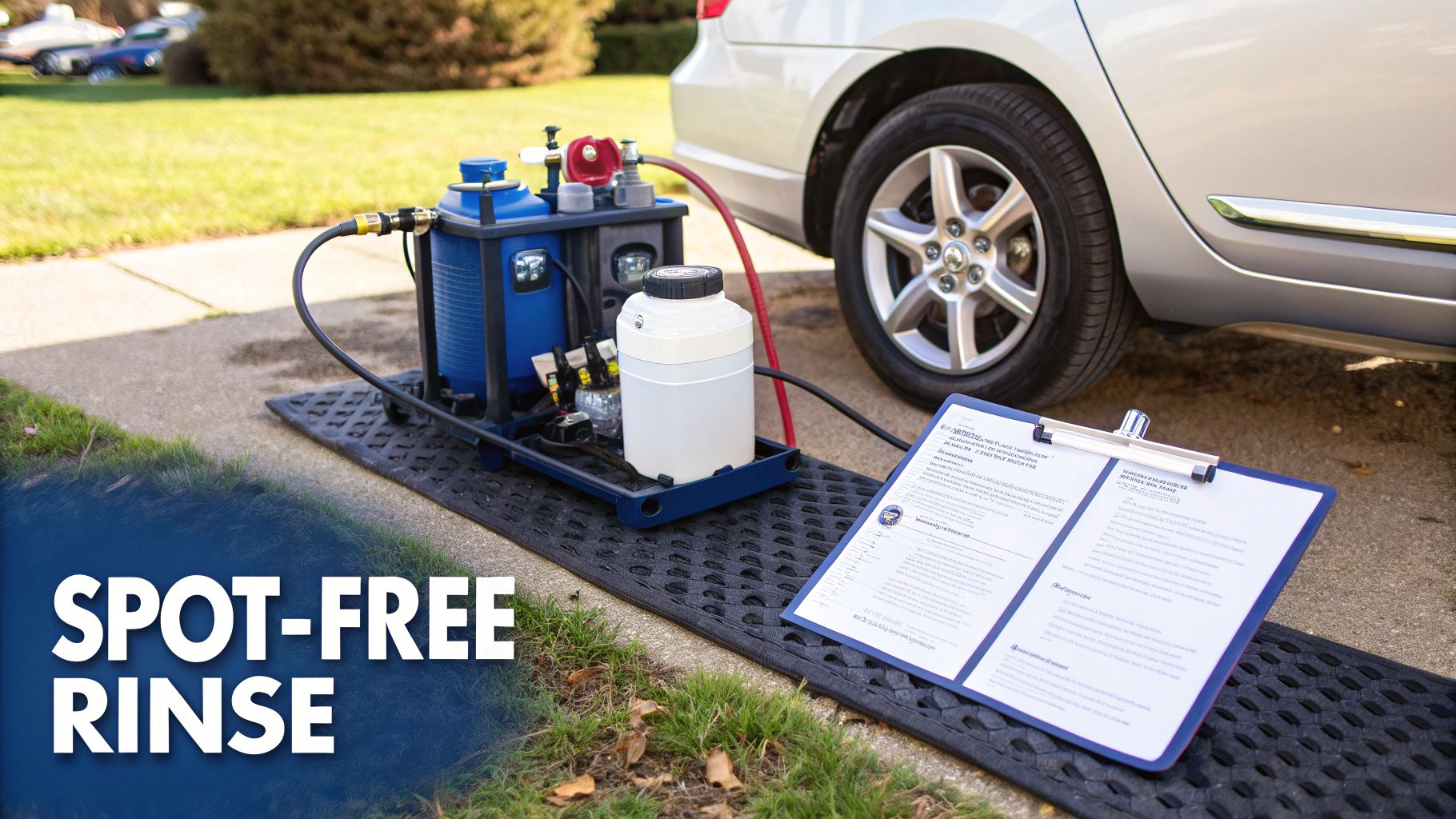
Achieving the Perfect Spot-Free Rinse
To get around the mineral-spot problem, professional detailers use purified water. The gold standard here is de-ionised (DI) water. A DI filtration system pushes water through a special resin that grabs onto and removes virtually all dissolved minerals, dropping the water's Total Dissolved Solids (TDS) count to nearly zero. This water is so pure that when it evaporates, it leaves absolutely nothing behind.
You have a few options for integrating filtration into your setup:
- Simple Inline Filters: These are basic sediment filters that sit between your tank and pump. They’re good for catching bits of grit and debris but won't touch the dissolved minerals that cause spotting.
- DI Resin Systems: This is the professional’s choice. A DI vessel is plumbed into your system, usually just for the final rinse, to guarantee that perfect, spot-free finish.
It's also crucial to keep your tank itself clean to prevent algae or bacteria from contaminating your pure water. The principles outlined in this guide on RV fresh water tank sanitizing are surprisingly relevant, even though it's for a different industry.
Navigating UK Legal Compliance
Working as a mobile detailer in the UK means you have serious legal duties when it comes to water. You can't just let soapy run-off disappear down the nearest drain. Most roadside drains flow directly into rivers and streams, so letting detergents, traffic film remover, and brake dust wash into them is a serious offence.
The main piece of law to be aware of is the Water Resources Act 1991, which deals with water pollution. If you allow contaminated trade effluent to enter a surface water drain, you could face prosecution by the Environment Agency. Fines can be steep, potentially reaching up to £20,000.
It is your legal responsibility to contain all wastewater you create on a job. This water, full of chemicals and pollutants, must be disposed of properly in a foul sewer – and only with permission from the local water authority.
This strict regulatory landscape is a massive reason why a dedicated water tank is so vital for mobile work. It's not just about convenience; it's about compliance. In fact, many modern setups are now designed to recycle 75-90% of their greywater using advanced filters. This not only keeps you legal but also serves as a great selling point for eco-conscious customers as the UK pushes towards its net-zero targets.
Keeping Your System in Top Nick: Maintenance and Winterising
Think of your water tank system as the heart of your mobile detailing business. If it goes down, you're not working. That's why a little bit of proactive care isn't just a good idea—it's absolutely crucial for keeping the cash flowing and avoiding those gut-wrenching moments when gear fails on a job.
Routine Checks and Cleaning
The first rule is to keep things clean. You should be flushing your tank out at least every few months, more often if you're storing water in it for extended periods. This stops any sediment, gunk, or algae from building up inside. A quick wash with a mild detergent or a proper tank cleaner, followed by a really good rinse, is all it takes to keep your water fresh and your system healthy.
Don’t just stop at the tank, though. Get into the habit of giving your entire plumbing setup a quick once-over. Check every hose, fitting, and valve for leaks, cracks, or any signs of wear and tear. A tiny drip you ignore today can become a full-blown flood tomorrow, emptying your tank and soaking a customer’s driveway—or worse, the inside of your van.
Getting Ready for a UK Winter
For any of us detailing in the UK, winterising your water tank setup isn't a suggestion; it's a necessity. When water freezes, it expands with enough force to crack a tank, wreck a pump, and split hoses wide open. It’s a fast track to expensive repairs and a quiet diary when you can least afford it.
Here’s a simple, no-nonsense checklist to protect your gear from the cold:
- Drain Everything: Start with the tank. Make sure it's completely empty—not a drop left.
- Run the Pump Dry: Disconnect your hoses and give the pump a quick blitz for a few seconds. This will push out any water trapped inside its mechanisms.
- Blow Out the Lines: If you have access to an air compressor, use it to blow air through all the lines and your pressure washer. You want everything bone dry.
- Leave Valves Open: Where you can, leave taps and valves in the open position. This ensures any sneaky bits of moisture can’t get trapped and freeze.
Taking ten minutes to winterise your system in the autumn will save you hundreds, maybe even thousands, of pounds. Seriously, it's the most important piece of seasonal maintenance you can do.
Finally, remember the whole system works together. Keeping your pressure washer in good shape is just as important as the tank itself. Mastering a few key pressure washer pump maintenance tips will ensure the whole setup runs smoothly for years to come.
Frequently Asked Questions
Even with the perfect setup, you’re bound to have questions. Let's tackle some of the most common ones we hear from mobile detailers about their water tanks, offering practical advice to help you on the job.
How Many Cars Can I Wash With My Tank?
This is the big one, isn't it? How far will that water actually stretch? As a solid rule of thumb, a standard 250-litre tank should see you through 2-3 full exterior washes when you’re using a pressure washer.
Of course, that's just a starting point. Your own technique and the flow rate of your pressure washer (measured in litres per minute) can make a huge difference. If you're doing lighter maintenance details or focusing mostly on interiors, that same 250 litres could last for several more jobs. It’s all about matching your tank size to the kind of work you do day in, day out.
Do I Really Need a Baffled Tank?
In a word, yes. Think of it less as an option and more as a non-negotiable piece of safety kit. Those internal walls, the baffles, are there for one crucial reason: to stop a massive surge of water from throwing your van's balance off when you brake, accelerate, or take a corner.
That "sloshing" effect in a tank without baffles can seriously destabilise your vehicle, particularly on roundabouts or if you have to stop suddenly. For any professional, a baffled tank is simply essential for handling your van safely.
A baffled water tank isn't a luxury; it's a critical piece of safety equipment. The stability it gives you makes it the only sensible and responsible choice for any system mounted in a vehicle.
How Do I Legally Dispose of Dirty Water in the UK?
Getting this right is absolutely crucial for staying compliant. Run-off from car detailing is considered contaminated, so it must never be allowed to enter a surface water drain—like a gully at the side of the road—because that water flows straight into local rivers.
The correct and legal way to handle this is by using a water containment mat to capture everything. From there, the wastewater has to be taken to a designated foul sewer disposal point, but you must have prior permission from the local water authority to do so. The other option is to have it collected by a licensed waste carrier.
If you've got more queries, from water quality to managing your account, feel free to dive into our full list of frequently asked questions.
For a reliable source of ultra-pure water that guarantees a spot-free finish every single time, find your nearest 24 Pure Water self-service filling station. Our network is built for professionals like you, offering 24/7 access to de-ionised water at a great price. Visit us at https://24purewater.co.uk to get started.