Think of the water that comes out of your tap. It might look perfectly clear, but it’s far from being just pure H₂O. Like sugar dissolving in a cup of tea, your water is carrying a whole host of invisible passengers. Total Dissolved Solids (TDS) is simply a measure of all these dissolved substances, from natural minerals to salts and other tiny bits of organic matter.
What TDS in Water Really Means
Imagine water on its long journey to your home. It travels over rocks, seeps through soil, and flows through pipes, picking up tiny particles along the way. These "passengers" are the dissolved solids that contribute to the final TDS reading. While the term sounds a bit scientific, the idea behind it is quite simple.
A TDS reading gives you the total concentration of these dissolved substances, usually measured in parts per million (ppm). One ppm is like one drop of ink in about 50 litres of water – a tiny amount, but it all adds up. It's a great snapshot of your water's overall makeup, though it doesn't tell you exactly what those solids are.
The Building Blocks of TDS
So, what are these dissolved solids made of? They’re mostly inorganic salts with a little organic matter mixed in. The most common culprits include:
- Minerals: Think calcium and magnesium. These are the classic ingredients for "hard water" and are responsible for that stubborn limescale in your kettle.
- Salts: Sodium, chlorides, and sulphates can all find their way into the water supply and often influence its taste.
- Metals: Tiny amounts of iron, potassium, and other elements are often picked up from the ground or old pipework.
It's really important to remember that a high TDS reading isn't automatically a red flag. Many premium bottled mineral waters, for instance, have high TDS levels precisely because they're packed with minerals that people find beneficial. You can find out more about why the purest water is not your drinking water in our detailed guide.
Key Takeaway: A TDS reading is a measure of quantity, not quality. It tells you how much is dissolved in your water, but not what it is. This is a crucial distinction for understanding its real-world impact.
Interpreting UK Water TDS Levels
In the UK, the TDS level is generally a good indicator of water hardness and taste, rather than a direct health issue. Water suppliers and quality experts use a general scale to classify TDS readings, which gives a good sense of what to expect from your tap.
Here's a simple breakdown of what those numbers mean in a UK context.
UK Water TDS Levels at a Glance
| TDS Level (ppm) | Water Quality Rating | Common Characteristics |
|---|---|---|
| 0 – 50 | Excellent / Ideal | Very soft water. Tastes crisp and pure, leaves no spots. |
| 50 – 300 | Good | Generally soft water with a pleasant taste. Low mineral content. |
| 300 – 600 | Fair / Hard | Noticeably "hard" water. Can cause limescale buildup and affect taste. |
| 600 – 900 | Poor / Very Hard | Very high mineral content. Limescale is a major issue. Taste can be unpalatable. |
| Above 900 | Unacceptable | Not recommended for consumption or most industrial uses without treatment. |
While a TDS level of 300 ppm is considered perfectly fine for drinking, it’s a different story for professional applications. For window cleaners, car detailers, or anyone needing a spot-free finish, those dissolved minerals are the enemy. When the water evaporates, they get left behind as ugly spots and streaks. This is exactly why managing TDS is non-negotiable for achieving that flawless, professional result.
How to Measure TDS and Interpret the Results
So, you know your water has dissolved solids, but the big question is, how much? Figuring this out is actually much easier than it sounds. You don't need a fancy lab coat or expensive equipment—a simple, handheld digital TDS meter will do the trick. They're affordable and incredibly easy to find.
With one of these little gadgets, you can get a near-instant snapshot of your water's quality. It puts the power in your hands, letting you check your tap water, see how well your filter is working, or monitor the conditions in your fish tank. The reading you'll see is in parts per million (ppm), which is the standard way to talk about TDS levels.
Using a Digital TDS Meter: A Step-by-Step Guide
Getting a reliable reading is all about being consistent. Follow these simple steps, and you'll get accurate results every time, whether it's your first test or you're keeping a regular check on your water.
Here’s the right way to do it:
- Get It Ready: Pop the protective cap off the meter. If it’s brand new or has been sitting in a drawer for a while, give the electrodes at the bottom a quick rinse with some distilled or deionised water. This just gets rid of any dust that might throw off your reading.
- Grab a Sample: Fill a clean glass with about an inch of the water you want to test. Make sure the glass is spotless, as any residue can contaminate your sample and give you a false high reading.
- Power On and Dip: Switch the meter on and dip the end with the electrodes into your water sample. Just be careful not to dunk it past the maximum level marker on the side.
- Wait for the Number: Give the meter a gentle stir to shake loose any air bubbles stuck to the probes. You’ll see the numbers on the display jump around a bit before they steady. That final, stable number is your TDS level in ppm.
In less than a minute, you've moved from guesswork to a concrete number you can actually use.
The Science Behind the Number: Electrical Conductivity
Now for a little bit of the "how." Interestingly, a TDS meter doesn't actually count every single particle. What it really measures is Electrical Conductivity (EC). See, completely pure H₂O is a terrible conductor of electricity. It’s the dissolved salts and minerals—which are made of charged ions—that allow a current to pass through.
The meter sends a tiny electrical current between its two electrodes. The more ions there are floating around, the easier it is for that current to travel, resulting in a higher EC reading. The meter then does a quick calculation, using a built-in conversion factor, to turn that EC measurement into the ppm reading you see on the screen.
A higher TDS level means more dissolved ions are present, which allows electricity to pass through the water more easily. This direct relationship between conductivity and dissolved solids is what makes a TDS meter so effective.
This journey from tap to glass is where all those dissolved solids come from.
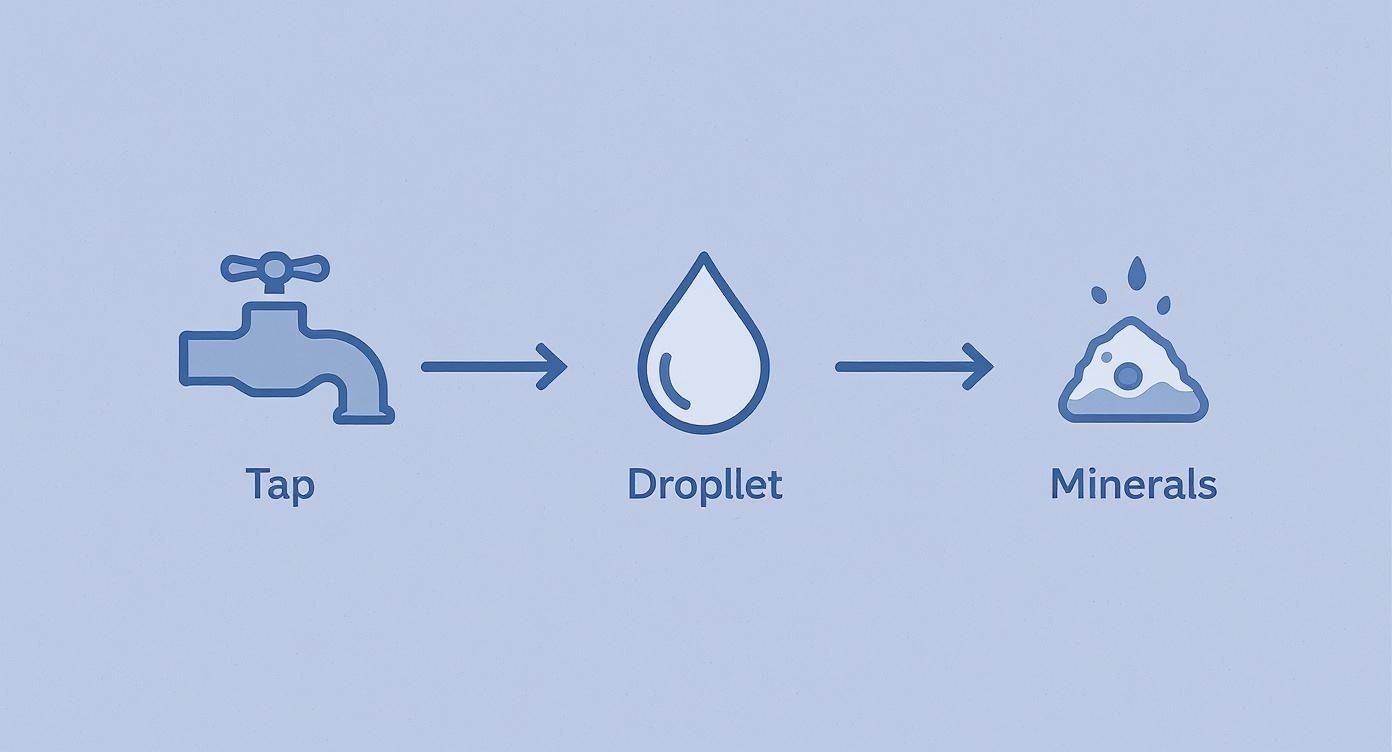
As you can see, even standard tap water has these solids, and that’s precisely what a TDS meter picks up on. For industries like professional cleaning where a perfect, spot-free finish is non-negotiable, getting the TDS down to zero is essential. If that's what you're aiming for, understanding how our ultra-pure water service works is the next logical step. Our process is designed to strip out these dissolved solids completely.
The Real-World Impact of Water TDS Levels
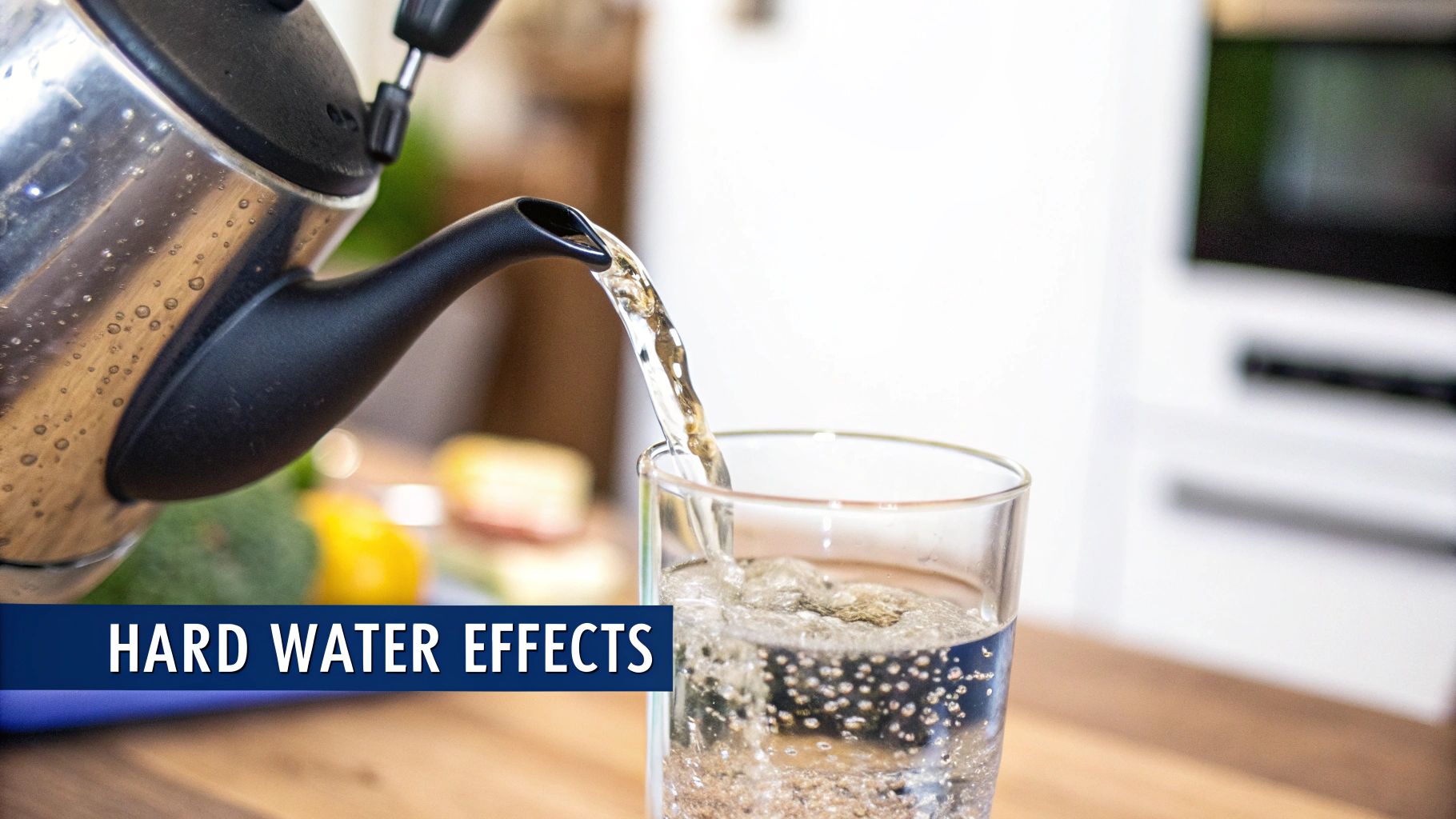
So, you’ve got a number from your TDS meter. What does it actually mean? It’s one thing to know the theory, but the real story of TDS is how those invisible particles affect your day-to-day life and professional work. From the kettle in your kitchen to the spotless finish on a client's car, high TDS levels have very real, and often frustrating, consequences.
Think of a high TDS reading as a signpost for hard water, a familiar problem for many of us here in the UK. This just means the water is loaded with minerals, mostly calcium and magnesium. While it’s perfectly safe to drink, these are the culprits behind a whole host of problems that can end up costing you real time and money.
High TDS in The Home
At home, you don’t have to look far to see the effects of high TDS water. Once you know what to spot, the signs are everywhere. Those dissolved minerals build up over time, leaving their mark on your appliances and turning simple cleaning into a chore.
- Limescale Buildup: This is the most obvious calling card of hard water. That chalky, white gunk coating your kettle’s heating element, clogging up showerheads, and leaving a film on taps? That's all down to calcium and magnesium deposits. Over time, this buildup chokes the life out of your appliances, making everything from washing machines to dishwashers less efficient and more likely to break down.
- Soap Scum and Poor Lather: Ever wonder why your soap or shampoo just won't foam up properly? The minerals in hard water react with soap to create a sticky film called soap scum, which is a real pain to rinse away. It not only leaves a residue on your skin and hair but also means you’re using way more product just to feel clean.
- Spotty Glasses and Dishes: If your glassware comes out of the dishwasher looking cloudy and streaked, you can bet high TDS is the reason. As the water evaporates in the drying cycle, it leaves behind a fine layer of mineral spots, completely ruining the point of washing them in the first place.
Specialist Hobbies and TDS
For some hobbies, managing TDS isn't just about avoiding annoyances; it's absolutely vital for creating a healthy, stable environment. The level of precision needed here is worlds away from general household concerns.
Take aquarium keepers, for example. They have to get the water parameters just right to keep their fish and plants alive and well. After all, different species evolved in wildly different conditions across the globe.
A delicate Discus fish from the soft, acidic waters of the Amazon simply won't survive in the hard, alkaline water common in London. For any serious aquarist, controlling TDS is a core part of recreating a species' natural habitat to prevent stress and disease.
It's a similar story for brewers, who know that the mineral profile of their water has a huge impact on the final taste of their beer. The famous pale ales from Burton-on-Trent, for instance, get their unique character from the region's naturally high-sulphate water. For brewers chasing consistency and quality, adjusting TDS is a non-negotiable part of the craft, as we explore in our guide for how breweries can benefit from pure water.
Professional Applications Where Purity is Paramount
Move into the professional world, and the fallout from high TDS becomes even more serious. For any business where a flawless finish is the main selling point, any mineral residue left by evaporating water is a disaster. It directly hits the quality of the service and, ultimately, the business's reputation.
A very common problem stemming from high TDS is hard water, which causes stubborn stains on surfaces. Learning how to remove hard water stains from windows is a frequent headache for professionals who haven't yet switched to pure water.
This is precisely why industries like professional window cleaning and car valeting won't settle for anything less than water with a TDS reading of 0 ppm.
- Window Cleaning: Use regular tap water on windows, and as it dries, it leaves all those dissolved solids behind as ugly white spots and streaks. Using ultra-pure, deionised water guarantees a perfect, crystal-clear finish every time. Why? Because there's simply nothing left behind to spoil the glass.
- Car Valeting and Detailing: For a car detailer, water spots can destroy hours of meticulous work. After a wash and rinse, any minerals in the water will dry onto the paintwork, leaving unsightly marks that can even etch into the clear coat over time. A final rinse with 0 ppm TDS water is the only way to ensure that perfect, spot-free shine that customers pay for.
In these fields, managing TDS isn’t just a nice-to-have. It’s a fundamental requirement for delivering professional results.
Understanding TDS in the Context of UK Water
When you get a TDS reading from your tap, it’s easy to jump to conclusions. A high number might look alarming, while a low one feels like a win. But the reality of water quality in the UK is a bit more complicated than that. A TDS reading is a fantastic starting point, but it doesn't tell you the full story of what's actually in your water.
It's a common myth that a high TDS level automatically means your water is unsafe. In many parts of the UK, especially in hard water areas, the tap water is naturally rich in healthy minerals like calcium and magnesium. These minerals push the TDS reading up but are perfectly safe to drink. On the flip side, a very low TDS doesn't guarantee purity; it just means there are fewer dissolved minerals.
The trick is to think of TDS not as a simple good-or-bad safety score, but as a tool for checking if water is right for a specific job. For drinking, the UK enjoys some of the best-quality tap water in the world. For specialist applications, though, a much closer look is needed.
Regulation and Water Quality in the UK
One of the main reasons we can be so confident in our tap water is thanks to decades of strict regulation and environmental management. These efforts have successfully targeted and cut down on harmful dissolved substances, which has completely changed what makes up a typical TDS reading today.
Long-term monitoring in England reveals just how effective this has been. Between 1990 and 2023, regulations have slashed the levels of harmful pollutants in our rivers. Concentrations of various dissolved metals have dropped dramatically: cadmium, chromium, and nickel are all down by around 70%, while lead and zinc have been reduced by over 50%. You can dive deeper into these impressive long-term trends in river quality in England.
This data is reassuring. While a TDS meter measures everything that’s dissolved, these programmes have systematically removed the nasty stuff that would otherwise be a cause for concern.
Why Context Is Everything for TDS
Knowing the context of your TDS reading is absolutely vital. The "right" level of TDS depends entirely on what you're using the water for. What’s perfectly fine for one task can be a complete disaster for another.
Let's look at a few real-world examples:
- Drinking Water: A TDS reading between 50-400 ppm is often seen as ideal. It tastes good and contains beneficial minerals. Most UK tap water sits comfortably in this safe, pleasant range.
- Speciality Coffee: Professional baristas are incredibly precise. They often aim for a TDS of around 150 ppm to get the perfect mineral balance for extracting the best flavour from the coffee beans.
- Professional Window Cleaning: Here, any dissolved solids are the enemy. As the water dries, they leave behind ugly spots and streaks. For that flawless, streak-free finish, the target TDS has to be 0 ppm.
This really gets to the heart of the matter: a TDS reading isn't inherently "good" or "bad". It’s just a measurement. Its meaning comes from what you need to achieve.
For professionals whose reputations are built on delivering a perfect finish, general tap water—no matter how safe it is to drink—simply won't cut it. Getting to a TDS of zero isn't just a preference; it's an absolute necessity for guaranteeing top-quality results, every single time.
Effective Ways to Reduce TDS in Water
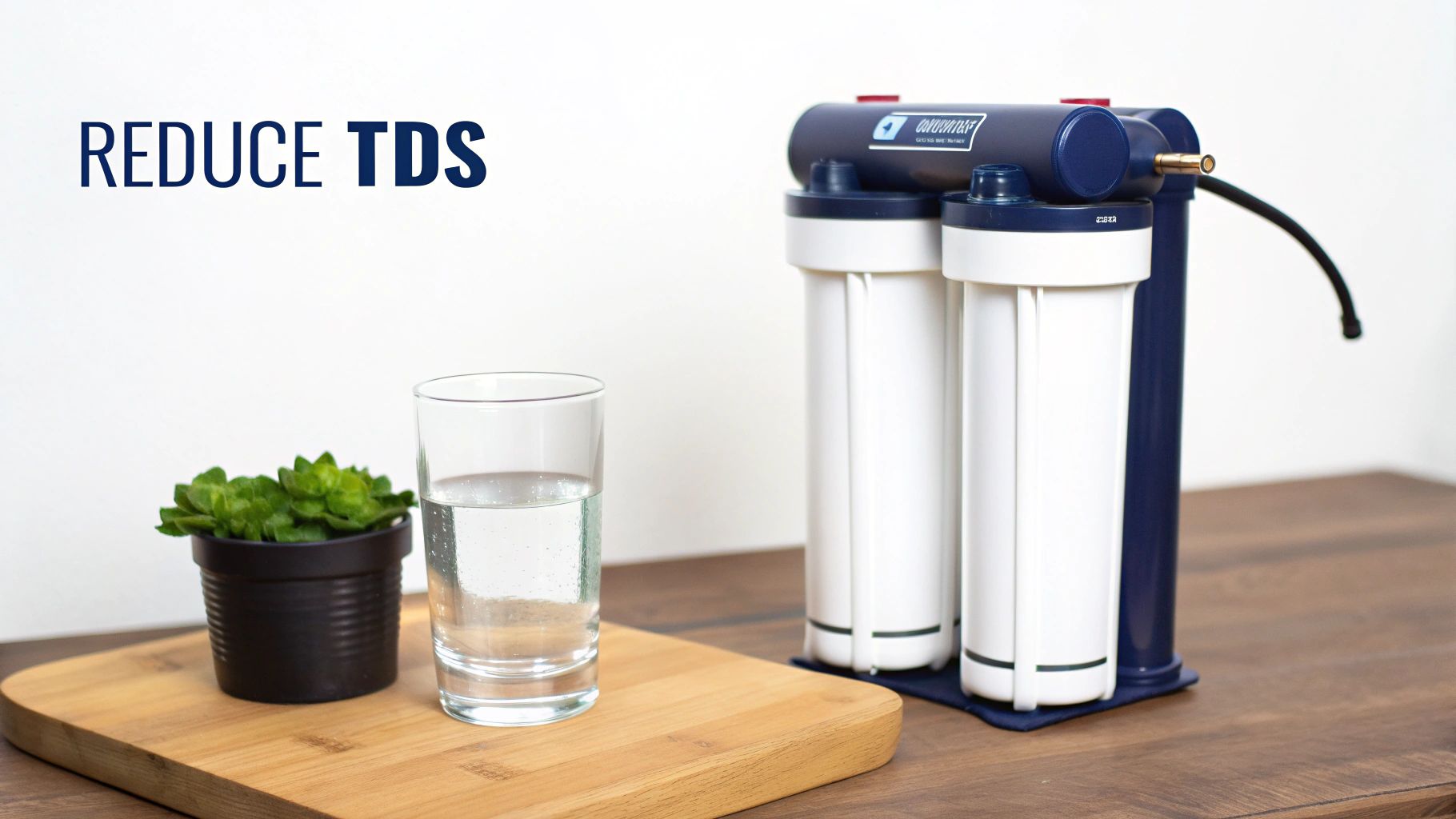
Knowing what TDS is and how it affects your work is the first part of the puzzle. The next is actually doing something about it.
For a huge range of professional jobs, from getting a perfect finish on a car to keeping a sensitive aquarium healthy, your standard tap water just won't cut it. The real goal is to strip out those dissolved solids, and thankfully, there are some brilliant methods designed for exactly that, turning high-TDS water into the pure stuff you need.
The two technologies that lead the pack are Reverse Osmosis (RO) and Deionisation (DI). While both are fantastic at slashing TDS levels, they work in completely different ways. In fact, they’re often used together to get the absolute best results. Which one you need really comes down to just how pure you need your water to be.
Reverse Osmosis: The Powerful Sieve
Think of Reverse Osmosis (RO) as an incredibly fine molecular sieve. It’s a filtration process that uses high pressure to force water through what’s called a semi-permeable membrane—a material riddled with microscopic holes.
These pores are just big enough for tiny water (H₂O) molecules to get through, but they’re too small for almost all the dissolved solids, like salts, minerals, and other contaminants. The pure water makes it to the other side, while all the gunk that’s been rejected gets flushed away. This technique is a real workhorse, capable of removing between 95-99% of TDS from the source water.
An RO system is your first line of attack for bringing high TDS readings down, but it’s not quite perfect. It rarely gets you to an absolute 0 ppm, as a few of the smallest dissolved ions can sometimes slip through.
Deionisation: The Ion Magnet
When even a tiny amount of TDS is too much, Deionisation (DI) is the answer. This isn't filtration in the traditional sense; it’s more of a chemical process that uses ion exchange to reach an incredible level of purity.
You can imagine it as using powerful magnets to pull impurities right out of the water. DI systems contain special resin beads that hold an electrical charge. As water passes over them, these beads grab onto the dissolved mineral ions—the positively charged cations (like calcium) and negatively charged anions (like chloride)—and swap them for hydrogen (H+) and hydroxyl (OH-) ions. These then combine to form pure H₂O.
This method is exceptionally thorough, mopping up virtually every last ion that an RO system might have missed. The result? Ultra-pure water with a TDS reading of 0 ppm.
Deionisation is the final polishing step for professionals who demand absolute perfection. It's the only commercially viable method for consistently achieving a zero TDS reading, which is essential for a guaranteed spot-free finish in cleaning or for creating a perfectly controlled environment in a laboratory.
Comparing Water Purification Methods
Both RO and DI are powerful tools, but they shine in different areas. For anyone curious about how water quality affects specific tasks, this article on understanding water filtration and its impact on coffee flavour offers some great insights.
To help you choose the right approach, it helps to see them side-by-side.
Comparing Water Purification Methods
| Method | How It Works | TDS Reduction Efficacy | Best For |
|---|---|---|---|
| Reverse Osmosis (RO) | Pushes water through a fine membrane, physically blocking most dissolved solids. | High (95-99%) | Pre-treatment for DI systems; general purification where near-zero TDS is not critical. |
| Deionisation (DI) | Uses ion-exchange resins to chemically remove charged mineral ions from water. | Extremely High (up to 100%) | Final polishing to achieve 0 ppm; essential for professional cleaning and scientific use. |
For the ultimate in water purity, these two methods are often used in tandem. An RO unit does the heavy lifting, removing the bulk of the TDS first. This takes the strain off the DI system and makes the expensive DI resin last much, much longer. The DI system then comes in as the final polisher, catching those last few ions to produce consistently perfect, ultra-pure water.
This two-stage approach is precisely the standard you'll find at 24 Pure Water's filling stations, giving professionals on-demand access to the 0 ppm water they need to get the job done right.
Got Questions About Water TDS? We’ve Got Answers
Let's clear up a few common questions that pop up when talking about Total Dissolved Solids. This is your quick-fire guide to bust some myths and solidify what you've learned.
We'll keep it simple and focus on the practical side of things, helping you understand what TDS means for you in the real world.
Is High TDS Water Unsafe to Drink in the UK?
In short, no. A high TDS reading by itself isn't a red flag for safety. UK tap water is incredibly well-regulated, and a high TDS level usually just points to hard water, which is rich in harmless (and even beneficial) minerals like calcium and magnesium.
The real difference is between taste and safety. Water with a very high TDS might taste a bit salty or bitter, but at the levels found in the UK, it’s not a health risk. A TDS meter is great for measuring minerals, but it can't detect specific nasties like lead or bacteria, which are the real safety concerns.
Can a Standard Water Filter Jug Reduce TDS?
Not really. That filter jug you keep in the fridge is great for making your water taste and smell better, but it won't do much for the TDS reading. Most of these filters use activated carbon, which is brilliant at removing chlorine and some organic stuff.
However, they just aren’t built to pull out the tiny dissolved mineral salts that contribute to TDS. To properly tackle those, you need to step up to a more serious filtration method like Reverse Osmosis or Deionisation, which are specifically designed to strip out those dissolved solids.
Why Does My TDS Reading Change?
It’s completely normal for TDS readings to go up and down. A single test is just a snapshot, and several things can cause the numbers to shift.
- Your Water Source: This is the biggest factor. Water that has travelled over or through mineral-rich ground will naturally pick up more dissolved solids.
- The Seasons: Believe it or not, the weather plays a part. Heavy rain can dilute the mineral concentration, leading to a lower reading, while a long dry spell can have the opposite effect.
- Temperature: The temperature of the water can influence the measurement, so it’s always best to test at a consistent room temperature to get reliable, comparable results.
If you notice a sudden, big jump in your usual TDS reading, it might signal a change in your local supply or a potential problem, which is why testing every now and then is a smart habit. It's worth noting that the Drinking Water Inspectorate (DWI) for England reported in 2024 that 99.9% of private water supplies met the required standards. That’s a massive improvement from just 34.3% in 2023, showing just how quickly water management is improving. You can read more about UK water quality standards to stay informed.
For professionals who can't compromise on purity and need a reliable source of 0 ppm water, 24 Pure Water is the answer. We take the hassle out of managing complex filtration systems with our nationwide network of self-service filling stations. Get on-demand, ultra-pure water for that perfect, spot-free finish every single time. Find your local station and fill up at https://24purewater.co.uk.