Before you even start looking for where to buy pure water, it’s worth taking a moment to get why it's such a game-changer for any professional who needs a flawless finish. Trying to get a perfect result with regular tap water is a bit like trying to paint a masterpiece on a dusty canvas. No matter how skilled you are, the final look will always be let down by the imperfections already there.
Understanding Why Pure Water Is a Professional Essential

The secret to that perfect, streak-free finish isn't what's in your cleaning solution—it's what's missing from your water. The invisible culprit in tap water is something called Total Dissolved Solids (TDS), which is just a measure of all the minerals and salts floating around.
Here in the UK, this is a massive issue. Around 60% of households are in hard water areas, which means the tap water is packed with minerals like calcium and magnesium. It’s perfectly fine to drink, but for professional work, these minerals are the reason you get those frustrating spots, streaks, and limescale deposits that can ruin a job.
The Science of a Flawless Finish
Ever wondered what causes those chalky white spots on a freshly cleaned window or car? When tap water evaporates, the water molecules turn to vapour, but every single mineral particle it was carrying gets left behind. That’s what you’re seeing. This forces you to go back over your work, polishing and buffing away the residue, which costs you time and energy.
Pure water, on the other hand, has been through a deionisation or filtration process that strips out all these solids, bringing its TDS reading down to almost zero.
Think of pure water as a natural magnet for dirt. Because it’s so free of its own minerals, it actively grabs onto grime and lifts it away from the surface. When it dries, it leaves absolutely nothing behind—just a crystal-clear finish.
This simple bit of science is what makes modern professional cleaning so effective.
Why It Matters for Your Trade
Getting your head around this is vital for any professional whose reputation is built on the quality of their finish. The difference pure water makes isn't just about looks; it directly affects how efficiently you work and how happy your clients are.
- For Window Cleaners: It's the key to a perfect, streak-free shine without ever needing a squeegee or a drying cloth. Imagine the time that saves on every single job.
- For Car Valeters: It guarantees a spotless final rinse, stopping the water spots that can completely undermine an otherwise meticulous detailing job.
- For Aquarists: It creates a stable, safe environment for delicate fish and aquatic life, free from the unpredictable and often harmful minerals in tap water.
At the end of the day, switching to pure water isn't just about cleaning better; it’s about working smarter. The importance of water purity is recognised across many industries, a principle even seen when exploring the impact of water filtration on coffee flavour. You can also read our guide on why ultrapure water is not your drinking water to learn more.
Where Can You Get Your Hands on Pure Water?
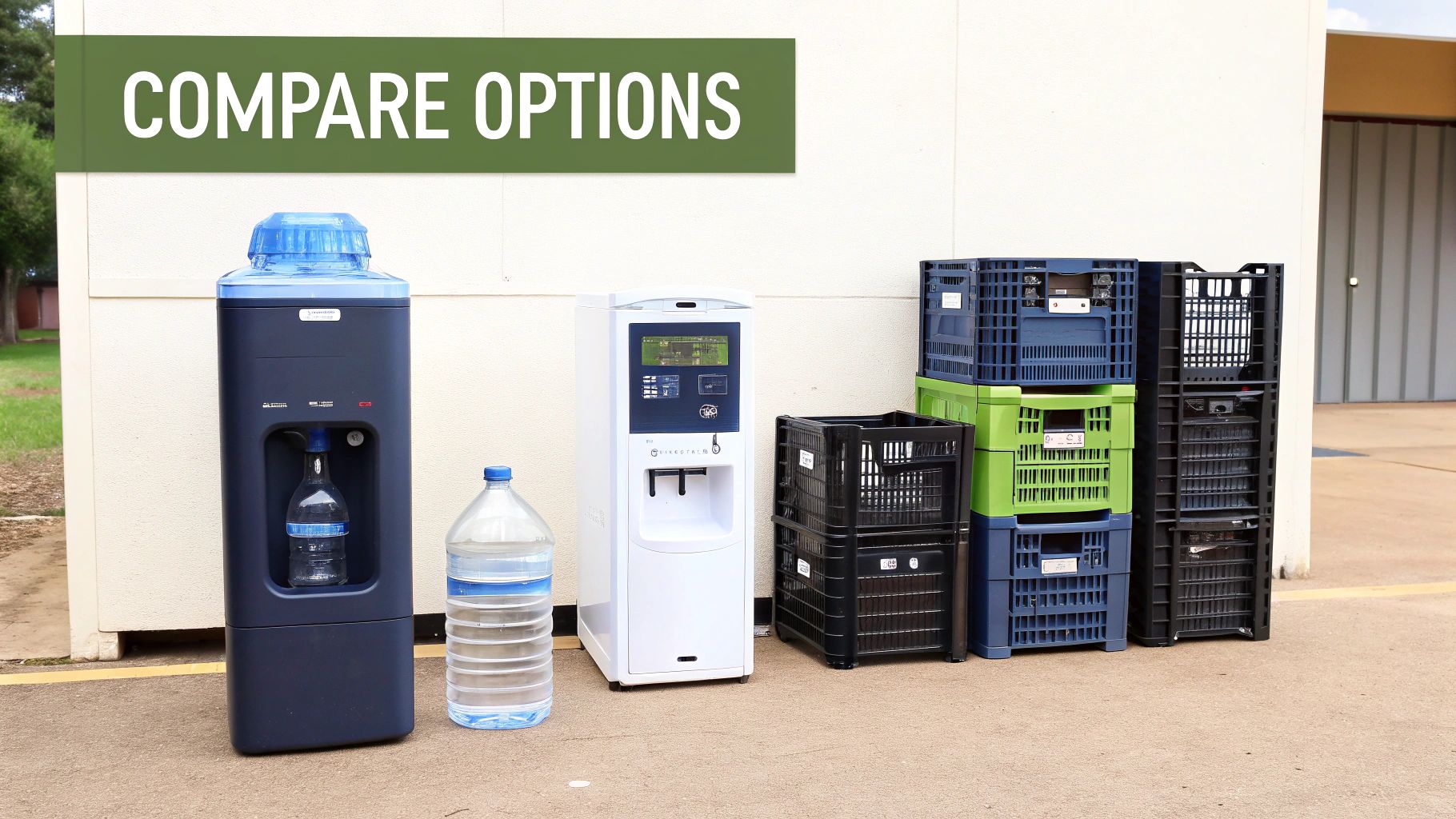
So, you're sold on the benefits of pure water for your business. The big question now is, where do you actually get it from? Your best bet really comes down to a few key things: how much water you get through each day, the space you have for storage, and what you’re prepared to spend upfront.
Let's break down the four main ways professionals source their pure water. Each has its own pros and cons, and what works for one business might be a total non-starter for another. A car valeter who just needs a few litres for a final spotless rinse has completely different needs from a window cleaning crew that burns through hundreds of litres on a big job.
Buying Pre-Bottled Deionised Water
For anyone just starting out, grabbing pre-bottled or pre-packaged deionised water is often the easiest first step. You can find it everywhere from online shops and Halfords to the shelves of big supermarkets. The appeal is pure convenience—you just grab what you need, when you need it, with zero setup costs.
But that convenience has a catch: the price. Bottled water is, without a doubt, the most expensive way to buy pure water per litre. If you're using it regularly, those costs will skyrocket. Plus, you’re left dealing with a mountain of plastic containers to store and get rid of.
Using Traditional Trade Suppliers
The next step up is often going to a trade supplier or a local depot. These places are set up for professionals and let you fill your own tanks directly on-site. It’s a much more cost-effective way to get larger quantities than buying small bottles.
The biggest snag here is that you're on their clock. You're tied to their 9-to-5 opening hours, which is a real pain if you need an early start or a late refill. You’ve also got to account for the time and fuel spent driving to and from the depot, which chips away at your time and profits.
Installing Your Own On-Site Filtration System
For businesses that use a massive amount of pure water, installing an on-site filtration system can look like the ultimate solution. A Reverse Osmosis (RO) system, for instance, hooks up to your mains water and produces pure water whenever you need it. Once you've paid off the initial cost, the price per litre is incredibly low.
The major hurdle is that high upfront investment, which can easily run into thousands of pounds. These systems also demand space, ongoing maintenance, and regular filter changes. If you want to explore pure water window cleaning systems in more detail, you’ll see the kind of commitment they require.
Filling Up at 24/7 Self-Service Stations
A newer, and increasingly popular, option is the 24/7 self-service filling station. Think of it like a petrol pump for pure water. These automated stations give you pay-as-you-go access to ultra-pure water, day or night. It’s a brilliant middle ground, mixing the low cost of bulk water with on-demand convenience.
With this method, there’s no hefty investment and no maintenance to worry about. You just find a local station with an app, fill up your tank whenever it suits your schedule, and only pay for what you take. For many mobile professionals, it's the most efficient and flexible choice out there.
A Quick Comparison of Pure Water Sourcing Methods
To make things clearer, here’s a straightforward look at how the four main options stack up against each other.
| Sourcing Method | Typical Cost per Litre | Upfront Investment | Convenience Level | Best For |
|---|---|---|---|---|
| Pre-Bottled Water | Highest | None | High (for small amounts) | Very low-volume or emergency use |
| Trade Suppliers | Medium | Low (cost of tanks) | Low (restricted hours) | Medium-volume users with flexible schedules |
| On-Site System | Lowest | Very High | High (on-demand at base) | High-volume, static businesses |
| 24/7 Filling Station | Low | None | Very High (anytime access) | Mobile pros needing flexibility and value |
Looking at them side-by-side, it's easy to see how a 24/7 filling station hits the sweet spot for most window cleaners, car valeters, and other mobile trades who need to balance cost, quality, and the freedom to work on their own terms.
How Self-Service Filling Stations Are Changing the Game
For any professional on the move, getting hold of pure water has always felt like a bit of a trade-off. You're either paying a premium for small, bottled quantities, killing precious work time driving to a supplier with limited hours, or staring down the barrel of a hefty investment in your own filtration system. But there's a newer, smarter solution that's completely changing how trades get the water they need.
Enter the 24/7 self-service filling station. Think of it like a petrol pump, but for ultra-pure water. These automated stations are popping up all over, offering total pay-as-you-go access. That means no contracts, no commitments, and no more planning your day around someone else's 9-to-5 schedule.
Unmatched Flexibility for the Modern Professional
The biggest draw here is freedom. Let's be honest, mobile professionals don't work tidy office hours. A job can run late, or you might need to be on the road at the crack of dawn to beat the traffic. These self-service stations are always on, so you can fill your tanks whenever it works for you—whether that’s 6 am before the first job or 10 pm on the way home.
This on-demand model also means you don't have to turn your garage into a water storage facility. For anyone tight on space, that's a huge win. You just top up as you go, ensuring you always have fresh, perfectly purified water for the next client.
The real advantage is taking all the hassle out of the equation. No bulky filtration kit to service, no filters to change, and no second-guessing the quality of water you've produced yourself. It's just simple, reliable, and professional.
A Smarter, More Cost-Effective Way to Work
Everything about the experience is built for speed. You typically use a mobile app to find your nearest station, check your credit, and even see how much you've used. When you get there, it’s a simple case of tapping a key fob or card and filling your tank. Quick and painless.
It’s not just about convenience; it's also incredibly cost-effective. In fact, the use of self-service pure water filling stations has jumped by 30% since the pandemic, driven by professionals who need that mix of flexibility and value. You get to skip the queues at old-school depots and buy ultra-pure water for as little as 4p per litre—a massive saving compared to buying it bottled. You can find more data on the UK water market on Statista.
By combining genuine affordability with ultimate convenience, these stations give tradespeople a serious edge. To get a feel for how it works in the real world, you can learn more about the network of 24-hour pure water filling stations across the UK. It’s the modern answer for any professional who needs pure water without compromising on quality, cost, or their own schedule.
Choosing the Right Water Source for Your Trade
Knowing your options is a great start, but the real trick is figuring out how they fit into your day-to-day work. The best way to decide where to get your pure water is to look closely at what your job actually demands. After all, what works for a high-volume window cleaner is going to be completely different from what a hobbyist fishkeeper needs.
Let's get practical and match the right water source to the right profession, focusing on what will be most efficient and budget-friendly for each.
For Window Cleaners and Solar Panel Cleaners
If you're in this business, you need one thing above all else: a massive, non-stop supply of ultra-pure water. A typical day can easily burn through hundreds of litres, and even the tiniest impurity will leave streaks and spots on glass. That means unhappy customers and frustrating callbacks.
- Mobility is everything: You’re constantly on the road, travelling between different sites all day long.
- Time is money: Every minute counts. Time wasted driving to a supplier during office hours or waiting for an on-site system to process water is time you aren't earning.
For these reasons, 24/7 self-service filling stations are pretty much the perfect solution. They give you unlimited access to cheap, ultra-pure water without the huge upfront cost of installing your own system. Being able to top up your van-mounted tank whenever you need to—whether it's 6 am or 10 pm—gives you the flexibility a mobile business thrives on.
For a high-volume trade like window cleaning, the pay-as-you-go model of a filling station takes all the hassle of equipment maintenance and the risk of a breakdown off your shoulders. It guarantees you have a reliable supply whenever a job comes in.
For Mobile Car Valeters and Detailers
Car valeting is all about a flawless finish. While you might not need the sheer volume of water a window cleaner does, the quality has to be just as high, especially for that final rinse. That’s what delivers the perfect, spot-free shine customers pay for.
Again, mobility and convenience are the name of the game. You need pure water on demand but can't afford to sacrifice precious van space for a bulky filtration system. Bottled water is fine in a pinch, but the cost quickly adds up if you're using it regularly.
A self-service filling station strikes the ideal balance. You can fill smaller, more manageable containers whenever you need them, only paying for what you take. This keeps your overheads down while ensuring every final rinse is done with 0 TDS water. It’s that professional touch that makes your service stand out.
This chart breaks down why a self-service station just makes sense for mobile trades.
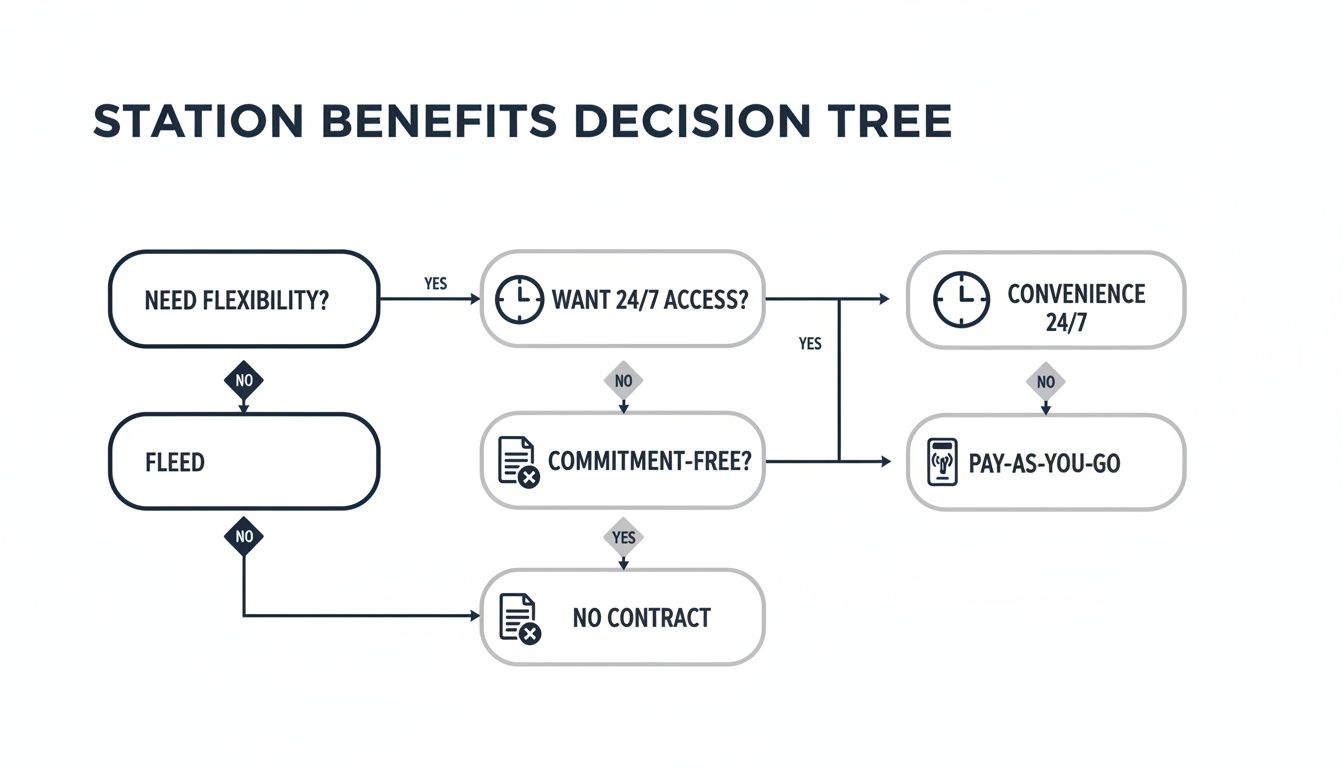
As you can see, the combination of 24/7 access and pay-as-you-go pricing is a perfect match for the unpredictable nature of mobile work.
For Aquarium Keepers and Aquatics Specialists
For anyone keeping fish, water purity isn't about looks—it's literally a matter of life and death. Tap water is full of chlorine, chloramine, and fluctuating mineral levels that can be toxic to sensitive fish, corals, and plants. Your entire goal is to create a stable, safe environment.
While some serious hobbyists might install a small home RO unit, they can be slow and create a lot of wastewater. For bigger tanks or for doing large water changes, buying pre-filtered water is often a much more practical option.
The best choice here really comes down to volume. If you have a small tank, grabbing a few bottles of deionised water is easy enough. But for larger setups or frequent water changes, a local filling station provides a much more affordable and consistent source of pure water, completely free from the nasties found in your tap.
Your First Visit to a 24-Hour Pure Water Station
Thinking about trying a self-service pure water station? It might seem a little strange at first—a fully automated system you can use any time of day or night. But honestly, it couldn't be simpler, and it's designed to get you back on the road in minutes. Let's walk through exactly what to do so your first visit is a breeze.
First things first, you'll need to grab the provider's mobile app. This little app is your command centre: it's how you'll find the nearest station, check your credit, and see how much water you've used. Most companies even throw in a bit of free credit just for signing up, which is a nice touch.
Once you’ve got the app installed, you'll need to load some credit onto your account. This is usually just a case of adding your debit or credit card details, much like topping up any other pay-as-you-go service. With money on your account, you're ready to head over to the station.
Arriving and Getting Ready to Fill
When you get to the filling station, pull your van up as close to the unit as you can. It’s a good idea to have your tank or water containers ready to go before you even get out—lids off, clean, and easy to reach. The water comes out fast, so a little prep makes everything go that much smoother.
Next, you need to 'wake up' the dispenser. You'll typically do this in one of two ways. You can either tap a physical key fob against the reader (you can usually order one when you sign up) or simply press a button inside the mobile app. The system will then light up or beep to let you know it's ready for you.
Filling Up and Hitting the Road
With the system active, pop the dispenser hose securely into the opening of your tank and hit the big "Start" button on the unit. The water will start flowing straight away, and it comes out with some serious force, so stay with it and keep a close eye on the water level.
Top Tip: Don't wander off! These systems can pump out water at over 100 litres per minute. You'll want to be right there to hit the stop button to avoid a messy and expensive overflow.
Once you’re full, just press the "Stop" button and the flow will cut off instantly. Hang the hose back on the unit, screw the caps back on your containers, and you're done. The cost is automatically taken from your account balance, and you’ll get a receipt in the app straight away. It’s a simple, no-fuss system that puts you in complete control.
Handling and Storing Pure Water for Best Results
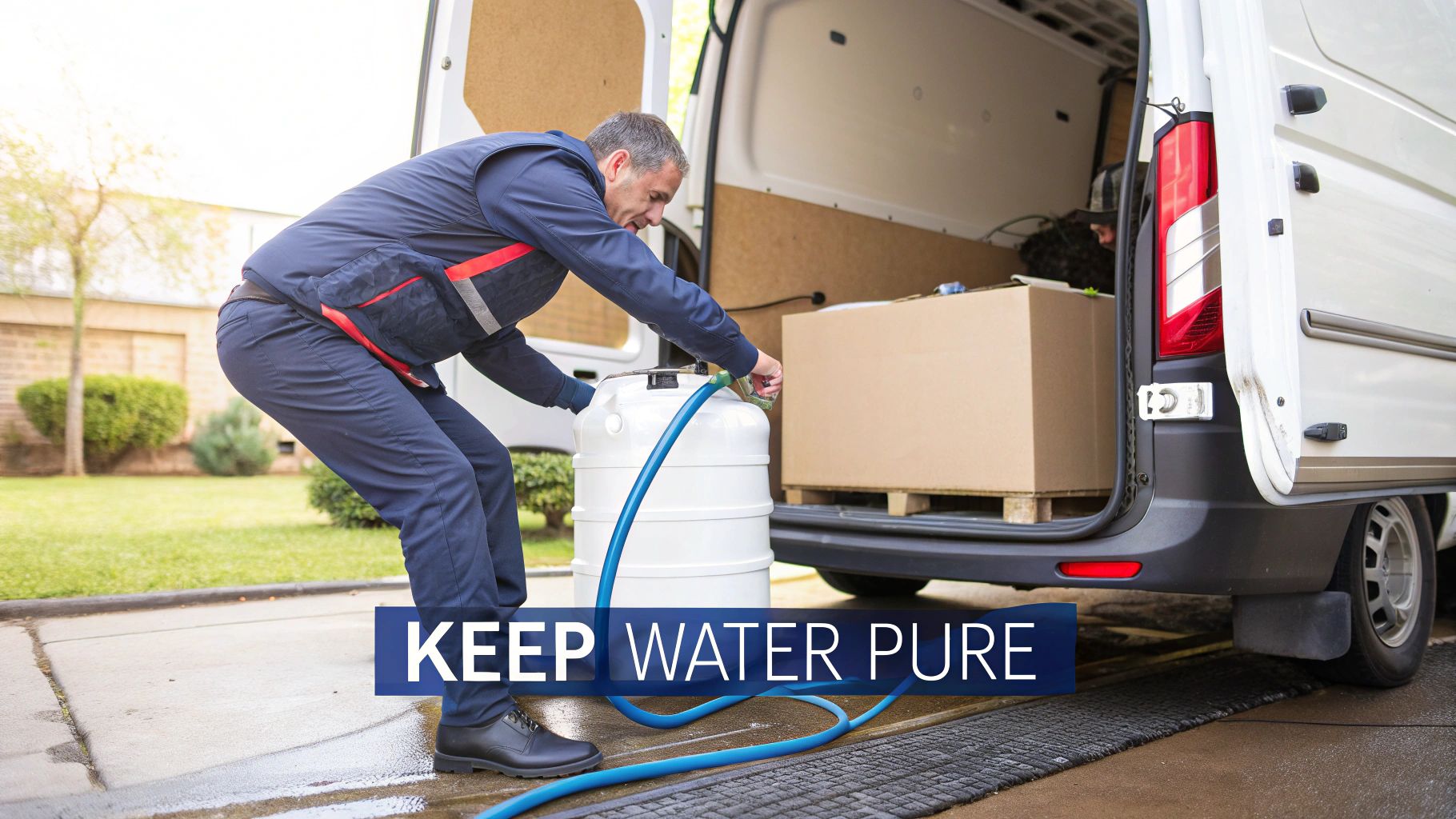
Knowing where to get your hands on pure water is one thing, but keeping it that way is the real key to achieving those perfect, streak-free finishes job after job. The moment you fill your tank, you're in charge of protecting that water quality.
Think of pure water as an aggressive cleaning agent. It's so clean, it actively wants to absorb minerals and impurities from anything it touches. This means any dust, algae, or bacteria in your tank or hoses will get drawn right back into the water, sending your TDS reading creeping up and ruining its cleaning power.
Choosing and Maintaining Your Equipment
Your first line of defence is having the right kit. You should only ever store pure water in food-grade plastic tanks made for the job. These are built from non-reactive materials, so they won’t contaminate the water by leaching chemicals or other nasties into it.
Of course, even the best tank needs a bit of upkeep. Regular cleaning is an absolute must, as biofilm and algae can start to build up over time, particularly when it gets warmer.
- Clean Tanks Regularly: Every few months, give your tanks a proper scrub to get rid of any potential contaminant build-up.
- Keep Hoses Clean: Don't forget your hoses and pumps. Flush them through regularly because any water left sitting inside is a perfect breeding ground for bacteria.
It’s vital to remember that deionised water is not safe for drinking. Because it contains no minerals, it can actually strip essential electrolytes from the body if you drink it. Make sure your pure water containers are clearly labelled to avoid any accidents.
Getting your storage and handling right is just as important as the initial filtering process. Look after your equipment, and you’ll protect your investment and make sure every job is done to the highest standard.
Your Pure Water Questions, Answered
To wrap things up, let's tackle a few common questions that always come up when professionals are figuring out where to buy pure water. Getting these final details sorted can help you move forward with confidence, knowing you’ve made the right call for your business.
How Can I Test My Water's Purity Myself?
The quickest and most reliable way to check your water’s purity is with a handheld Total Dissolved Solids (TDS) meter. These little digital gadgets are inexpensive and give you an instant reading in Parts Per Million (PPM).
Just dip the meter's probe into a sample of your water. For any professional cleaning job, you are aiming for a reading of 000 PPM. If that number creeps up, it means there are minerals in your water that will almost certainly leave spots or streaks behind.
Is Using Deionised Water Environmentally Friendly?
That's a great question, and the answer is a solid yes, particularly when you compare it to traditional cleaning methods. Switching to pure water completely removes the need for harsh cleaning chemicals, which means fewer detergents and surfactants washing down the drain and into the water system.
When you fill up at a local self-service station, you're also cutting out the mountain of plastic waste that comes with buying countless single-use bottles. It's a much more sustainable way of working that shrinks both your chemical and plastic footprint.
What's the Real Difference Between Types of Pure Water?
You'll often hear terms like deionised, distilled, and even filtered water thrown around, but they definitely aren't the same thing.
- Filtered Water: Think of this as tap water that's been through a basic filter, like a Brita jug. It might remove the taste of chlorine and some chunky impurities, but it leaves most of the minerals behind. It’s nowhere near pure enough for professional work.
- Distilled Water: This is made by boiling water and then collecting the condensed steam. The process leaves all the minerals behind, so it's very pure. The downside is that it’s a slow, energy-hungry process to produce in large quantities.
- Deionised Water: This is the industry standard. Water is passed through special ion-exchange resins that act like magnets, grabbing and removing the mineral ions. It's the fast, efficient method for producing the ultra-pure water needed for that perfect, spot-free finish.
For a deeper dive into these topics and a few others, have a look at our complete pure water FAQs for some extra guidance.